


 matt@aihealthician.co.uk


TL;DR:
- Most adults operate in a metabolic grey zone, with only 6.8% meeting all ideal health criteria, yet generic advice remains ineffective.
- Personalized assessments of biomarkers, genetics, and microbiome are essential to tailor interventions that account for individual variability in metabolic responses.
Most adults are functioning in a metabolic grey zone, with only 6.8% meeting all ideal metabolic health criteria, yet most health guidance still offers the same recycled advice about eating less and moving more. That approach ignores your genetics, your microbiome, your hormonal context, and the dozens of individual variables that determine whether a given strategy will work for you or do nothing at all. This guide lays out a precise, evidence-backed framework for assessing where you actually stand, selecting interventions that match your biology, and tracking progress with metrics that matter.
Table of Contents
- What affects metabolic health and why individualisation matters
- How to assess your metabolic health baseline
- Personalised dietary strategies: What really works
- Exercise, fasting, and other interventions: Building your optimal routine
- Monitoring changes and optimising over time
- Why the best metabolic health strategies defy the conventional playbook
- Take your metabolic health journey further with tailored solutions
- Frequently asked questions
Key Takeaways
| Point | Details |
|---|---|
| Personalisation is essential | Genetics, microbiome, and advanced data drive far greater improvements than generic plans. |
| Diet and exercise synergy | Combining tailored nutrition with evidence-based exercise provides optimal metabolic results. |
| Track, adapt, repeat | Continuous measurement and adjustment are the keys to sustained progress—not one-off fixes. |
| Fasting and timing matter | Alternate day fasting and correctly-timed exercise enhance metabolic outcomes for many. |
| Advanced testing accelerates results | Tools like CGM, VO2 testing, and DEXA scans make your strategy more targeted and effective. |
What affects metabolic health and why individualisation matters
Understanding what defines metabolic health starts with five core markers: fasting blood glucose, triglycerides, HDL cholesterol, blood pressure, and waist circumference. Optimal metabolic health means all five are within healthy ranges, without medication. Most people fall short on at least one, and many don’t know it.
Beyond those markers, several interconnected systems drive your metabolic function:
- Diet quality and composition: Macronutrient ratios, fibre intake, and meal timing all influence insulin sensitivity and lipid metabolism differently depending on your physiology.
- Physical activity: Volume, intensity, and type of exercise each produce distinct metabolic adaptations.
- Sleep quality: Even a few nights of disrupted sleep raise cortisol, impair glucose tolerance, and shift appetite hormones.
- Chronic stress: Elevated cortisol promotes visceral fat accumulation and blunts insulin sensitivity over time.
- Genetics: Variants like FTO and TCF7L2 significantly alter how you respond to carbohydrate load and protein intake.
- Gut microbiome: Your bacterial composition predicts your postprandial (after-meal) glucose response and how well you tolerate different types of fibre.
The importance of metabolic health measurement becomes clear when you consider just how differently two people can respond to identical diets. Personalised nutrition via genetics and microbiome analysis can guide decisions around low glycaemic index eating and high-protein approaches based on your actual variants, not population averages.
| Factor | What it influences | Individual variability |
|---|---|---|
| Genetics | Carb/fat metabolism, appetite | High |
| Gut microbiome | Glucose response, inflammation | High |
| Sleep | Cortisol, insulin sensitivity | Moderate |
| Diet composition | Blood glucose, triglycerides | High |
| Exercise modality | Lean mass, resting metabolic rate | Moderate |
| Stress | Visceral fat, blood pressure | Moderate |
One of the most consistent findings in metabolic research is that exercise benefits hepatic steatosis (fatty liver) independent of weight loss, and that personalised dietary approaches consistently outperform generic guidelines because of the sheer degree of inter-individual variability in response. The data is clear: your metabolic blueprint is unique, and your strategy should be too.
“Two individuals eating the same meal can have blood glucose responses that differ by up to 25% based on microbiome composition alone.”
How to assess your metabolic health baseline
Having established the key influences on metabolic health, the next critical step is to accurately measure where you stand. Without a concrete baseline, you’re adjusting variables without knowing where you started.
Here is a step-by-step approach to building your metabolic picture:
- Start with essential blood markers: Fasting glucose, HbA1c (average blood glucose over 3 months), full lipid panel (including LDL particle size if available), high-sensitivity CRP for inflammation, and insulin levels.
- Add anthropometric measurements: Waist circumference, body weight, and BMI as starting reference points. Waist-to-height ratio is often more predictive than BMI alone.
- Layer in advanced testing: Continuous glucose monitoring (CGM) for 14 days captures your real-world glucose variability, not just a single fasting snapshot. VO2max testing quantifies cardiorespiratory fitness, one of the strongest predictors of long-term metabolic and cardiovascular risk. DEXA body composition scanning gives accurate lean mass and visceral fat data.
- Consider multi-omics profiling: Genetic panels and microbiome sequencing can explain why your body responds differently to certain foods and exercise protocols.
- Interpret trends, not single data points: One elevated glucose reading after a poor night’s sleep means very little. Consistent patterns over weeks are what drive clinical decisions.
For serious biohackers, CGM, VO2max, and DEXA form the ideal baseline toolkit, with multi-omics layered in for dietary personalisation. Lifestyle optimisation always takes priority over pharmacological tools.
You can assess metabolic health in stages, starting with accessible blood tests and building toward more sophisticated metabolic health tests as your understanding develops. Organising your biological health data into a coherent picture is what separates reactive guessing from genuinely targeted intervention.
| Testing tier | Tools | Data granularity | Accessibility |
|---|---|---|---|
| Basic | Blood panel, BMI, BP | Low to moderate | High |
| Intermediate | HbA1c, waist-hip ratio, resting HR | Moderate | High |
| Advanced | CGM, VO2max, DEXA scan | High | Moderate |
| Specialist | Multi-omics (genetics, microbiome) | Very high | Low to moderate |
Pro Tip: A single fasting glucose reading taken after a stressful week can appear elevated and mislead your entire assessment. Use at least two separate readings taken under consistent conditions, and pair them with HbA1c to distinguish acute spikes from chronic trends.
Personalised dietary strategies: What really works
With your baseline data in hand, you’re now equipped to apply and tailor dietary interventions proven to shift your biggest risk factors.
The most researched dietary patterns for metabolic health each have different mechanisms and suit different metabolic profiles:
- Mediterranean diet: High in polyphenols, monounsaturated fats, and fibre. Works particularly well for individuals with elevated triglycerides, inflammation, or metabolic syndrome. The Mediterranean diet reduces metabolic syndrome prevalence by roughly 52% within six months.
- DASH diet: Specifically designed to lower blood pressure, with emphasis on potassium, magnesium, and calcium. Reduces systolic blood pressure by 5 to 7 mmHg, making it ideal for individuals with hypertensive metabolic syndrome.
- Low-carbohydrate diet (50 to 130g carbs per day): Targets insulin resistance directly. Data shows reductions in HbA1c by 0.62%, triglycerides by 0.24 mmol/L, and waist circumference by 0.77 cm in patients with metabolic syndrome.
- Ketogenic diet: A more aggressive carbohydrate restriction, best suited for those with severe insulin resistance or specific conditions, but not appropriate for everyone and requires close monitoring of lipids.
- High-fibre focused diet: Especially effective for improving gut microbiome diversity, lowering postprandial glucose, and reducing visceral fat. Most impactful in individuals whose microbiome sequencing shows low Bifidobacterium or Faecalibacterium prausnitzii counts.
| Diet | Best suited for | Key metabolic benefit | Monitoring needed |
|---|---|---|---|
| Mediterranean | Elevated triglycerides, inflammation | Reduces metabolic syndrome risk | Lipids, CRP |
| DASH | High blood pressure | Systolic BP reduction | Blood pressure, sodium |
| Low-carb | Insulin resistance, high HbA1c | Glucose and triglyceride reduction | LDL, HbA1c |
| Ketogenic | Severe insulin resistance | Rapid glucose and weight improvement | Lipids, ketones |
| High-fibre | Dysbiosis, glucose spikes | Microbiome diversity, postprandial glucose | CGM, stool analysis |
To personalise your nutrition effectively, use your baseline CGM data to identify your postprandial glucose patterns, then match your macronutrient ratios accordingly. If your microbiome data shows poor fibre fermentation capacity, starting aggressively on a high-fibre plan may cause more inflammation before improvement.
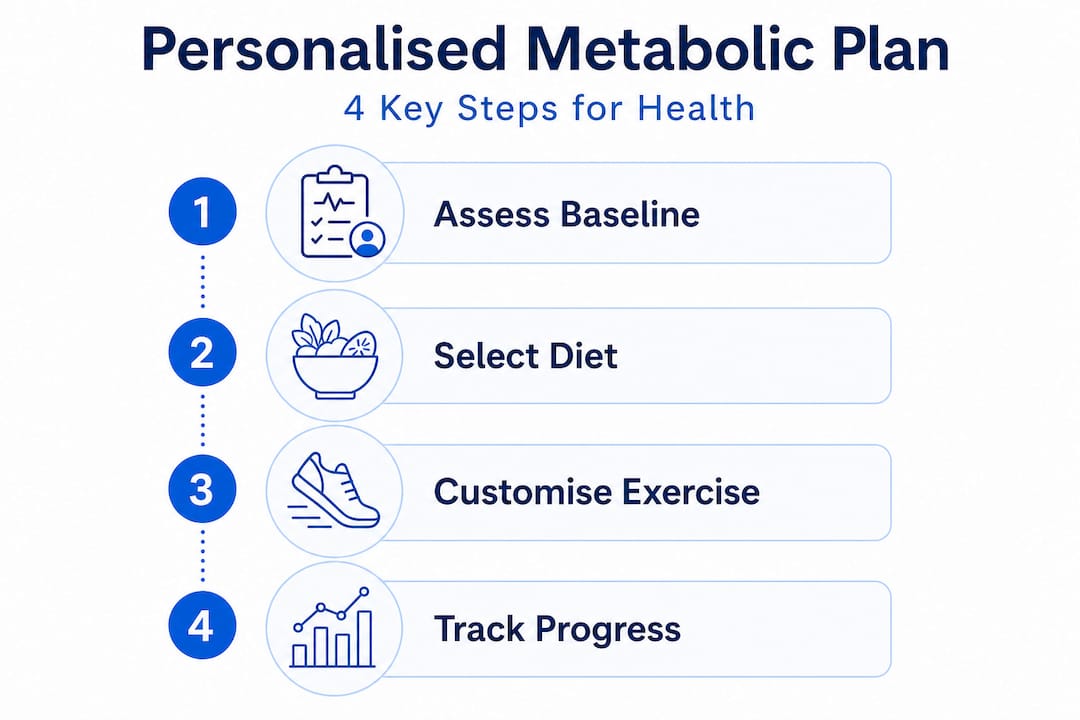
Nutrient profiling reveals whether you are functionally deficient in key cofactors like magnesium, zinc, or B vitamins, all of which directly affect glucose metabolism and energy production.
Pro Tip: If your genetic panel shows a TCF7L2 risk variant, you are likely to benefit more strongly from a low-GI or low-carbohydrate approach than population-level recommendations suggest. This is not a preference; it is a physiological directive from your own DNA.
Exercise, fasting, and other interventions: Building your optimal routine
Diet is just one pillar. Movement, fasting, and smart routines can leverage your biology for sustained metabolic gains.

Regular physical activity lowers blood glucose, blood pressure, and cholesterol, and resistance training is especially valuable because it preserves lean muscle mass during weight loss, which protects your resting metabolic rate from declining.
Here is an evidence-informed intervention stack, ordered by priority:
- Establish a resistance training base: Two to three sessions per week targeting major muscle groups. This is non-negotiable for long-term metabolic health.
- Add zone 2 aerobic work: Three to five hours per week at a conversational pace builds mitochondrial density and improves fat oxidation capacity.
- Introduce time-restricted eating (TRE): An 8 to 10 hour eating window aligned with daylight hours supports circadian metabolic function without the compliance challenges of more aggressive fasting.
- Trial alternate day fasting (ADF) if weight loss is a priority: Alternate day fasting reduces body weight by 1.29 kg more than continuous energy restriction, and also lowers total cholesterol and triglycerides compared to time-restricted eating.
- Optimise sleep and circadian alignment: Exercise timing aligned with circadian rhythms produces measurably better metabolic outcomes. A 3 to 5% reduction in body weight through circadian-aligned interventions meaningfully reduces insulin resistance.
Key warnings to note:
- Ketogenic diets are not appropriate for individuals with familial hypercholesterolaemia or certain lipid disorders without specialist supervision.
- Aggressive fasting protocols may worsen outcomes in those with a history of disordered eating or adrenal dysfunction.
- High-intensity exercise without adequate recovery can elevate cortisol and temporarily worsen glucose control.
“Stacking a well-timed resistance session with a compressed eating window aligned to morning daylight creates a metabolic environment that no single supplement can replicate.”
Pro Tip: Your chronotype (whether you are naturally a morning or evening type) influences when exercise produces the greatest metabolic benefit. Morning types tend to see better glucose-lowering effects from early workouts; evening types often get superior performance and recovery from afternoon sessions. Your CGM data can confirm which window works best for your personal glucose response.
Use the stepwise metabolic planning framework to sequence your interventions sensibly, and review the metabolic health improvement workflow to avoid stacking too many changes simultaneously, which makes it impossible to isolate what is actually working.
Monitoring changes and optimising over time
After constructing your new metabolic routine, focus on the most crucial part: monitoring, learning, and adapting as your body responds.
Here is a structured timeline for tracking metabolic progress:
- Weeks 1 to 4: Focus on consistency and behavioural habit formation. Track CGM trends, subjective energy, and sleep quality. Do not over-interpret early data.
- Month 2: Retest fasting glucose and HbA1c if your baseline was elevated. Compare waist circumference and body weight to baseline.
- Month 3: Full blood panel retest including triglycerides, HDL, LDL, and CRP. Assess whether your primary target markers are moving in the right direction.
- Month 6: DEXA rescanning to quantify changes in lean mass and visceral fat. Retest VO2max if available. Review microbiome if intervention included significant fibre or prebiotic changes.
| Checkpoint | Key metrics | What to assess |
|---|---|---|
| Week 4 | CGM patterns, energy, sleep | Dietary adherence, glucose stability |
| Month 2 | Fasting glucose, HbA1c, waist | Early metabolic signal |
| Month 3 | Full lipid panel, CRP, BP | Cardiovascular risk markers |
| Month 6 | DEXA, VO2max, microbiome | Body composition, fitness, gut health |
If results plateau, circadian alignment and insulin resistance data suggest that adjusting exercise timing or further tightening your eating window can restart adaptation. Plateaus are often not a sign of failure; they are a signal to rotate stimulus.
Tracking metabolic improvement over time transforms scattered lifestyle changes into a coherent performance protocol with measurable outcomes.
Pro Tip: The two data trends that carry the most long-term predictive weight are HbA1c trajectory and VO2max trend. Both are slow-moving, but both have strong independent associations with all-cause mortality risk. If these are improving over six to twelve months, you are winning, regardless of what the scales say.
Why the best metabolic health strategies defy the conventional playbook
Most metabolic health programmes fail not because the interventions are wrong, but because they are applied generically. The standard advice to eat less, move more, and avoid sugar is not incorrect; it is just radically insufficient when applied without context.
The biohackers and performance-focused individuals who consistently transform their metabolic markers share one characteristic: they treat their body as a system to interrogate, not a problem to manage. They run experiments. They track responses. They change one variable at a time and read the data before layering in the next change.
What advanced diagnostics have taught us is uncomfortable for anyone who wants a universal protocol. Your ideal macronutrient split is not the same as your colleague’s. Your optimal exercise timing depends on your cortisol rhythm, not a general guideline. Your fibre tolerance is shaped by your gut bacteria, which are as unique as your fingerprint.
Real-world data-driven health examples consistently show that individuals who integrate multi-omics data with functional testing and then iterate based on results achieve outcomes that generic programmes never approach. Not because they have access to exotic interventions, but because they stop wasting time on strategies that were never right for their biology.
The uncomfortable truth is this: lasting metabolic improvement requires personalisation, patience, and a willingness to be proven wrong by your own data. It is slower than a detox plan and less exciting than a biohacking gadget. But it is the only approach that actually holds.
Take your metabolic health journey further with tailored solutions
Understanding the framework is one thing. Having the diagnostic tools to act on it precisely is what separates genuine progress from informed guessing. If you are serious about transforming your metabolic profile, the next step is accessing testing that goes beyond a standard GP panel.

AI Healthician offers advanced diagnostics built specifically for individuals who require more than generic wellness advice. From DNA health testing kits that reveal your genetic risk variants and dietary response patterns, to resting and active metabolic tests with 3D body scanning that accurately quantify your metabolic rate and body composition, these tools give you the biological data you need to build a truly personalised protocol. Turn what you have learned here into measurable, sustained results.
Frequently asked questions
How quickly can you improve your metabolic health?
Measurable improvements are often seen within weeks to months with consistent dietary and movement changes; the Mediterranean diet reduces metabolic syndrome prevalence by roughly 52% within just six months.
Which single intervention gives the biggest impact on metabolic health?
Combining dietary change with regular resistance and aerobic exercise yields the greatest results for most people, since physical activity lowers blood glucose, blood pressure, and cholesterol while preserving lean mass.
Can genetics and microbiome testing really personalise my diet?
Yes. Personalised nutrition via genetics and microbiome profiling can reliably predict your individual glucose response and tolerance to specific nutrients and dietary patterns.
Is alternate day fasting safe and effective for everyone?
Alternate day fasting is effective, with body weight reductions of 1.29 kg more than continuous energy restriction, but it is not suitable for everyone, particularly those with certain medical conditions or a history of disordered eating.
What results can I expect if I only change my diet but not my exercise?
Diet alone can move markers like blood glucose and triglycerides meaningfully, but Mediterranean and DASH dietary patterns show even stronger and more durable outcomes when paired with regular physical activity.
Recommended
- Metabolic optimisation: personalise your strategy in 6 steps – Aihealthician
- 7 Steps to a Personalised Metabolic Health Improvement Checklist – Aihealthician
- Metabolic Health Improvement Workflow for Peak Performance – Aihealthician
- Why targeted health strategies outperform generic advice – Aihealthician


