


 matt@aihealthician.co.uk


TL;DR:
- Nutrient profiling objectively ranks foods by healthfulness, helping individuals make better dietary choices.
- Higher NPM scores are linked to reduced disease risk and improved long-term health and performance.
- Personalised nutrient profiling uses genetic, metabolic, and biomarker data to optimize individual nutrition beyond population models.
Most people assume that if a food is labelled “natural,” “low fat,” or “high protein,” it must be a sound choice. The reality is far more nuanced. Nutritional value varies enormously even within categories we consider healthy, and without an objective framework, it is almost impossible to consistently distinguish genuinely nourishing options from cleverly marketed ones. Nutrient profiling models (NPMs) provide exactly that framework, translating complex nutritional data into clear, evidence-based scores that cut through the noise. This article explains how NPMs work, why they matter for your long-term health and performance, and how personalised approaches are pushing the science even further.
Table of Contents
- What is nutrient profiling and why does it matter?
- How nutrient profiling impacts health, performance, and longevity
- Nutrient profiling in action: policy, food labelling, and shopping smarter
- Personalised nutrient profiling: tailoring nutrition for optimal results
- Limitations and future directions: beyond the score
- A fresh perspective: why precision matters more than ever
- How to get started: personalised testing and next steps
- Frequently asked questions
Key Takeaways
| Point | Details |
|---|---|
| Objective food scoring | Nutrient profiling provides an evidence-based way to assess the healthfulness of food. |
| Improved health outcomes | Better nutrient profile scores are linked to lower risk of disease and longer life. |
| Personalisation boosts results | Tailoring nutrient profiling with individual data leads to greater dietary improvements. |
| Policy and market impact | Nutrient profiling shapes food policies and makes healthy choices more accessible. |
| Limits and evolution | Current models have limits but are evolving to address sustainability and personalisation. |
What is nutrient profiling and why does it matter?
Nutrient profiling is the science of categorising foods based on their nutritional composition, specifically to promote health and prevent disease. A nutrient profiling model assigns scores to foods by weighing beneficial nutrients against harmful ones. The UK model, for example, operates on a points system where “A” points penalise content such as energy, saturated fat, total sugars, and sodium, while “C” points reward fruit, vegetable, nut content, fibre, and protein. The final score determines whether a food qualifies as “healthier” under regulatory standards.
Nutrient profiling models classify foods based on nutrient content using a balance of penalising and rewarding points, making it possible to objectively rank foods without relying on marketing language. This is significant because a product can be high in protein and simultaneously high in saturated fat and sodium, which would give it a poor overall score despite its superficially “healthy” appearance.
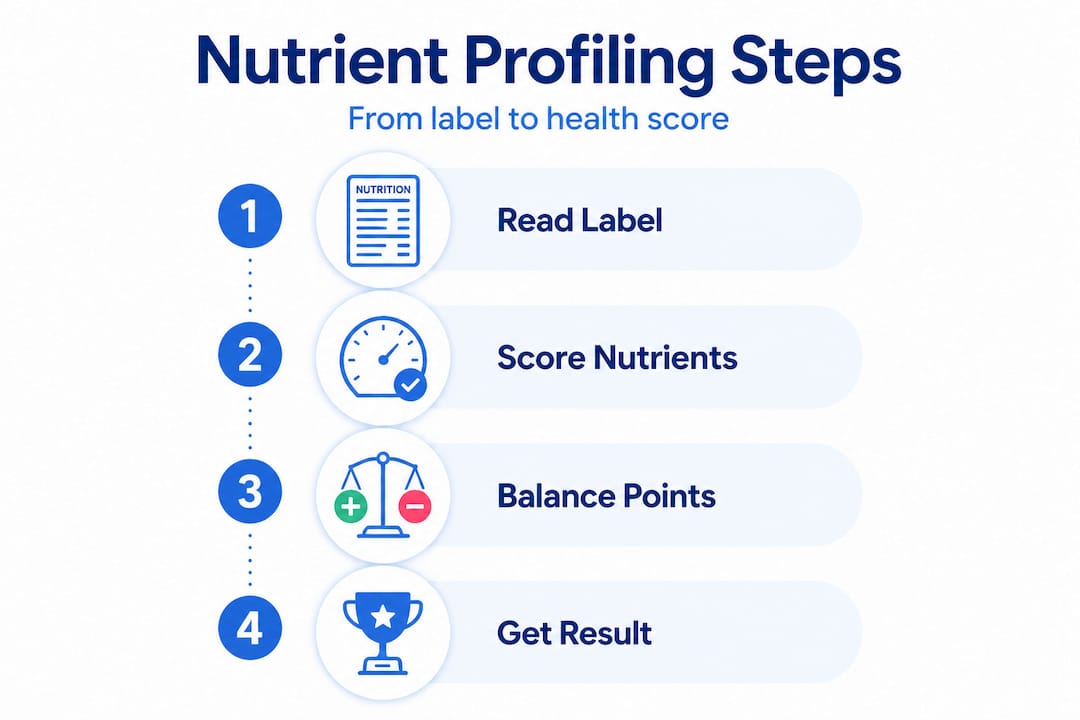
How NPM scores work in practice
Here is a simplified breakdown of how key nutrients are weighted in the UK model:
| Nutrient category | Direction | Example nutrients |
|---|---|---|
| A points (penalised) | Increase score | Energy, saturated fat, sugars, sodium |
| C points (rewarded) | Decrease score | Fibre, protein, fruit/veg/nut content |
| Threshold (food) | Pass/fail | Score of 4 or below = healthier |
| Threshold (drink) | Pass/fail | Score of 1 or below = healthier |
Foods that pass the threshold can be marketed to children and featured in certain promotional contexts. Foods that fail cannot, regardless of how they are packaged or described.
The practical value of NPMs extends well beyond regulation. For anyone serious about personalising nutrition, NPMs provide a consistent, evidence-based lens through which to evaluate individual food choices. Without this kind of framework, even experienced health-conscious individuals can be misled by:
- Foods high in “natural” sugars that still spike insulin significantly
- Protein bars with favourable macros but excessive sodium and additives
- Fruit juices that score poorly due to free sugar content despite their vitamin profile
- Whole grain products with added salt that undermine their fibre benefit
The NPM does not replace clinical judgement, but it provides a reliable starting point for building a higher-quality diet with measurable criteria.
“Nutrient profiling gives us a shared scientific language for food quality. Without it, the term ‘healthy’ is essentially meaningless in a commercial context.”
How nutrient profiling impacts health, performance, and longevity
With the foundations of nutrient profiling explained, let’s look at why it matters for your immediate and long-term health.

The evidence connecting diet quality, as measured by NPM-aligned scores, to health outcomes is robust and growing. Better NPM scores link to lower mortality and cardiovascular disease risk, according to PREDIMED cohort data, one of the most comprehensive dietary intervention studies conducted in Europe. This is not a marginal effect. Individuals with consistently higher diet quality scores show meaningfully reduced all-cause mortality, which makes NPM-informed eating a genuine longevity strategy rather than a theoretical exercise.
For performance-driven individuals, the benefits are equally compelling:
- Sustained energy output: Foods with high NPM scores tend to deliver more stable blood glucose responses, reducing energy crashes during demanding cognitive or physical work.
- Faster recovery: Nutrient-dense foods with strong C-point profiles provide the micronutrients essential for tissue repair, inflammation resolution, and immune function.
- Reduced disease burden: Consistently eating foods that score well on NPMs lowers cumulative exposure to excess sodium, saturated fat, and added sugars, which are primary drivers of metabolic dysfunction over time.
- Improved body composition: Higher diet quality correlates with better satiety signalling, making it easier to maintain lean mass without constant caloric restriction.
- Clearer decision-making: NPM scores give you a measurable target, removing the guesswork from food selection and making it easier to stay consistent under time pressure.
Integrating health risk profiling with dietary NPM assessment allows you to connect your current food choices directly to your individual risk markers, rather than relying on population-level averages.
Pro Tip: Start tracking the NPM scores of your five most frequently consumed foods. If three or more fail the threshold, that is your highest-leverage intervention point, not your supplement stack.
Nutrient profiling in action: policy, food labelling, and shopping smarter
Beyond the personal benefits, nutrient profiling is shaping the food landscape and the choices available to you every day.
NPMs enable key public health policies like restricting the marketing of unhealthy foods and front-of-pack labelling, according to the Obesity Health Alliance. In the UK, this includes restrictions on television advertising of high fat, salt, and sugar (HFSS) foods before the 9pm watershed, as well as supermarket placement rules that limit prominent positioning of HFSS products near checkouts and store entrances.
Internationally, WHO and FDA support nutrient profiling for policies such as warning labels and the “healthy” food claim, each with slightly different scoring criteria and enforcement mechanisms. Here is how the major models compare:
| Model | Region | Key focus | Enforcement mechanism |
|---|---|---|---|
| UK NPM (2018 review) | United Kingdom | HFSS marketing restrictions | Advertising standards and retail rules |
| WHO/PAHO model | Global/Americas | Warning labels on packaging | National legislation varies |
| FDA “healthy” claim | United States | Nutrient thresholds for labelling | Federal food labelling law |
One of the most important updates in the revised UK NPM is the shift towards penalising free sugars specifically, rather than total sugars. This closes a significant loophole where manufacturers could reformulate products using concentrated fruit juice or other “natural” sugar sources to avoid HFSS classification while delivering an equivalent glycaemic load.
How nutrient profiling influences day-to-day shopping decisions
- Front-of-pack labels: Traffic light labels on UK products are directly informed by NPM criteria. Red lights for fat, sugar, or salt indicate a food that would score poorly on the model.
- Supermarket placement: HFSS-classified products are now restricted from end-of-aisle promotions and checkout zones, meaning the foods most prominently displayed are more likely to meet NPM thresholds.
- Meal deal composition: Retailers reformulate products to qualify as healthier options under NPM criteria, which directly affects what appears in meal deal selections.
- Children’s food marketing: Any food advertised to children on television or online must pass the NPM threshold, so understanding the model helps you evaluate what your household is being exposed to.
- Restaurant and takeaway menus: Calorie labelling requirements, while separate from NPMs, are part of the same regulatory drive towards transparent nutritional information.
Personalised nutrient profiling: tailoring nutrition for optimal results
Standardised models are effective, but what if you could take your nutrient profiling to the next level with truly bespoke recommendations?
Generic NPMs are population-level tools. They tell you what is broadly healthier for most people most of the time. But your physiology is not average. Your metabolic rate, gut microbiome composition, genetic variants affecting nutrient absorption, and current biomarker status all influence how your body responds to any given food. Personalised nutrient profiling demonstrably improves dietary quality and supports weight loss beyond what generic guidelines achieve, according to a recent meta-analysis of dynamic and personalised nutritional approaches.
Emerging tools are making this level of precision increasingly accessible:
- DNA testing: Genetic variants in genes such as MTHFR, FTO, and APOE influence how you process folate, fat, and cholesterol respectively. A DNA nutrient core test can identify these variants and inform which nutrients you need to prioritise or moderate.
- Metabolic tracking: Continuous glucose monitors and resting metabolic rate assessments reveal how your body responds to specific foods in real time, enabling you to refine your NPM-informed choices based on actual physiological data rather than averages.
- Blood biomarker panels: Markers such as ferritin, vitamin D, omega-3 index, and hs-CRP reveal existing deficiencies and inflammatory load, allowing you to weight your food choices towards specific corrective nutrients.
- Iterative feedback loops: The most effective personalised approaches treat nutrition as a dynamic system. You test, adjust, retest, and refine continuously rather than following a static plan.
This approach aligns with broader personalised health approaches that consistently outperform one-size-fits-all strategies across health domains. Following a structured step-by-step personalisation process ensures your dietary changes are grounded in your own biological data rather than population trends. For those pursuing peak output, integrating nutrition into a broader improvement workflow for peak performance creates compounding returns across energy, recovery, and resilience.
Pro Tip: Use personal data to continuously refine your food choices for evolving goals. Your nutritional needs at high training volume differ significantly from those during a recovery phase or a period of cognitive intensity. Static plans fail to capture this variability.
Limitations and future directions: beyond the score
No system is flawless, so it is vital to look at both the blind spots and the progress still to come.
NPMs have transformed food policy and individual decision-making, but they are not without significant limitations. NPMs currently lack integration of sustainability and can overlook the nuance of food processing or individual differences, as highlighted in recent food systems research. This matters because a food can score well nutritionally while carrying a substantial environmental cost, and current models provide no mechanism to account for this.
Key limitations worth understanding:
- No sustainability weighting: A food produced through resource-intensive farming with high carbon emissions receives the same NPM score as an equivalent product made sustainably. Future models will need to integrate planetary health criteria.
- Ultra-processed food nuance: Some ultra-processed foods can technically pass NPM thresholds due to fortification or reformulation, even though the broader evidence on ultra-processed food consumption and health outcomes is concerning. The NOVA classification system addresses processing level but is not yet integrated into mainstream NPMs.
- Static population averages: Standard NPMs do not account for individual variation in absorption, metabolism, or microbiome composition. A food that scores well for the average person may be suboptimal for someone with specific genetic variants or gut dysbiosis.
- Micronutrient gaps: Current models focus on a limited set of nutrients. Phytonutrients, polyphenols, and prebiotic compounds are not captured in most scoring systems despite their documented health benefits.
Future frameworks are likely to incorporate processing level, environmental impact scores, and individual biomarker data, creating a more complete picture of food quality. Staying current with these developments is part of following personalised health protocols that evolve as the science does.
“Policy-makers and individuals alike need to stay agile as new science refines our food standards. Treating any model as final is the fastest route to falling behind the evidence.”
A fresh perspective: why precision matters more than ever
Having surveyed the evidence and future of nutrient profiling, it is worth addressing something that rarely appears in mainstream nutrition content: nutrient profiling is a tool, not a destination.
The most common mistake we see among health-conscious individuals is treating a score, a label, or a model as a proxy for genuine optimisation. Passing an NPM threshold does not mean a food is ideal for your biology. It means it is better than average for a population. That is a useful starting point, but it is not the finish line.
There is also a tendency to chase the latest nutritional framework as though it replaces the previous one entirely. Nutrient profiling does not make macronutrient tracking obsolete. Personalised biomarker data does not make population-level NPMs irrelevant. These tools work best in combination, each providing a different layer of resolution.
The contrarian insight here is that the people who get the most from nutrient profiling are not those who follow it most rigidly. They are the ones who use it as a baseline, then interrogate their own response to specific foods through tracking, testing, and honest self-assessment. Ignoring marketing hype and instead testing, tracking, and iterating based on your body’s response is the single most reliable path to genuine dietary optimisation.
Practically, this means:
- Start with the model: Use NPM scores to audit your current diet and identify the lowest-quality foods in your regular rotation.
- Layer in personal data: Add blood biomarkers, metabolic testing, and where possible, genetic data to understand where population-level guidance diverges from your individual needs.
- Iterate deliberately: Make one or two changes at a time, allow enough time to observe a genuine physiological response, and then reassess. Rapid overhauls make it impossible to identify what is actually working.
- Resist the label trap: A food that passes an NPM threshold and carries a “natural” or “clean” label is not necessarily superior to a less glamorous food with a similar score and better bioavailability.
The goal of optimising your nutrition personally is not to achieve a perfect score on a model. It is to build a dietary pattern that demonstrably improves your energy, recovery, resilience, and long-term disease risk markers based on your own biological data.
How to get started: personalised testing and next steps
Ready to move from theory to practical action? Here is how you can put nutrient profiling to work for your unique needs.
Understanding NPMs is the foundation, but real change comes from applying this knowledge to your specific physiology. At AI Healthician, we combine DNA health testing with functional metabolic assessments to give you a precise picture of how your body processes nutrients, where your current diet is falling short, and which interventions will deliver the most measurable impact.
A resting and active metabolic test paired with a resting metabolic analysis reveals your true caloric needs and fuel utilisation patterns, so your NPM-informed food choices are calibrated to your actual metabolic reality rather than a textbook estimate. This is the difference between knowing what a healthy diet looks like in general and knowing exactly what it looks like for you.
Frequently asked questions
How is nutrient profiling used to choose healthier foods?
Nutrient profiling classifies foods by nutrient content to support healthier choices, ranking them on a points system that balances beneficial nutrients against harmful ones, making it straightforward to identify better options without relying on marketing claims.
What does a low NPM score mean for my health and longevity?
Better NPM scores link to lower all-cause mortality and cardiovascular disease risk, meaning that consistently choosing foods with favourable scores is a measurable strategy for extending healthy lifespan.
Can nutrient profiling be personalised to my individual needs?
Yes. Dynamic personalised profiling adapts to individual physiology using AI, biomarker data, and genetic information, producing outcomes that generic population-level models cannot match.
Does nutrient profiling consider food sustainability?
NPMs exclude sustainability and require integration of health and environmental criteria, though future model updates are expected to begin addressing this significant gap.
Which policies are influenced by nutrient profiling?
NPMs underpin public health policies restricting the marketing of unhealthy foods, front-of-pack labelling schemes, and the regulatory definition of what qualifies as a “healthy” food claim across multiple countries.


