


 matt@aihealthician.co.uk


TL;DR:
- Precision nutrition tailors plans using individual biological data like glucose responses and genetics.
- Ongoing assessment and small adjustments over weeks lead to meaningful metabolic improvements.
- Basic lifestyle habits remain crucial, with personalized data refining the final 20 percent of results.
You eat well, sleep reasonably, and still feel like your energy runs out by mid-afternoon. You’ve tried cutting carbs, adding protein, following the latest dietary trend, and nothing sticks. The problem isn’t your willpower. It’s that generic nutrition advice is built for an average person who doesn’t exist. Precision nutrition changes that by using your actual biological data, from glucose responses to genetic variants, to build a plan that fits your physiology. This guide walks you through exactly how to do it, step by step, with the tools, benchmarks, and decision points that matter most.
Table of Contents
- Preparing for personalised nutrition: what you need to get started
- Step-by-step precision nutrition process: from assessment to action
- Avoiding common pitfalls: troubleshooting and real-world challenges
- Tracking outcomes: how to measure and adjust for success
- Why personalisation is only part of the solution: an expert’s viewpoint
- Take the next step towards your optimal nutrition
- Frequently asked questions
Key Takeaways
| Point | Details |
|---|---|
| Start with data | Assess genetics, metabolism, and lifestyle to set your nutrition plan on solid ground. |
| Personalisation is powerful | Tailoring your diet with AI, wearables, and biomarkers drives measurable health gains. |
| Be ready to adapt | Monitor progress and adjust regularly for best long-term outcomes. |
| Watch for pitfalls | Address genetic quirks and practical challenges as part of your process. |
| Lifestyle integration matters | Real transformation comes from pairing nutrition with exercise, sleep, and daily habits. |
Preparing for personalised nutrition: what you need to get started
Now that you know what makes personal nutrition uniquely effective, let’s make sure you’re equipped to start the process. Before you invest in any testing or technology, it helps to understand what kind of data actually moves the needle. Precision nutrition requires assessment of genetic, metabolic, microbiome, and lifestyle factors using advanced tools. That’s a broad set of inputs, and you don’t need all of them on day one.
Start by auditing what you already know. Do you have recent bloodwork? A rough sense of your sleep patterns? Even a food diary from the past two weeks? These low-cost data points form the foundation of any solid health optimisation protocol and often reveal patterns that expensive tests later confirm.
Essential tools to consider:
- Continuous glucose monitor (CGM) for real-time glycaemic feedback
- Wearable tracker for sleep, heart rate variability, and activity data
- Basic blood panel covering fasting glucose, HbA1c, lipids, and CRP
- Personal health log tracking energy, mood, digestion, and food intake
- Microbiome test kit (optional but useful for gut-related symptoms)
- Genetic panel focused on nutrition-relevant variants (optional, see caveats later)
| Data source | What it reveals | Cost range |
|---|---|---|
| Blood panel | Metabolic and inflammatory markers | £80–£250 |
| CGM (14-day) | Glycaemic response to foods | £40–£90 |
| Microbiome test | Gut diversity and bacterial balance | £100–£200 |
| Genetic panel | Nutrient metabolism variants | £100–£300 |
| Wearable tracker | Sleep, HRV, activity trends | £80–£350 |
Privacy is worth considering here. Genetic and microbiome data are sensitive. Use reputable providers with clear data retention policies. You can see how biological data analysis is applied in practice to understand what responsible interpretation looks like.
Pro Tip: Before spending anything on advanced testing, spend two weeks logging meals, energy levels, and sleep quality manually. The patterns you spot will make every subsequent test far more useful.
Step-by-step precision nutrition process: from assessment to action
With all the essentials in hand, you’re ready to begin a truly tailored nutrition journey. Here’s how to put it all into practice, step by step.
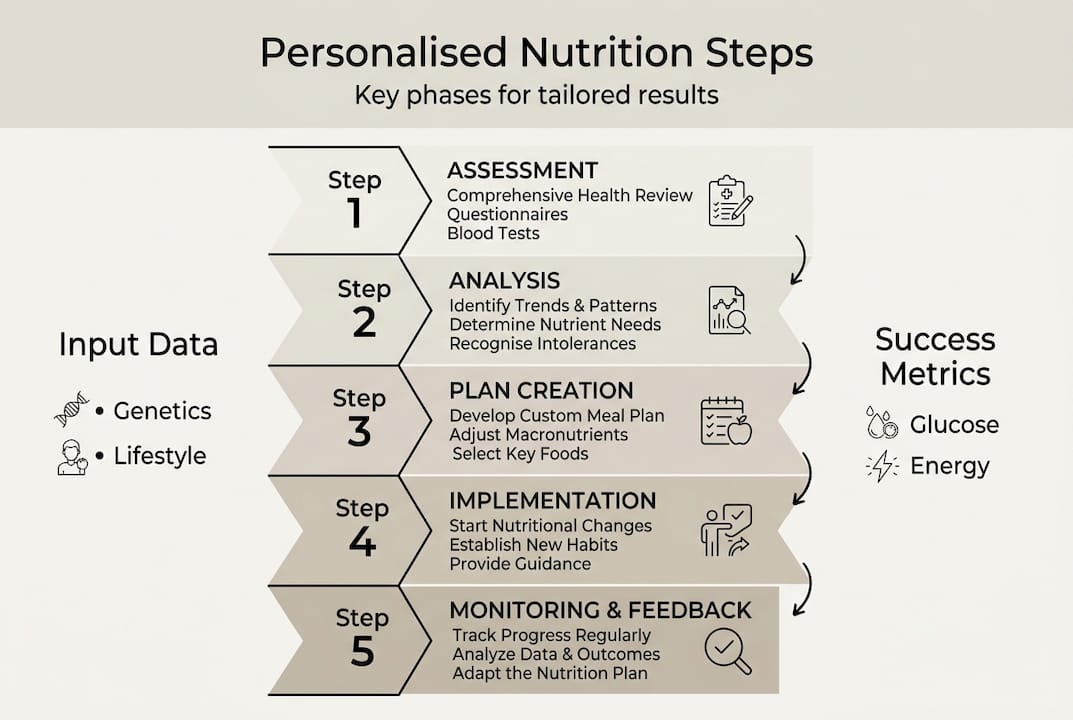
- Baseline assessment. Collect your genetic, metabolic, and lifestyle data. Prioritise bloodwork and a CGM trial first. These two sources alone provide more actionable insight than most people expect.
- Analyse your data. Use AI-assisted tools or work with a practitioner to identify your personalised glycaemic profile. Look for foods that spike your glucose unexpectedly, as these vary significantly between individuals.
- Tailor your intervention. Adjust macronutrient ratios, meal timing, and food selection based on your findings. Someone with poor fat metabolism needs a different approach to someone with impaired glucose clearance.
- Implement and monitor. Wear your CGM and tracker simultaneously for at least four weeks. Log symptoms alongside device data to build a complete picture.
- Adjust using n-of-1 cycles. Treat yourself as the experiment. Periodised nutrition and n-of-1 trials deliver measurable dietary improvements when applied consistently. Review your data weekly and make one change at a time.
The evidence supports this approach. The DASH4D diet reduced mean glucose by 11.1 mg/dL and improved time-in-range by 5.2% in a structured trial. That’s a meaningful shift in metabolic control from dietary adjustment alone.
| Feature | Traditional nutrition | Precision nutrition |
|---|---|---|
| Basis | Population averages | Individual biomarkers |
| Feedback | Periodic check-ins | Real-time CGM and wearables |
| Adjustment | Fixed plan | Iterative n-of-1 cycles |
| Outcome focus | General health | Specific metabolic targets |
You can explore the full metabolic health improvement workflow for a more granular breakdown of each phase. Reviewing metabolic biomarker examples also helps you understand which numbers to prioritise at each stage.
Pro Tip: Apply the 4Ps framework, Personalise, Periodise, Prefuel, and Prepare, to each intervention phase. It keeps your approach structured without becoming rigid.
Avoiding common pitfalls: troubleshooting and real-world challenges
A perfected plan only works if you navigate the challenges. Let’s cover the hurdles, both technical and behavioural, you might face along the way.
Genetic edge cases are real but affect a minority. Variants like FTO and MC4R require more specific interventions, and high costs alongside data privacy concerns remain genuine obstacles for many. Most people, however, will not carry variants that dramatically alter their nutritional needs.
“Genetic testing provides little added value for most, but can highlight rare needs.”
Behavioural adherence is where most plans actually fail. It’s rarely a lack of information. It’s the friction between knowing what to do and doing it consistently when life gets busy. Tracking fatigue, social eating, and unrealistic initial targets are the three most common reasons people abandon their plans within six weeks.
Top troubleshooting actions to stay on track:
- Reduce tracking complexity: log only two or three key metrics rather than everything
- Set a weekly review window of 15 minutes rather than daily obsessive checking
- Identify your highest-risk meal or situation and pre-plan it specifically
- If energy or symptoms worsen after a change, revert and wait one week before trying again
- Use your health optimisation steps as a reference when you feel lost in the data
- Consider whether your expectations match the realistic timeline for change
Device accuracy is another practical concern. CGMs occasionally give erroneous readings, particularly during the first 24 hours of wear or during intense exercise. Cross-reference device data with how you actually feel. Wearables are trend tools, not diagnostic instruments.

Pro Tip: Combine genetic insights with day-to-day energy and symptom tracking rather than relying on lab numbers alone. Your lived experience is data too.
Tracking outcomes: how to measure and adjust for success
After overcoming the common pitfalls, it’s time to make sure your nutrition is truly delivering results. Here’s how to track and adapt for long-term success.
Your key performance indicators should include glycaemic response via CGM, time-in-range, energy levels across the day, and body composition changes. These give you both objective and subjective signals. Sustained dynamic profiling has demonstrated significant time-in-range and weight loss improvements when applied consistently over weeks.
Most people see improved dietary quality within eight weeks, with mean glucose reductions of around 11.1 mg/dL achievable through structured intervention. That’s a meaningful benchmark to work towards.
| Metric | Baseline target | 8-week improvement goal |
|---|---|---|
| Mean fasting glucose | Under 5.6 mmol/L | Reduction of 0.5–1.0 mmol/L |
| Time-in-range (CGM) | Establish personal baseline | Improve by 5% or more |
| Body weight | Record and monitor | 1–2% reduction if indicated |
| Subjective energy score | Log daily (1–10 scale) | Consistent improvement trend |
Use digital tools for weekly snapshots and manual logs for daily context. The combination catches things either method alone would miss. Understanding why metabolic data matters helps you interpret these numbers with the right frame of reference.
Steps to adjust your plan based on ongoing data:
- Review your weekly CGM average and time-in-range trend
- Compare energy logs against meal timing and composition
- Identify the one meal or pattern most correlated with poor outcomes
- Make a single targeted change and monitor for seven days
- Use the metabolic health checklist to confirm you’re addressing all key variables
- If no improvement after four weeks of consistent effort, seek professional interpretation
Why personalisation is only part of the solution: an expert’s viewpoint
You now understand the technical process, but real-world impact relies on context and common sense. Here’s our perspective on where true health improvement begins.
The precision nutrition space has a tendency to oversell the value of genetic and microbiome data. For a small subset of people, these tools are genuinely transformative. For most, basic healthy diet adherence is rare and genetic testing adds little on top of that gap. The biggest lever isn’t your FTO variant. It’s whether you’re consistently eating vegetables, managing sleep, and moving your body.
Long-term health gains depend on intertwining nutrition with exercise, sleep, and stress reduction. Plant-based dietary shifts reduce TMAO and LDL, but outcomes remain individual. That nuance matters. Personalisation doesn’t replace the fundamentals. It refines them.
What we see repeatedly at AI Healthician is that the clients who get the most from precision tools are those who already have solid lifestyle foundations. The data helps them close the final 20%. For everyone else, the data is most useful as a motivational mirror, showing you in concrete numbers why the basics matter. Explore data-driven metabolic health to understand how this thinking applies in practice.
Take the next step towards your optimal nutrition
Ready to put your knowledge into action? Here’s where to continue your personalised nutrition journey with expert support.
If you’ve worked through this guide and want to move beyond self-guided tracking, AI Healthician offers structured pathways to do exactly that. Our DNA health testing gives you clinically relevant genetic insights mapped to your actual nutritional needs, not generic population data.
For a deeper metabolic picture, the active metabolic test measures how your body actually burns fuel, giving you precise targets for macronutrient intake and exercise intensity. If you’re ready for a fully integrated protocol covering nutrition, longevity markers, and long-term risk reduction, the longevity blueprint consultation is where that work begins.
Frequently asked questions
Is genetic testing necessary for nutrition optimisation?
Genetic testing seldom predicts significant dietary changes for most people. Consistent adherence to core nutrition and lifestyle habits delivers greater returns for the majority.
How long does it take to see results from the nutrition optimisation process?
Dynamic profiling trials show dietary quality gains and measurable metabolic changes within eight weeks when the process is followed consistently.
Are personal devices like CGM and wearables safe and accurate?
Modern CGMs show high reproducibility in glycaemic sensitivity across n-of-1 trials. Used as directed, they are safe and reliable for personal optimisation.
Can nutrition optimisation help with long-term disease prevention?
Personalised nutrition RCTs show modest but meaningful improvements in cardiometabolic markers when interventions are sustained over time.


