


 matt@aihealthician.co.uk


TL;DR:
- Metabolic health is key to energy, recovery, and resilience, requiring personalized assessment.
- Regular biomarker testing and tracking enable tailored nutrition and exercise strategies.
- Ongoing monitoring, including sleep and stress management, sustains long-term metabolic optimization.
Metabolic health is the engine behind everything you care about as a performance-focused individual: energy output, recovery speed, body composition, and long-term resilience. Yet most people chasing peak performance are working from generic advice that was never calibrated to their biology. The result is frustrating plateaus, unexplained fatigue, and wasted effort. This guide breaks metabolic optimisation into a precise, stepwise process rooted in real biomarker data, evidence-based nutrition, targeted training, and systematic monitoring. If you want results that actually stick, this is where you start.
Table of Contents
- Assessing your metabolic baseline
- Building a personalised nutrition strategy
- Exercise protocols for metabolic flexibility
- Long-term monitoring and adaptation
- Why one-size-fits-all metabolic optimisation fails (and what actually works)
- Personalise your metabolic optimisation journey with expert support
- Frequently asked questions
Key Takeaways
| Point | Details |
|---|---|
| Start with data | Assess your baseline with key biomarkers and body composition before making changes. |
| Personalise your approach | Customise nutrition, training, and recovery based on your real biological needs and data. |
| Prioritise sustainable routines | Routine monitoring, sleep, and stress management matter as much as diet and exercise tweaks. |
| Avoid extremes | Balance is key—eschew one-size-fits-all or harsh protocols for evidence-driven, gradual changes. |
Assessing your metabolic baseline
You cannot optimise what you have not measured. That sounds obvious, but most people skip this step entirely, relying on how they feel rather than what their biology is actually doing. A proper metabolic baseline gives you an objective starting point and, critically, tells you which levers will move the needle most for your physiology.
The essential biomarkers for a meaningful baseline include fasting insulin, fasting glucose, HbA1c, high-sensitivity C-reactive protein (hsCRP), a full lipid panel with ApoB, and HOMA-IR. Baseline assessment with these specific markers gives you actionable insight that no generic wellness checklist can replicate. Pair these with body composition analysis, ideally via DEXA scan, and you have a genuinely complete picture.
Key biomarkers and target ranges
| Biomarker | Optimal range | Why it matters |
|---|---|---|
| Fasting insulin | 2-6 µIU/mL | Early insulin resistance signal |
| Fasting glucose | 70-85 mg/dL | Baseline glucose regulation |
| HbA1c | Below 5.4% | 3-month glucose average |
| hsCRP | Below 1.0 mg/L | Systemic inflammation |
| ApoB | Below 70 mg/dL | Cardiovascular risk marker |
| HOMA-IR | Below 1.0 | Insulin sensitivity index |
The sobering context here: only 6.8% of adults qualify as metabolically healthy by rigorous criteria. That means the vast majority of people, including many who consider themselves fit, have at least one metabolic dysfunction running silently in the background.
For assessing metabolic health beyond a single blood draw, a continuous glucose monitor (CGM) worn for two to four weeks reveals hidden glucose spikes that standard fasting tests completely miss. Many athletes are surprised to find that foods they considered clean trigger significant glucose excursions. Tracking your metabolic markers weekly, even informally through waist measurements and energy logs, lets you catch regression before it compounds.
How to establish your baseline in five steps:
- Book a comprehensive blood panel including all markers listed above
- Schedule a DEXA scan for precise lean mass and visceral fat measurement
- Wear a CGM for two to four weeks to map your real-world glucose responses
- Record waist and hip measurements alongside your blood results
- Set a calendar reminder to re-test every eight to twelve weeks
Pro Tip: DEXA scans are worth the cost. They reveal visceral fat and lean mass distribution in ways that body weight or BMI simply cannot, and that data directly informs both your nutrition and training targets.
Building a personalised nutrition strategy
Once you know your baseline, your next lever is nutrition, fine-tuned to your biology. Generic macronutrient advice is a starting point at best. What actually moves your markers is a strategy built around your glucose response, inflammatory load, and performance demands.
For protein, the evidence supports 0.7 to 1.0 g per pound of target body weight daily, combined with 30 to 40 grams of fibre from diverse plant sources. This combination supports muscle protein synthesis, feeds a diverse gut microbiome, and directly reduces hsCRP. Prioritising whole foods while minimising ultra-processed options is not a novel idea, but the specifics matter enormously when you are trying to shift real biomarkers.
Whole foods versus processed foods: metabolic impact
| Dietary approach | Effect on fasting insulin | Effect on hsCRP | Effect on HbA1c |
|---|---|---|---|
| High whole food, high fibre | Reduces | Reduces | Stabilises |
| High ultra-processed | Increases | Increases | Worsens |
| High protein, varied plants | Neutral to reduces | Reduces | Stabilises |
For athletes, carbohydrate periodisation is where generic advice falls apart completely. Eating the same carbohydrate load on a rest day as on a high-intensity training day creates unnecessary glucose variability and blunts fat adaptation. Structured low-carbohydrate periods around easy sessions build metabolic flexibility, while strategic carbohydrate loading before hard efforts preserves performance output.
Personalised insights via CGM data, lab results, and genetic testing are measurably superior to population-level dietary guidelines. Your glucose response to oats, rice, or fruit is genuinely different from someone else’s, and that difference compounds over months of eating.
Use your personalised nutrition guide to map food choices to your actual biomarker responses rather than relying on generalised glycaemic index tables. The personalised metabolic checklist is a practical tool for keeping this process structured without becoming obsessive.
Practical nutrition priorities:
- Anchor each meal around a protein source of at least 30 to 40 grams
- Aim for eight or more distinct plant foods per week for microbiome diversity
- Time the majority of carbohydrates around training sessions
- Eliminate liquid calories and high-fructose sources as a first step
- Log food for two weeks to identify hidden processed food intake you are not consciously registering
Pro Tip: Two weeks of food logging is not about calorie counting. It is about pattern recognition. Most people are shocked by how frequently ultra-processed ingredients appear in foods they consider healthy.
Exercise protocols for metabolic flexibility
With nutrition set, the right movement strategy accelerates your progress significantly. Metabolic flexibility is the capacity to efficiently switch between burning fat and carbohydrate depending on availability and demand. It is the physiological hallmark of a well-trained, well-fuelled athlete, and it is trainable.

The evidence base for building metabolic flexibility is clear. Zone 2 cardio, defined as 150 to 180 minutes per week at a conversational pace, combined with two to three resistance sessions weekly and short post-meal walks, produces measurable improvements in fat oxidation and insulin sensitivity. These are not optional extras. They are the foundation.
For performance athletes, the goal is to push fat oxidation toward 0.8 to 1.0 g per minute through structured periodisation without sacrificing high-intensity output. This is achievable, but it requires patience and a willingness to train easy when the instinct is to push hard.
“Endurance athletes who implement structured metabolic training protocols demonstrate up to twice the fat oxidation of untrained individuals, with no loss of peak performance capacity when carbohydrates are strategically reintroduced.”
The ‘train low, race high’ approach, where you complete low-intensity sessions in a fasted or glycogen-depleted state and reserve carbohydrates for competition, is one of the most evidence-supported tools in the advanced athlete’s toolkit. It forces mitochondrial adaptation and upregulates fat-burning enzymes without compromising your ability to perform when it counts.
Explore metabolic flexibility strategies tailored to your training load and goals for a more structured approach.
Common mistakes to avoid:
- Staying in chronic low-carbohydrate states, which impairs thyroid function and recovery over time
- Treating all cardio as high-intensity, which blunts fat adaptation
- Neglecting resistance training, which is the single most effective tool for improving insulin sensitivity
- Skipping post-meal movement, even a ten-minute walk substantially reduces glucose spikes
Long-term monitoring and adaptation
While the plan is set, ongoing monitoring prevents progress from stalling. Metabolic optimisation is not a one-time intervention. It is a dynamic process that must adapt as your fitness improves, your life changes, and your biomarkers shift.
The most effective monitoring structure combines weekly informal checks, such as waist measurement, energy levels, and sleep quality, with formal lab re-testing every eight to twelve weeks. Repeat monitoring with 7 to 8 hours of sleep nightly and active stress management are non-negotiable components of any sustainable protocol. Sleep deprivation alone raises fasting glucose and cortisol in ways that no dietary intervention can fully counteract.
Key metrics to track over time:
- Fasting glucose and insulin trends across re-test cycles
- Body composition changes in lean mass and visceral fat via DEXA
- Waist circumference as a simple weekly proxy for visceral fat
- Subjective energy, mood, and recovery quality scores
- Training performance metrics relative to heart rate and perceived effort
For women and high-level athletes, a critical point is that no single metabolic protocol applies universally. Female physiology requires consideration of menstrual cycle phases and hormonal fluctuations when interpreting biomarker data and adjusting training loads. What looks like a plateau may simply be a phase-specific hormonal shift that resolves with appropriate periodisation.
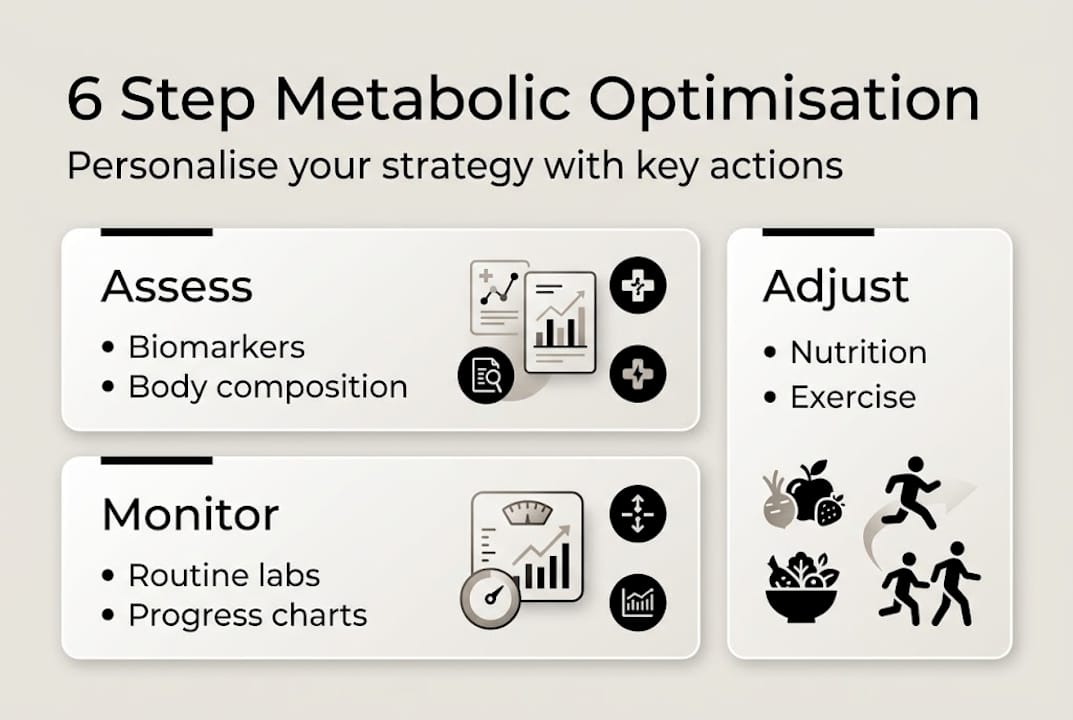
The improvement workflow that produces consistent results follows a simple loop: test, intervene, monitor, adjust. Reviewing biological data analysis examples from real protocols helps contextualise your own results and identify which adjustments are likely to produce the greatest return. For a complete framework, the step-by-step health optimisation guide ties all these elements together.
Why one-size-fits-all metabolic optimisation fails (and what actually works)
Here is the uncomfortable reality: most metabolic advice is written for the average person, which means it is optimised for nobody in particular. Generic protocols produce generic results. The individuals who achieve genuine, sustained metabolic transformation are the ones who treat their biology as a unique dataset rather than a problem to be solved with a standard template.
The evidence is clear that while general health guidance emphasises foundational basics, performance athletes require advanced, individually calibrated protocols. Extreme approaches, whether carnivore, prolonged fasting, or ultra-high volume training, tend to produce short-term results followed by hormonal disruption, burnout, or metabolic adaptation that stalls progress entirely.
What actually works is less dramatic but far more durable. Consistent sleep, adequate dietary fibre, progressive resistance training, and periodic biomarker re-testing outperform nearly every supplement stack or trending diet protocol. The targeted health strategies that produce lasting change are built on this foundation, then layered with personalised adjustments as data accumulates. Re-evaluation is not a sign that your plan failed. It is the mechanism by which your plan succeeds.
Personalise your metabolic optimisation journey with expert support
Knowing the steps is one thing. Having the clinical-grade data to execute them precisely is another. If you are ready to move beyond educated guesswork and into evidence-led metabolic transformation, the tools to do it are available now.

AI Healthician offers DNA health testing that reveals genetic predispositions affecting your metabolism, nutrient utilisation, and training response. Pair that with a metabolic test with body scan for precise resting and active metabolic rate data alongside a detailed 3D body composition analysis. For a fully structured protocol built around your unique biology, a personalised health consultation brings all your data together into a single, actionable longevity blueprint.
Frequently asked questions
Which biomarkers are most important for metabolic optimisation?
The key markers are fasting insulin, fasting glucose, HbA1c, hsCRP, a full lipid panel with ApoB, HOMA-IR, and body composition measures such as DEXA or waist/hip ratio. Baseline assessment with these specific biomarkers gives you genuinely actionable insight rather than a broad wellness snapshot.
How often should I re-test my metabolic markers?
Re-test your labs and body composition every 8 to 12 weeks to track progress effectively and make data-driven adjustments. Re-testing at this frequency allows you to identify trends before they become entrenched problems.
Can metabolic optimisation be done without advanced genetics or a CGM?
Yes. While advanced tools provide deeper resolution, starting with basic labs, structured diet tracking, and consistent activity monitoring produces meaningful improvements. Personalisation is ideal, but foundational habits create substantial metabolic change on their own.
What is the biggest mistake people make when optimising metabolism?
Following extreme or generic protocols rather than tailoring choices to their own biomarker data is the most common and costly error. Avoiding extreme approaches and building from an individualised foundation produces far more durable results.
How do sleep and stress impact metabolic health?
Poor sleep and chronic stress directly impair glucose regulation, raise cortisol, and blunt fat oxidation, making them as metabolically significant as nutrition or training. Managing these factors is a non-negotiable part of any serious optimisation protocol.


