


 matt@aihealthician.co.uk


Rushing from meetings to deadlines often leaves little room to question whether your health strategy truly matches your unique needs. For entrepreneurs and professionals balancing ambition with wellbeing, gaining insight into your own metabolic profile is not just a luxury but a competitive edge. Harnessing personalised metabolic biomarkers and tailored diagnostic tools, you can move beyond generic recommendations and discover how integrating evidence-based wellness interventions leads to greater metabolic efficiency and sustained productivity.
Table of Contents
- Step 1: Assess Personalised Metabolic Biomarkers
- Step 2: Interpret Diagnostic Data For Tailored Strategy
- Step 3: Implement Evidence-Informed Nutrition Protocols
- Step 4: Optimise Physical Activity And Recovery Routines
- Step 5: Verify Progress With Continuous Testing
Quick Summary
| Key Message | Explanation |
|---|---|
| 1. Assess personalised metabolic biomarkers | Identify unique metabolic indicators for gaining specific insights. |
| 2. Expert interpretation of data is crucial | Transform raw data into actionable health strategies with expert help. |
| 3. Tailor nutrition to individual profiles | Design personalised nutrition plans based on metabolic assessments. |
| 4. Optimise physical activity and recovery | Create custom routines that enhance performance and prevent injury. |
| 5. Continuous testing for progress verification | Implement dynamic monitoring for real-time adjustments in health strategy. |
Step 1: Assess personalised metabolic biomarkers
Metabolic biomarker assessment is your first critical step towards understanding your unique physiological performance landscape. By mapping out personalised metabolic indicators, you’ll gain unprecedented insights into how your body processes nutrients, energy, and manages cellular functions.
To effectively assess your metabolic biomarkers, you’ll want to leverage advanced metabolomics diagnostic techniques. This sophisticated approach allows deep analysis of your metabolic profile by examining the complex interactions between genetics, environment, and biochemical processes.
Key assessment strategies include:
- Blood plasma metabolite screening
- Comprehensive hormonal panel testing
- Genetic metabolic pathway analysis
- Microbiome composition evaluation
Your metabolic assessment typically involves collecting precise biological samples that reveal intricate details about metabolic efficiency and potential health risks. Professional laboratories utilise advanced statistical methods to interpret these complex datasets, transforming raw biological information into actionable health insights.
Metabolic biomarkers provide a dynamic snapshot of your body’s functional state, offering far more nuanced information than traditional diagnostic approaches.
Professional testing often involves multi-stage analysis that integrates genetic predispositions, current physiological markers, and potential future health trajectories. Quantitative metabolomics research has demonstrated remarkable precision in identifying individual metabolic variations.
Top tip: Select a comprehensive metabolic assessment that analyses multiple biomarker categories to ensure the most holistic understanding of your metabolic health.
Step 2: Interpret diagnostic data for tailored strategy
Interpreting your diagnostic data transforms complex metabolic information into a personalised roadmap for peak performance. Your goal is to translate raw biological markers into actionable insights that can significantly optimise your health and physiological potential.
Advanced diagnostic models enable precise risk stratification by creating a three-dimensional metabolic profile unique to your body. This approach goes far beyond traditional diagnostic methods, offering a nuanced understanding of your metabolic health landscape.
Key interpretation strategies include:
- Mapping genetic metabolic predispositions
- Correlating biomarker interactions
- Identifying potential metabolic inefficiencies
- Tracking cellular energy production patterns
Professional data analysis requires a comprehensive approach that examines multiple biological dimensions. Comprehensive metabolic data integration allows for unprecedented insights into your individual metabolic mechanisms, revealing intricate relationships between genetic, environmental, and physiological factors.
Your metabolic data is a complex narrative that requires expert interpretation to unlock its full potential for personalised health optimisation.
Successful interpretation involves understanding the interconnected nature of metabolic processes. Professional metabolic specialists use advanced statistical techniques to decode these complex datasets, transforming numerical information into clear, actionable recommendations tailored specifically to your physiological profile.
Top tip: Request a detailed consultation with a metabolic health specialist who can provide comprehensive narrative explanation alongside your raw diagnostic data.
Step 3: Implement evidence-informed nutrition protocols
Implementing evidence-informed nutrition protocols transforms your metabolic health strategy from generic recommendations to a precisely calibrated personal performance plan. Your objective is to design a nutritional approach that aligns seamlessly with your unique metabolic fingerprint and physiological requirements.

Personalised nutrition intervention frameworks emphasise the critical importance of integrating scientific evidence with individual biological nuances. This means moving beyond one-size-fits-all dietary guidelines to create a nutrition strategy that responds dynamically to your specific metabolic markers.
Key implementation strategies include:
- Aligning macronutrient ratios with genetic metabolic profiles
- Timing nutrient intake to support cellular energy production
- Incorporating targeted micronutrient supplementation
- Monitoring metabolic responses to dietary interventions
Nutritional protocol development requires a multifaceted approach that considers your genetic predispositions, current metabolic state, and performance objectives. Evidence-based nutrition guidelines provide a robust framework for designing interventions that optimise both immediate performance and long-term metabolic health.
Effective nutrition protocols are not about restrictive diets, but about strategic nutritional engineering tailored to your unique physiological blueprint.
Successful implementation involves continuous monitoring and adaptive refinement. Professional metabolic specialists can help you interpret biochemical feedback, making precise adjustments to your nutrition strategy that ensure ongoing metabolic efficiency and peak performance potential.
Top tip: Document your nutritional interventions and metabolic responses meticulously, creating a personalised knowledge base that enables increasingly sophisticated performance optimization.
Step 4: Optimise physical activity and recovery routines
Optimising physical activity and recovery routines requires a strategic approach that balances performance enhancement with intelligent physiological regeneration. Your goal is to design a comprehensive routine that maximises metabolic efficiency while preventing overtraining and supporting long-term health.
Physical activity strategies demonstrate profound impacts on both psychological and physiological well-being, emphasising the importance of structured yet personalised movement patterns. This means moving beyond generic exercise recommendations to create a tailored approach that resonates with your unique metabolic profile.
Key optimisation strategies include:
- Mapping exercise intensity to metabolic capacity
- Implementing periodised training cycles
- Integrating active and passive recovery techniques
- Monitoring physiological stress markers
Recovery protocol development demands a nuanced understanding of individual metabolic responses. Tailored recovery approaches consider multiple variables including exercise modality, individual training history, and current physiological state to prevent performance plateaus and minimise injury risk.
Recovery is not a passive process but an active strategy of metabolic regeneration and performance optimization.
Successful implementation requires continuous adaptation and precise monitoring. Professional metabolic specialists can help you develop sophisticated recovery protocols that transform physical stress into performance gains, ensuring your body becomes more resilient and efficient with each training cycle.
Top tip: Invest in comprehensive physiological tracking technologies that provide real-time insights into your body’s recovery status and metabolic readiness.
Step 5: Verify progress with continuous testing
Continuous testing transforms your metabolic health journey from guesswork into precision data tracking. Your objective is to establish a dynamic monitoring system that provides real-time insights into your physiological performance and metabolic adaptations.
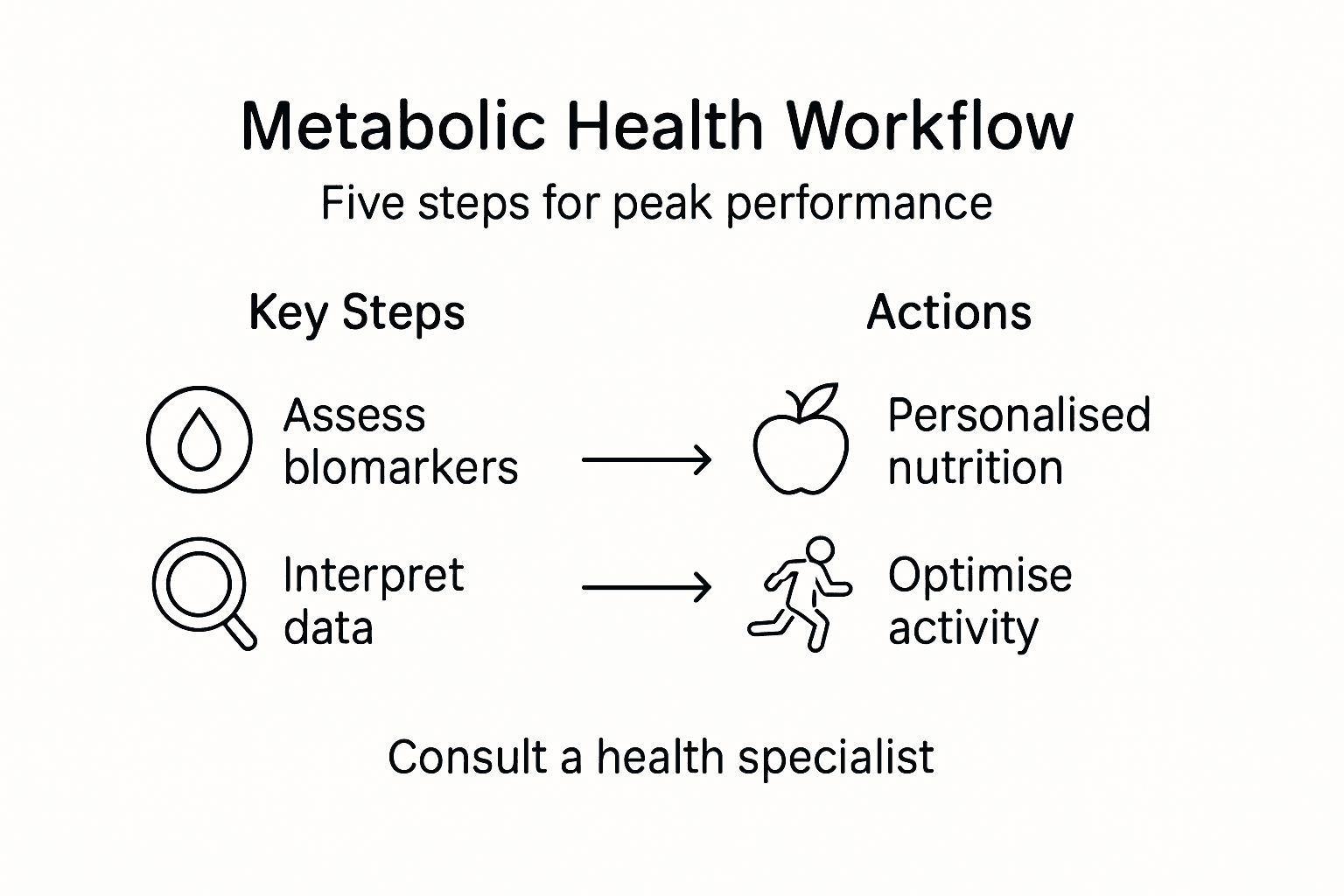
Metabolic syndrome tracking strategies demonstrate the critical importance of longitudinal assessment, enabling early identification of potential health risks and performance trajectories. This approach moves beyond snapshot diagnostics to create a comprehensive understanding of your metabolic evolution.
Key continuous testing strategies include:
- Implementing regular comprehensive biomarker panels
- Utilising advanced wearable monitoring technologies
- Tracking multiple metabolic health indicators
- Establishing quantitative baseline and comparative metrics
Metabolic health verification requires sophisticated data collection and intelligent interpretation. Continuous glucose monitoring represents a breakthrough in understanding how lifestyle interventions directly impact your physiological responses in real-time.
Continuous testing is not about collecting data, but transforming raw information into actionable metabolic intelligence.
Successful verification involves creating a personalised tracking protocol that integrates multiple data streams, providing a holistic view of your metabolic performance. Professional metabolic specialists can help you design a nuanced testing framework that adapts alongside your physiological development.
Top tip: Invest in integrated testing platforms that offer comprehensive data visualisation, enabling you to understand complex metabolic trends at a glance.
Below is a comparison of traditional versus personalised metabolic health approaches:
| Aspect | Traditional Approach | Personalised Approach |
|---|---|---|
| Diagnostic Focus | General population norms | Individual biomarker analysis |
| Recommendations | One-size-fits-all advice | Tailored to genetics and biomarkers |
| Data Monitoring | Periodic check-ups | Continuous, real-time tracking |
| Outcome Measurement | Broad health outcomes | Specific physiologic performance markers |
| Adaptability | Minimal adjustments | Ongoing strategy refinement |
Here is a summary of how each step in the metabolic optimisation process builds on the previous one:
| Stage | Core Action | Main Benefit | Professional Support |
|---|---|---|---|
| Biomarker Assessment | Identifying key indicators | Baseline metabolic insights | Laboratory diagnostics |
| Data Interpretation | Analysing results | Personalised recommendations | Specialist consultation |
| Nutrition Implementation | Tailoring diet protocols | Enhanced metabolic efficiency | Dietary planning |
| Activity and Recovery | Structuring exercise/rest | Improved performance, recovery | Fitness & recovery experts |
| Continuous Verification | Ongoing monitoring | Informed adaptation | Integrated health platforms |
Unlock Your Peak Metabolic Performance with Precision Guidance
The challenge of navigating complex metabolic biomarkers and tailoring nutrition and recovery strategies can feel overwhelming. This article highlights the need for personalised, evidence-informed approaches that go beyond generic advice to achieve real metabolic efficiency and long-term resilience. If you want to move from uncertain guesswork to actionable insights based on your unique physiological data, AI Healthician offers a comprehensive solution designed exactly for this purpose.
Explore our DNA Health Testing services to identify your individual metabolic markers and begin a personalised optimisation journey. Combine this with our expert-led Courses for interpreting your data and implementing effective nutrition and recovery protocols.
Take control of your metabolic health now with AI Healthician’s advanced diagnostics and tailored performance plans. Visit AI Healthician today to transform your physiological data into measurable improvements and experience the confidence of a scientifically backed strategy that powers your energy, recovery, and overall longevity.
Frequently Asked Questions
What are metabolic biomarkers and why are they important for performance?
Metabolic biomarkers are indicators that provide insights into how your body processes nutrients and manages energy. Assessing these biomarkers helps identify your unique metabolic strengths and weaknesses, allowing for tailored performance strategies.
How can I interpret my metabolic diagnostic data effectively?
Interpreting your metabolic data involves analysing complex biological markers to create a personalised health roadmap. Work with a metabolic health specialist to translate your results into specific recommendations for optimising your nutrition and physical activity.
What steps should I take to implement evidence-informed nutrition protocols?
To implement personalised nutrition protocols, start by aligning your dietary choices with your unique metabolic markers. Focus on adjusting macronutrient ratios and timing nutrient intake to enhance your cellular energy production.
How can I optimise my physical activity and recovery routines based on metabolic health?
Optimising your physical activity involves tailoring your exercise intensity and implementing structured recovery strategies. Develop a personalised routine that considers your metabolic capacity and includes both active and passive recovery methods to prevent overtraining.
Why is continuous testing crucial for tracking metabolic health progress?
Continuous testing allows you to monitor your metabolic health over time, providing real-time feedback on your physiological responses. Regularly evaluate your biomarker panels and make adjustments to your strategies based on the insights gathered to ensure sustained performance gains.


