


 matt@aihealthician.co.uk


TL;DR:
- Health analytics personalizes health decisions using data from biomarkers, wearables, and genetics.
- It improves performance, prevents injuries, and supports long-term health through tailored insights.
- Data privacy, accuracy, and critical interpretation are essential for effective and ethical use.
Health analytics is no longer the exclusive domain of elite sports scientists or hospital consultants. If you wear a fitness tracker, monitor your sleep, or have ever had a blood panel done, you are already generating data that could transform how you train, recover, and live. The real question is whether you are doing anything meaningful with it. This article covers what health analytics actually is, how its core components work, where it delivers real-world results, and what risks to navigate, so you leave with a clear, practical map for using your own biology as your most reliable performance tool.
Table of Contents
- What is health analytics and why does it matter?
- Key components of health analytics
- Applications of health analytics for individuals and athletes
- Potential challenges and ethical considerations
- Our perspective: what most health analytics articles overlook
- Explore your health analytics potential with AI Healthician
- Frequently asked questions
Key Takeaways
| Point | Details |
|---|---|
| Personalised health insights | Health analytics empowers individuals and athletes to tailor decisions based on unique data. |
| Broader impact areas | Analytics supports performance, recovery, and long-term health goals with evidence-based guidance. |
| Power and responsibility | Making the most of health analytics requires understanding both its potential and its ethical challenges. |
| First steps | Starting with basic tracking can build confidence before using advanced analytical tools. |
What is health analytics and why does it matter?
Health analytics is the systematic, data-driven evaluation of health information to identify patterns, predict outcomes, and guide precise decisions. It draws from biomarkers, physiological measurements, lifestyle inputs, and genetic data to build a picture of where you are biologically and where you are heading. Far from being a passive report, it is an active framework for understanding the gap between current function and optimal potential.
Why does it matter? Because generic advice produces generic results. The same training load that elevates one athlete’s performance can trigger overtraining syndrome in another. The nutritional protocol that resolves one person’s fatigue may be entirely irrelevant to someone with a different metabolic profile. Analysing health data leads to tailored treatment and improved care, which is precisely why it has migrated from clinical settings into everyday performance optimisation.
The areas most meaningfully impacted by health analytics include:
- Performance optimisation: identifying the precise training zones, recovery windows, and nutritional strategies that your biology responds to best
- Injury prevention: detecting early warning signals in movement patterns, inflammation markers, and tissue stress before they become injuries
- Long-term health tracking: monitoring metabolic age, cardiovascular risk, and hormonal trends over time to stay ahead of decline
- Mental performance: correlating sleep quality, HRV (heart rate variability), and cortisol patterns with cognitive output
“The real power of health analytics is not in the data itself, but in the decisions it makes possible.”
The concept of precision health builds directly on this foundation, moving health management from population-level recommendations towards interventions calibrated to your specific physiology.
Pro Tip: If you are new to analytics, start with a wearable that tracks HRV, sleep stages, and resting heart rate. Establish your baselines for four to six weeks before layering in more advanced testing. Context is everything when interpreting data.
Key components of health analytics
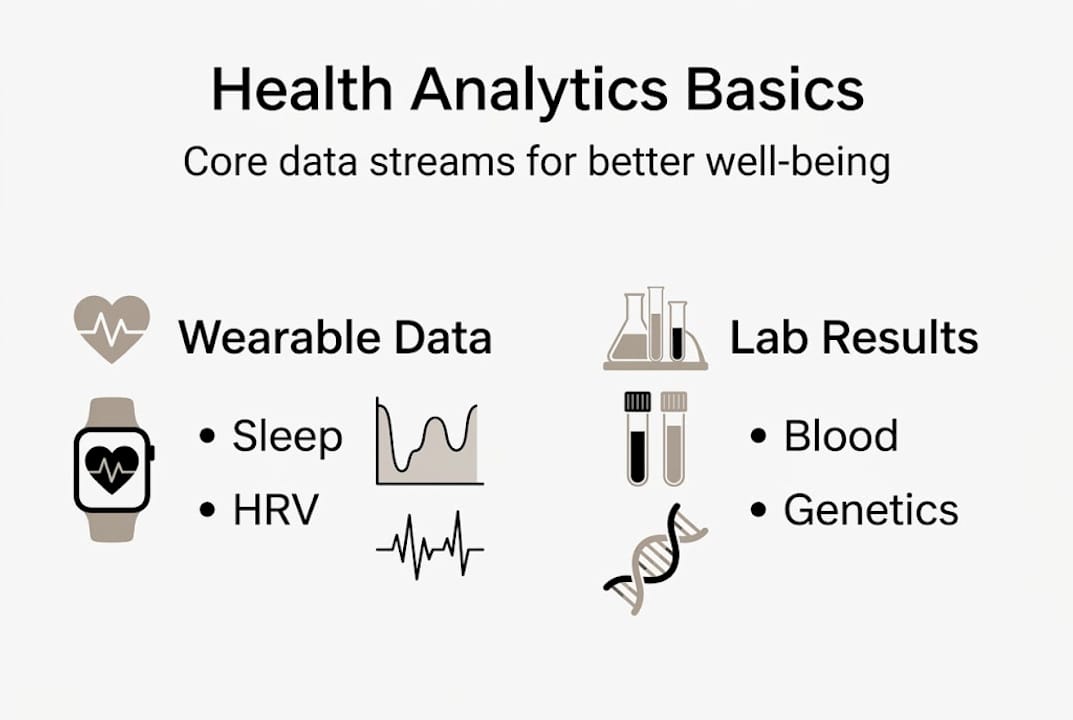
Health analytics draws from several distinct data streams, each revealing something different about your physiology. Modern health analytics uses wearable data, genomics, metabolic testing, and more, combining these inputs to generate insights that no single source could produce alone.
| Data type | What it measures | Best used for |
|---|---|---|
| Wearables | HRV, sleep, steps, heart rate | Daily trend monitoring, recovery |
| Biomarker analysis | Blood, urine, hormone levels | Metabolic and inflammatory status |
| Genomic testing | DNA variants, gene expression | Long-term risk, nutrient metabolism |
| Metabolic testing | VO2 max, fat oxidation rates | Training zone calibration |
Each data type has a distinct role. Wearables provide high-frequency, real-time signals. Biomarker panels offer a biochemical snapshot. Genomics tells you what you are predisposed to. Metabolic testing reveals how efficiently your body converts fuel to energy. Used together, they produce a genuinely three-dimensional view of health.
The analytics workflow follows a consistent sequence:
- Data collection: gather inputs from wearables, labs, and functional tests
- Standardisation: convert raw outputs into comparable, interpretable formats
- Pattern recognition: identify trends, anomalies, and correlations across data sets
- Interpretation: contextualise findings against your goals, history, and baselines
- Action: implement protocol adjustments and monitor the response
The role of data in diagnostics has expanded significantly as processing power has improved, allowing patterns that once took months to identify to emerge within days. Accuracy and data privacy are the two non-negotiables when choosing any analytics platform. Look for providers who use clinical-grade testing standards and clearly state how your data is stored, processed, and protected. The most sophisticated data set is worthless if it is built on inaccurate inputs or handled carelessly.
For practical data-driven health examples, the evidence repeatedly shows that consistent, structured tracking outperforms sporadic testing by a considerable margin.
Applications of health analytics for individuals and athletes
Data analysis for athletes confirms that real-world analytics can prevent injuries, personalise training, and support recovery in measurable ways. But these benefits extend well beyond competitive sport.
| Use case | Data inputs used | Outcome achieved |
|---|---|---|
| Sleep optimisation | HRV, sleep stages, cortisol | Improved restoration, reduced fatigue |
| Injury prediction | Load data, inflammation markers | Reduced overuse injuries |
| Nutrition personalisation | Metabolic rate, glucose response | Better fuelling, body composition |
| Recovery monitoring | Resting HR, muscle oxygenation | Faster return to high performance |
For health-conscious individuals who are not competitive athletes, the benefits are equally compelling. Trend monitoring over time reveals whether lifestyle changes are actually shifting your biology in the right direction. Tailored fitness protocols replace guesswork with specificity. And early detection of metabolic or hormonal drift allows intervention before symptoms appear, which is the defining advantage of proactive data-driven wellness.

For elite athletes, the stakes are higher and the applications more granular. Load management informed by daily HRV data reduces overtraining risk. Individualised recovery protocols based on muscle oxygenation and inflammation markers cut downtime between sessions. Nutritional strategies calibrated to metabolic testing maximise fuel efficiency during competition.
Common outcomes seen across both groups include:
- Measurably improved performance metrics within structured training cycles
- Reduced performance plateauing through continual protocol refinement
- Earlier detection of hormonal imbalances, deficiencies, and inflammatory patterns
- Greater confidence in decision-making around training load, nutrition, and rest
The through-line is personalisation. Generic programmes produce average results. Analytics-informed programmes produce your results.
Potential challenges and ethical considerations
While the opportunities are impressive, any innovation carries its own responsibilities. Integrating advanced analytics raises genuine questions about data privacy, accessibility, and interpretation that every user should take seriously.
The main risks to be aware of include:
- Data misuse: third parties accessing your health data for purposes beyond healthcare, including insurance profiling or targeted advertising
- Privacy loss: inadequate anonymisation leaving personal health information traceable back to individuals
- Data security: breaches exposing sensitive genetic or medical records
- Algorithm bias: analytical models trained on non-representative populations producing skewed recommendations for underrepresented groups
Informed consent is foundational. Before sharing any biological data with a platform, understand exactly what you are consenting to. Read the terms carefully. Know whether your data is sold, shared, or used to train third-party algorithms. This is not paranoia; it is due diligence.
The ethical dimension extends further. There is a real tension between innovation and individual rights. As analytics capabilities grow, the question of who controls your health data and what they can do with it becomes increasingly significant. Robust health risk profiling requires rigorous ethical frameworks, not just technical sophistication.
Overreliance is another genuine risk. Analytics tools are decision-support systems, not decision-making systems. Misinterpreting data without professional guidance can lead to unnecessary anxiety or, worse, misdirected intervention. Pair your data with expert interpretation whenever possible. Solid preventative health strategies always integrate human judgement alongside algorithmic output.
Pro Tip: Before signing up to any health analytics platform, check whether it complies with UK GDPR, uses encrypted storage, and offers independent verification of its testing accuracy. A quick search for third-party audits or clinical validation studies will tell you a great deal about a provider’s credibility.
Our perspective: what most health analytics articles overlook
Most commentary on health analytics focuses on what the technology can do. Far less attention goes to what you need to do for the technology to actually work. The uncomfortable truth is that data without discernment is noise. We see this consistently: clients arrive with months of wearable data, multiple blood panels, and genetic reports, yet no coherent picture of their health and no idea where to act first.
More data does not automatically produce better health. What converts analytics into real-world results is the combination of consistent application and critical thinking. That means reviewing your data regularly, questioning what the numbers mean in the context of how you actually feel, and being willing to adjust your protocols based on evidence rather than habit or preference.
The performance improvement case studies that produce the most dramatic results share one trait: the individual became an active, curious participant in their own optimisation rather than a passive recipient of reports. Your biology is the most sophisticated system you will ever have access to. The analytics are simply the language it uses to speak to you. Learning to listen, critically and consistently, is where the real advantage lies.
Explore your health analytics potential with AI Healthician
Understanding the principles behind health analytics is one thing. Applying them with precision to your own physiology is another entirely.
At AI Healthician, we translate your biological data into actionable, personalised protocols that move the needle on energy, recovery, performance, and long-term resilience. Our DNA health testing services reveal the genetic architecture underlying your health, while our metabolic testing options calibrate your energy systems with clinical precision. If you are ready to move beyond guesswork and into genuinely data-informed optimisation, we are equipped to guide that process from first test to measurable result.
Frequently asked questions
What does health analytics actually measure?
Health analytics measures trends by evaluating data such as physical activity, biometrics, metabolic rates, and genetic markers to inform health and performance decisions. Modern analytics uses diverse data sources to personalise insights far beyond what a standard check-up can reveal.
How can health analytics improve athletic performance?
Health analytics enables athletes to personalise training, track recovery, and minimise injury risk through insights drawn from multiple data points. Data analysis enhances performance, risk management, and recovery for athletes at every level.
Is my data safe when using health analytics tools?
Most reputable platforms use encryption and strict privacy protocols, but always review a provider’s policy before sharing sensitive information. Ethical integration of health analytics requires robust data privacy measures as a baseline, not an afterthought.
Can health analytics help with disease prevention?
Yes, by identifying patterns and risks early, analytics enables tailored preventative strategies before symptoms develop. Predictive analytics supports disease prevention and longevity strategies with meaningful clinical backing.


