


 matt@aihealthician.co.uk


TL;DR:
- Blood-based biomarkers reveal insights into energy, hormones, and inflammation affecting performance.
- Proper preparation and consistent retesting are crucial for accurate interpretation of results.
- Focus on core markers and personal trends to optimize health and athletic capacity effectively.
Generic advice has a ceiling. You can train consistently, eat well, and still feel like you’re leaving performance on the table. The reason is often invisible: your biology. Blood-based biomarker testing analyses measurable markers in your blood to reveal exactly what’s happening beneath the surface, from energy availability to hormonal balance and inflammatory load. This guide walks you through every stage of the process: how to prepare, which methods to use, how to interpret your results, and how to convert data into targeted action that actually moves the needle.
Table of Contents
- Understanding biomarkers and their role in health optimisation
- Preparing for biomarker analysis: what you need before testing
- Analysing biomarkers: step-by-step guide and recommended methodologies
- Interpreting biomarker data: from numbers to actionable insights
- Common pitfalls and expert tips for advanced biomarker analysis
- Our perspective: the real power (and limitations) of biomarker analysis
- Take your health optimisation further with expert biomarker testing
- Frequently asked questions
Key Takeaways
| Point | Details |
|---|---|
| Personalised insights | Biomarker analysis reveals your unique needs, helping tailor health and performance strategies. |
| Preparation is crucial | Accurate results require you to follow provider instructions and track lifestyle context. |
| Trends over single values | Focus on how your markers change over time—not just one-off numbers or generic population ranges. |
| Expert input matters | Work with professionals for complex interpretation and safe, effective interventions. |
| Avoid overcomplication | Sticking to essential markers and simple steps delivers the best long-term results. |
Understanding biomarkers and their role in health optimisation
A biomarker is any measurable indicator of a biological process. In the context of health and performance, we’re primarily talking about molecules in your blood that reflect how well your body is functioning right now and where it’s heading. These are not abstract data points. They are direct windows into your physiology.
Blood panel analysis covers a wide range of markers, each telling a different part of the story. The most clinically useful for health-conscious individuals and athletes include:
- Iron and ferritin: Critical for oxygen transport and energy production
- Vitamin D: Affects immune function, muscle strength, and mood
- hsCRP (high-sensitivity C-reactive protein): A sensitive marker of systemic inflammation
- Testosterone and cortisol: Key hormones governing recovery, stress response, and body composition
- Fasting glucose and HbA1c: Metabolic health and insulin sensitivity indicators
- Creatine kinase (CK): Reflects muscle damage and recovery status
The biomarker testing benefits extend far beyond simply spotting deficiencies. They allow you to build a personalised baseline, detect imbalances before they become problems, and design interventions that are specific to your biology rather than borrowed from someone else’s protocol.
“The greatest value of biomarker analysis is not catching disease early. It’s understanding your individual physiology well enough to optimise it deliberately.”
Understanding biomarker analysis importance means recognising that population reference ranges are built on averages. Your optimal ferritin level may differ from the next person’s. That distinction is precisely what separates personalised health from generic wellness advice.
Preparing for biomarker analysis: what you need before testing
Accurate results depend as much on preparation as they do on laboratory quality. Testing during a period of acute stress, illness, or disrupted sleep will skew your baseline and lead to misguided interventions. Timing is foundational.
Baseline testing in a low-stress phase produces the most reliable individual reference points. This means avoiding testing immediately after a hard training block, during illness, or following significant travel. Your results should reflect your typical physiological state, not a transient disruption.
Before your blood draw, document the following:
- Sleep quality and duration over the preceding week
- Training load and intensity in the days before testing
- Nutritional intake, particularly any supplementation that may influence results
- Medication use, including over-the-counter anti-inflammatories
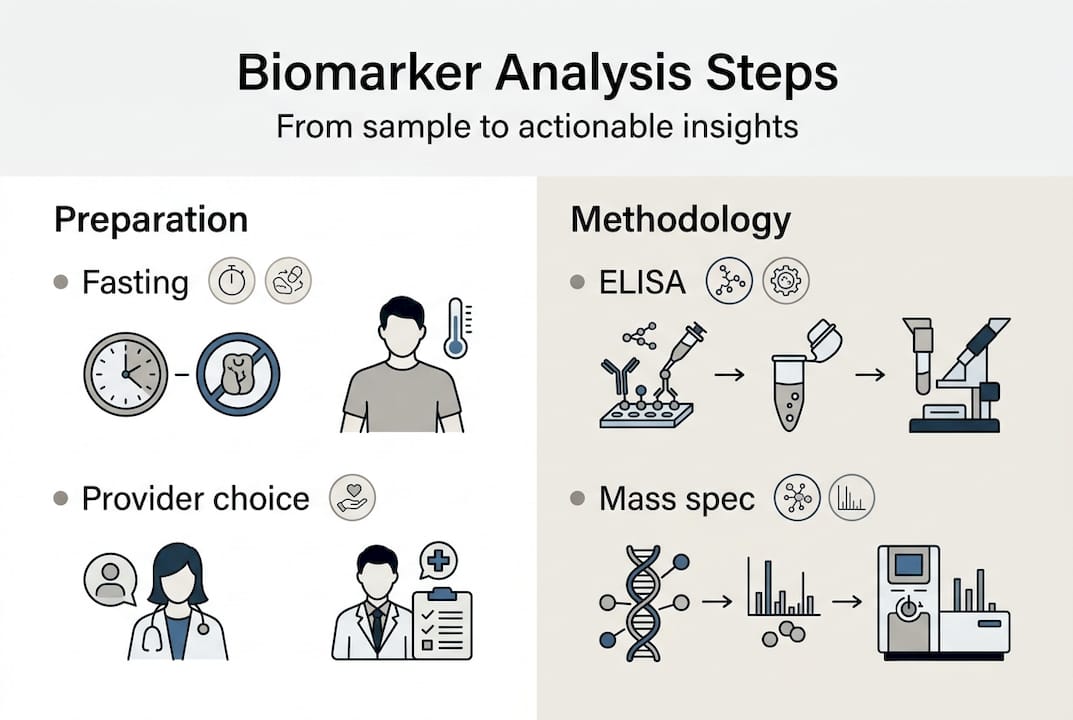
- Fasting status: many metabolic markers require 8 to 12 hours of fasting
Choosing a credible provider matters enormously. FDA fit-for-purpose validation standards require accuracy, precision, sensitivity, selectivity, and stability checks. Not every commercial lab meets this bar. Ask about their assay validation process before committing.
| Preparation factor | Why it matters | Recommended action |
|---|---|---|
| Fasting status | Affects glucose, insulin, lipids | Fast 8-12 hours for metabolic panels |
| Time of day | Cortisol peaks in the morning | Test hormones at the same time each visit |
| Training recency | Elevates CK and inflammatory markers | Rest 24-48 hours before testing |
| Supplement use | Can mask or inflate certain markers | Pause non-essential supplements 48 hours prior |
Pro Tip: Pair your lab results with a simple daily log covering sleep, energy, and training load for the week before testing. This context transforms numbers into a story your practitioner can actually act on.
For a broader view of available options, functional health tests provide a useful framework for deciding which panels to prioritise based on your goals.
Analysing biomarkers: step-by-step guide and recommended methodologies
Once you’ve prepared properly, the analysis workflow itself follows a logical sequence. Skipping steps here is where most people lose the value of their investment.
- Baseline blood draw: Collect your sample under standardised conditions (same time of day, fasting state, rest day)
- Select the appropriate assay method: Match the method to the marker and your precision requirements
- Send to a certified laboratory: Ensure the lab holds relevant accreditation and uses validated assays
- Receive and record results: Store results in a format that allows longitudinal comparison
- Integrate with subjective data: Cross-reference lab values with your training log, sleep data, and energy ratings
- Re-test at defined intervals: Establish a rhythm of 3 to 6-monthly retesting to track trends
Methodology selection is not trivial. Validated methods include chromatography, ligand-binding assays such as ELISA, mass spectrometry, flow cytometry, and multi-omics integration. For most clinical biomarkers, ELISA and mass spectrometry offer the best balance of precision and accessibility. Multi-omics panels, which combine genomic, proteomic, and metabolomic data, add significant depth but also require specialist interpretation.
| Method | Best used for | Precision level |
|---|---|---|
| ELISA | Hormones, inflammatory markers | High |
| Mass spectrometry | Metabolites, steroids | Very high |
| Multi-omics | Systems-level insights | Highest (complex) |
| Standard immunoassay | Routine panels (CBC, lipids) | Moderate to high |
Pro Tip: When reviewing blood biomarkers in training contexts, always note the units and reference ranges used by your specific lab. Different labs use different calibrations, which makes direct comparisons between providers unreliable.
For a broader view of how testing fits into a complete diagnostic picture, explore health diagnostics and deep health testing for endurance-specific applications.
Interpreting biomarker data: from numbers to actionable insights
Results arrive as numbers. Your job is to turn them into decisions. This is where most people either over-react or miss the signal entirely.
The critical principle is to prioritise your own trend over population norms. A ferritin of 38 ng/mL might sit within the standard reference range, yet if your personal optimal is 70 ng/mL and you’ve dropped from there over three months, that’s a meaningful decline. Ferritin below 30 to 50 ng/mL measurably impairs endurance performance, and hsCRP above 3 mg/L signals chronic inflammation that warrants investigation.
Key markers to watch and what deviations typically signal:
- Ferritin trending down: Energy decline, impaired oxygen delivery, risk of iron deficiency anaemia
- hsCRP rising: Inflammatory load increasing, possibly from overtraining, poor sleep, or dietary factors
- Creatine kinase elevated: Incomplete recovery from training, muscle damage accumulating
- Cortisol to testosterone ratio shifting: Overreaching, inadequate recovery, or significant life stress
“A single out-of-range result is a question. A trend across three or more tests is an answer.”
The performance testing evidence consistently supports multi-marker panels over single-marker approaches. No one biomarker tells the whole story. Fatigue, for instance, can stem from low iron, poor sleep, elevated cortisol, or suboptimal thyroid function. Only a panel reveals which factor is dominant.
Use biological data analysis frameworks to structure your interpretation, and pair results with metabolic markers and recovery data for a complete picture.
Common pitfalls and expert tips for advanced biomarker analysis
Even experienced practitioners make avoidable errors with biomarker data. Knowing where the traps are saves time, money, and unnecessary interventions.
The most common mistakes:
- Testing too many markers at once: A 50-marker panel sounds thorough, but without a clear hypothesis, most results create noise rather than signal
- Ignoring context: A high CK reading after a hard race is expected. The same reading in a rest week is a red flag
- Chasing population normals: Optimising toward average reference ranges rather than your personal baseline misses the point entirely
- Acting on a single data point: One abnormal result rarely justifies a major protocol change
- Neglecting re-testing: Implementing a change without re-testing 8 to 12 weeks later means you never know if it worked
Distinguishing screening from monitoring is a nuance that matters. Screening looks for problems you don’t yet know about. Monitoring tracks known markers over time. Both are valuable, but they require different panels and different frequencies.
Pro Tip: Build a simple spreadsheet tracking each marker across every test date. Visualising trends over 12 to 24 months reveals patterns that individual results hide entirely.
For athletes specifically, athlete data analysis shows that integrating biomarker data with training load metrics produces far better outcomes than either approach alone. Use a wellness checklist for athletes to ensure you’re not missing foundational variables, and revisit functional testing explained to understand how each test type fits your overall strategy.
Advanced multi-omics panels are genuinely powerful but require specialist interpretation. Don’t pursue them until you’ve stabilised your core markers and established a reliable testing rhythm.
Our perspective: the real power (and limitations) of biomarker analysis
Here’s what years of working with data-driven health protocols actually teaches you: the most impactful biomarker insights are rarely exotic. They’re iron. They’re vitamin D. They’re cortisol patterns that confirm what the athlete already suspected but couldn’t quantify.
The industry has a tendency to push complexity. New panels, novel markers, cutting-edge multi-omics. Some of it is genuinely useful. Much of it is noise that distracts from the fundamentals. Bloodwork complements training logs and subjective data; it does not replace them. The athlete who sleeps poorly, trains hard, and chases rare biomarkers is optimising the wrong variable.
The real power of biomarker analysis lies in its ability to personalise. Not to make you perfect, but to make your interventions precise. When you know your ferritin drops every winter, you supplement proactively. When you see cortisol rising mid-season, you adjust load before breakdown occurs. That’s the value. Precision over perfection.
We recommend starting simple, testing consistently, and letting the panel analysis value compound over time. The longitudinal picture is always more powerful than any single result.
Take your health optimisation further with expert biomarker testing
Understanding the methodology is a strong start. Putting it into practice with professional support is where results accelerate.

At AI Healthician, we combine validated laboratory testing with expert data interpretation to build protocols that are specific to your biology, your goals, and your lifestyle. If you’re ready to move beyond guesswork, our DNA health testing packages provide deep genetic and physiological insights that inform long-term strategy. For immediate metabolic clarity, our metabolic testing options deliver precise data on how your body produces and uses energy. These are not off-the-shelf products. They are the starting point for a personalised protocol built around your data.
Frequently asked questions
What are the best biomarkers to test for overall health?
Key markers for a holistic assessment include iron and ferritin, vitamin D, hsCRP, testosterone, cortisol, fasting glucose, HbA1c, and creatine kinase. These cover energy, inflammation, hormonal balance, and metabolic function.
How often should I re-test my biomarkers?
Re-test core markers every 3 to 6 months to track biomarker trends longitudinally and assess whether your interventions are producing measurable change.
Are at-home biomarker tests accurate?
At-home tests can be accurate when the laboratory applies fit-for-purpose validation standards covering accuracy, precision, and stability, and when the sample is collected and handled correctly.
Do athletes need different biomarker panels?
Athletes should build on a standard panel by adding markers for recovery, energy availability, and inflammation. Prioritise iron, vitamin D, and hormonal markers during periods of high training load.
Is it possible to over-optimise with biomarker analysis?
Yes. Focusing on rare or trendy markers rather than core ones risks unnecessary interventions and analysis paralysis. The greatest gains consistently come from monitoring and acting on foundational markers.


