


 matt@aihealthician.co.uk


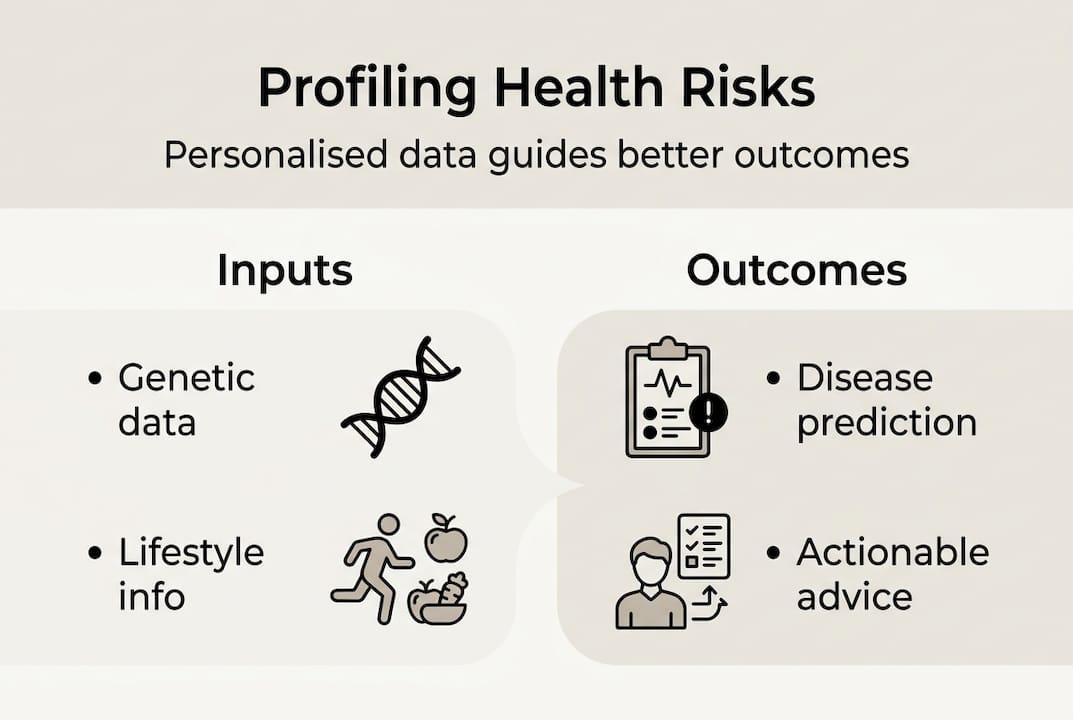
Most health advice is built for the average person. The problem is that no one is truly average. Your cardiovascular risk, metabolic rate, hormonal patterns, and genetic predispositions are entirely your own, yet standard wellness guidance treats everyone as though they share the same biology. Health risk profiling is the process of assessing and categorising an individual’s likelihood for specific health outcomes using comprehensive data, moving far beyond the generic advice that misses what actually matters for your physiology. When your personal data drives the protocol, the results are measurably different.
Table of Contents
- Understanding health risk profiling: fundamentals and scope
- How health risk profiling works: data, tools and technologies
- Why physiological data and personalisation matter
- The real-world impact: evidence, accuracy, and challenges
- Expert insights: evolving models, AI, and the future of health risk profiling
- The uncomfortable truth: why context and interpretation matter most
- Take the next step with personalised health solutions
- Frequently asked questions
Key Takeaways
| Point | Details |
|---|---|
| Personalised over generic | Health risk profiling tailors advice to individual data for better results. |
| AI enhances prediction | Modern tools use machine learning to give more accurate health forecasts. |
| Actionable insights | Profiling translates complex metrics into everyday steps you can take. |
| Continuous monitoring | Wearables and ongoing data collection improve risk accuracy over time. |
| Context matters | Expert guidance ensures data leads to practical, healthy changes. |
Understanding health risk profiling: fundamentals and scope
Health risk profiling is not simply a more detailed check-up. It is a structured, data-led process that identifies your individual risk factors, quantifies them, and translates them into targeted interventions. Where traditional health assessments offer population-level guidance, profiling builds a picture that is specific to you.
The foundation rests on risk stratification, which uses data from demographics, clinical records, genetics, and lifestyle variables to place individuals into meaningful risk categories. This allows practitioners to prioritise interventions where they will have the greatest measurable impact rather than applying blanket recommendations.
| Traditional health assessment | Health risk profiling |
|---|---|
| Population-level guidance | Individual-specific protocols |
| Snapshot in time | Continuous data integration |
| Symptom-focused | Predictive and preventative |
| Generic lifestyle advice | Targeted physiological interventions |
The core components of any robust profiling process include:
- Data capture: demographics, clinical history, genetic markers, wearable outputs, and physiological metrics
- Analysis: statistical modelling and AI-driven pattern recognition across data sets
- Stratification: categorising risk levels to prioritise action
- Intervention design: building protocols that address your specific vulnerabilities
The value of analysing health data at this level is that small, previously invisible signals become actionable. A slightly elevated fasting glucose combined with a specific genetic variant and a sedentary lifestyle pattern tells a very different story than any single data point alone.
Pro Tip: The more data sources you include in your profile, the more accurate your risk picture becomes. Combining genetic data with real-time physiological metrics is where data-driven wellness becomes genuinely predictive rather than reactive.
How health risk profiling works: data, tools and technologies
Understanding the workflow behind profiling removes the mystery and helps you engage with your results more critically. The process moves through several distinct stages.
- Data collection: Information is gathered from electronic health records, laboratory tests, wearable devices, imaging, and multi-omics panels covering genomics, proteomics, and metabolomics.
- Data integration: Disparate data sources are standardised and merged into a unified analytical framework.
- Model application: Statistical and machine learning algorithms process the integrated data to generate risk scores.
- Stratification: Outputs are classified into low, medium, or high risk categories to guide clinical and lifestyle decisions.
- Interpretation and action: Risk scores are translated into specific, prioritised interventions.
Risk scoring tools now routinely incorporate electronic health records, lab tests, wearables, statistical models, and AI/ML for predictive analytics, representing a significant leap from earlier single-variable assessments.
“The shift from single-biomarker testing to multi-modal data integration is what separates modern risk profiling from traditional diagnostics. The model is only as powerful as the data fed into it.”
Well-established examples include the Framingham Risk Score for cardiovascular disease, QRISK3 for ten-year cardiovascular event probability, and polygenic risk scores (PRS) that aggregate thousands of genetic variants into a single predictive value. Each of these tools demonstrates how AI in health is reshaping what prediction actually means in practice.
Modern algorithms such as random forest classifiers and deep learning networks can identify non-linear relationships between variables that traditional logistic regression would miss entirely. The result is that biological data analysis now surfaces patterns invisible to conventional clinical review. Paired with continuous health monitoring, these models update dynamically as your data evolves.

Why physiological data and personalisation matter
The real power of health risk profiling is not in the algorithm. It is in the quality and specificity of the physiological data feeding it. Generic risk scores built on population averages will always carry a margin of error for any individual. Granular, real-time physiological data closes that gap significantly.
Personalised wellness uses advanced metrics like body composition, heart rate variability (HRV), genetics, and continuous glucose monitoring (CGM) to tailor advice that is genuinely relevant to your biology rather than your demographic bracket.
Consider what each of these metrics reveals:
- CGM data: Shows how your blood glucose responds to specific foods, stress, and sleep disruption, revealing metabolic patterns invisible in a single fasting glucose reading
- HRV: Quantifies your autonomic nervous system’s resilience and recovery capacity, a far more sensitive stress marker than resting heart rate alone
- Body composition via BIA: Distinguishes between fat mass, lean muscle, and visceral fat, each carrying distinct risk implications
- Genetic markers: Identify predispositions to conditions such as type 2 diabetes, cardiovascular disease, and nutrient metabolism disorders
Key statistic: Advanced prediction models built on multi-modal physiological data consistently achieve AUC values above 0.8, indicating strong discriminatory accuracy between those who will and will not develop a given condition.
The practical outcome is measurable. Personalised protocols built from this data improve energy, accelerate recovery, and reduce long-term disease risk in ways that generic plans simply cannot replicate. Reviewing the full spectrum of health diagnostics available makes clear how much information is currently going uncaptured in standard care. Tracking health trends for performance through this lens transforms health management from reactive to genuinely strategic.
The real-world impact: evidence, accuracy, and challenges
The promise of health risk profiling is well-supported by evidence, but it is important to understand both the benchmarks and the boundaries.
Disease prediction outcomes show that models achieve AUC values of 0.70 to 0.91 for disease prediction, and polygenic risk scores reduce premature deaths by 23%, figures that represent genuine population-level impact.
| Metric | Benchmark performance |
|---|---|
| Cardiovascular risk (Framingham) | AUC ~0.75 |
| Multi-modal AI models | AUC 0.80 to 0.91 |
| Polygenic risk score impact | 23% reduction in premature deaths |
| Hospitalisation reduction | Significant in high-risk stratified groups |
Pro Tip: An AUC of 0.5 means a model is no better than chance. An AUC above 0.8 means it correctly distinguishes high-risk from low-risk individuals in 80% or more of cases. That is clinically meaningful.
However, challenges remain. Data quality is the most significant limiting factor. Incomplete records, inconsistent wearable data, and gaps in genetic coverage all reduce model accuracy. Model transparency is another concern. Many high-performing AI models operate as black boxes, making it difficult for clinicians to explain why a specific risk score was generated.
“Population-level accuracy does not guarantee individual-level precision. Risk scores are probabilities, not certainties, and must be interpreted within the full context of a person’s circumstances.”
Equity across populations is also unresolved. Most validated models were built on data sets skewed towards specific ethnic groups, meaning their accuracy varies significantly across diverse populations. Reviewing advanced diagnostics through this critical lens is essential for anyone applying profiling in practice. The role of precision health optimisation is to bridge these gaps with contextually appropriate interpretation.
Expert insights: evolving models, AI, and the future of health risk profiling
The trajectory of health risk profiling is accelerating rapidly, driven by convergence between AI, multi-omics, and digital simulation technologies.
- Multi-modal AI integration: Systems that combine genomic, proteomic, imaging, and wearable data outperform any single-domain model. The whole is genuinely greater than the sum of its parts.
- Digital twins: Virtual physiological models allow simulated interventions before they are applied in the real world, enabling risk-free optimisation of protocols.
- Polygenic risk scores as lifelong tools: PRS can be calculated at birth and updated throughout life, providing a continuous genetic risk backdrop against which lifestyle and environmental data is layered.
- Cluster-based multimorbidity modelling: Rather than treating each condition in isolation, emerging approaches group co-occurring conditions into clusters, enabling more holistic and accurate risk assessment.
AI-powered predictive health research confirms that multi-modal AI outperforms single-domain models, digital twins enable simulated interventions, and PRS offers lifelong forecasts that reshape how we think about prevention entirely.
“The future of risk profiling is not a single test at a single point in time. It is a continuously updated, multi-layered biological narrative that evolves as you do.”
The outstanding debates centre on model validation across diverse populations, algorithmic transparency, and how risk information is communicated without causing unnecessary anxiety or fatalism. The role of data in diagnostics will only grow more central as these technologies mature.
The uncomfortable truth: why context and interpretation matter most
Here is something the technology rarely advertises: a risk score on its own changes nothing. We have seen individuals receive detailed, accurate profiles and walk away more confused than when they started, because data without context is just noise.
The uncomfortable reality is that health risk profiling is only as useful as the interpretation layer sitting between the numbers and the person receiving them. A high cardiovascular risk score means something very different for a 35-year-old with reversible lifestyle factors than for a 60-year-old with established arterial changes. The model cannot know that. You need someone who does.
Misinterpretation is not a minor risk. It leads to unnecessary anxiety, inappropriate interventions, and sometimes the abandonment of genuinely helpful protocols because the framing was wrong. The real world is messier than any stratification category.
This is why we believe precision health optimisation must remain person-centred, not just data-driven. The data informs the conversation. It does not replace it. The most sophisticated model in the world still needs a human being to decide what to do next, and to stay engaged long enough for the intervention to work.
Take the next step with personalised health solutions
Understanding health risk profiling is the first move. Applying it to your own biology is where the real change happens.
At AI Healthician, we translate your physiological data into precise, actionable protocols built around your actual risk profile. Our DNA health testing reveals genetic predispositions that standard check-ups never capture, while our metabolic test with body scan provides granular insight into your energy systems and body composition. Every result is interpreted in context and converted into a protocol you can act on immediately. If you are ready to move beyond generic health advice, explore our full range of precision health solutions and start building a health strategy grounded in your own data.
Frequently asked questions
What is health risk profiling in simple terms?
Health risk profiling uses multiple data types to assess and categorise your disease risk, giving you a personalised picture of which conditions you are most likely to develop so you can take focused, preventative action.
How does health risk profiling benefit me compared to regular health check-ups?
It goes beyond basic check-ups by providing detailed, personalised insight based on advanced physiological and genetic data, enabling targeted protocols rather than population-level recommendations.
Are AI and machine learning now standard in health risk profiling?
Yes. Most modern profiling relies on AI/ML algorithms to analyse complex, multi-variable health data and generate predictions that traditional statistical methods cannot match.
What are the main limitations of health risk profiles?
Data quality, model transparency, and varying accuracy across different populations remain the most significant barriers, as highlighted in population health impact research.


