


 matt@aihealthician.co.uk


Upgrading your health strategy means understanding more than just symptoms and test scores. For driven entrepreneurs and high-performing athletes, the difference lies in how well you interpret structured and unstructured information from a range of sources like Electronic Health Records or wearables. Today, medical diagnostics data brings together clinical observations, imaging files, and real-time analytics to give a clearer, more accurate view of your body’s resilience and performance potential.
Table of Contents
- Defining Data In Medical Diagnostics
- Types Of Diagnostic Health Data Sources
- How Data Analytics Enhances Diagnostic Precision
- AI And Machine Learning Transform Diagnostics
- Challenges: Data Privacy, Bias And Reliability
- Avoiding Missteps In Data-Driven Interventions
Key Takeaways
| Point | Details |
|---|---|
| Diverse Data Types | Medical diagnostics encompass structured, unstructured, clinical, administrative, and research data, all contributing to a comprehensive understanding of patient health. |
| Importance of Data Standardisation | Standardisation models like OMOP CDM and FHIR facilitate data integration across systems, enhancing diagnostic accuracy and collaborative research. |
| Role of Data Analytics | Advanced analytics methods, including machine learning, improve diagnostic precision by identifying risk patterns and enabling real-time monitoring of patient health. |
| Challenges of AI Implementation | Ensuring data privacy, mitigating algorithmic bias, and maintaining reliability are critical challenges in deploying AI technologies in medical diagnostics. |
Defining Data in Medical Diagnostics
Medical diagnostics data represents a sophisticated ecosystem of structured and unstructured information critical to understanding patient health. Standardised healthcare information encompasses multiple dimensions beyond traditional clinical records, transforming how medical professionals interpret and respond to complex physiological signals.
The landscape of medical diagnostic data includes several key categories:
- Structured data: Quantitative clinical test results, numerical measurements, and tabular information
- Unstructured data: Clinical notes, radiological images, handwritten physician observations
- Clinical data: Patient-specific health indicators and diagnostic markers
- Administrative data: Patient demographics, treatment histories, insurance information
- Research datasets: Aggregated anonymised medical information for broader scientific investigation
These diverse data types interact dynamically, creating a comprehensive picture of an individual’s health trajectory. Medical data analytics enables healthcare professionals to extract meaningful insights by integrating these disparate information sources, transforming raw numbers into actionable medical intelligence.
Advanced data standardisation frameworks like the Observational Medical Outcomes Partnership (OMOP) Common Data Model facilitate seamless data translation across different healthcare systems. By creating a universal language for medical information, these models support collaborative research, enhance diagnostic precision, and ultimately improve patient outcomes worldwide.
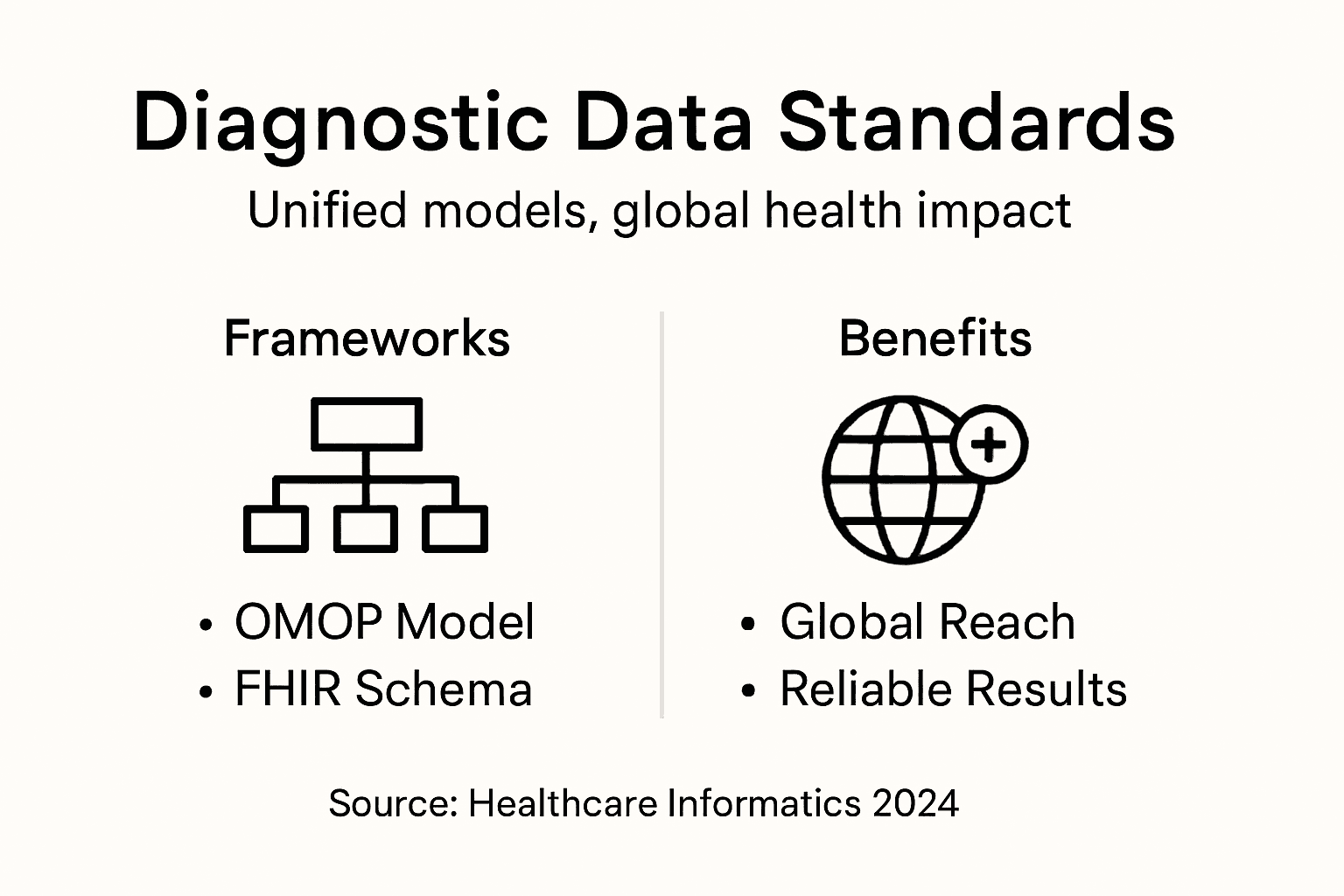
The following table highlights how data standardisation models support medical diagnostics and research collaboration:
| Data Standardisation Model | Key Benefit | Impact on Healthcare | International Reach |
|---|---|---|---|
| OMOP CDM | Integrates diverse datasets | Enables cross-system analysis | Widely adopted globally |
| FHIR | Streamlines data exchange | Improves clinical workflows | Supported in multiple regions |
| HL7 | Facilitates communication | Enhances interoperability | Used in over 50 countries |
| SNOMED CT | Unifies medical terminology | Supports precise diagnoses | Covers global clinical vocabularies |
Pro tip: Always verify the data source and standardisation protocols when interpreting medical diagnostic information to ensure accuracy and reliability.
Types of Diagnostic Health Data Sources
Healthcare diagnostics rely on a comprehensive network of data sources that collectively provide insights into patient health and medical systems. Global health datasets encompass a wide range of information collection methods, each serving unique analytical purposes in understanding medical complexities.
The primary diagnostic health data sources include:
-
Clinical datasets:
- Electronic Health Records (EHRs)
- Laboratory test results
- Medical imaging files
- Patient consultation notes
-
Administrative datasets:
- Patient demographic information
- Insurance claims
- Treatment history records
-
Population-level datasets:
- National health surveys
- Census data
- Public health registries
-
Research-oriented datasets:
- Longitudinal health studies
- Epidemiological research collections
- Clinical trial information
Operational healthcare datasets integrate clinical, financial, and administrative information, enabling healthcare professionals to develop comprehensive diagnostic strategies. These multifaceted data sources transform raw information into actionable medical intelligence, supporting precision diagnostics and personalised healthcare interventions.
Modern diagnostic data collection emphasises interoperability and standardisation, ensuring that diverse data sources can communicate effectively. Advanced data integration techniques allow healthcare providers to synthesise information from multiple origins, creating a holistic view of patient health that transcends traditional diagnostic boundaries.
Pro tip: Regularly validate and cross-reference multiple data sources to ensure diagnostic accuracy and comprehensive patient understanding.
How Data Analytics Enhances Diagnostic Precision
Data analytics represents a transformative approach to medical diagnostics, enabling healthcare professionals to uncover intricate insights that traditional analytical methods might overlook. Healthcare performance analytics provide a sophisticated mechanism for evaluating and improving diagnostic processes at individual and population levels.
Key mechanisms through which data analytics enhances diagnostic precision include:
-
Predictive Pattern Recognition:
- Identifying subtle health trend correlations
- Anticipating potential disease progression
- Detecting early warning signs before clinical manifestation
-
Risk Stratification:
- Segmenting patient populations by health risk
- Personalising preventative intervention strategies
- Prioritising high-risk patient groups
-
Real-time Monitoring:
- Integrating continuous physiological data
- Tracking dynamic health parameters
- Enabling immediate clinical interventions
Predictive health technologies leverage advanced algorithms to transform raw medical data into actionable intelligence. By analysing complex datasets, these technologies can predict potential health risks with unprecedented accuracy, shifting healthcare from reactive treatment to proactive prevention.

Advanced data analytics methodologies employ machine learning and artificial intelligence to process vast quantities of medical information rapidly. These technologies can synthesise diverse data sources—including genetic profiles, lifestyle information, environmental factors, and clinical history—to generate comprehensive diagnostic insights that transcend traditional medical assessment techniques.
This table compares the main analytical approaches used in data-driven medical diagnostics:
| Analytical Approach | Strengths | Potential Limitations |
|---|---|---|
| Machine Learning Algorithms | Fast discovery of patterns | May introduce algorithmic bias |
| Statistical Modelling | Transparent outcome measures | Limited complexity handling |
| AI-Based Predictive Models | Accurate risk predictions | Requires rigorous validation |
| Human Expert Review | Contextual interpretation | Subject to human error |
Pro tip: Continuously validate and update analytical models to maintain diagnostic precision and adapt to emerging medical research.
AI and Machine Learning Transform Diagnostics
Artificial Intelligence (AI) and machine learning are fundamentally reshaping medical diagnostics, offering unprecedented capabilities in processing and interpreting complex healthcare data. Advanced diagnostic technologies are revolutionising how clinicians approach disease detection, prediction, and personalised treatment strategies.
Key transformative applications of AI in diagnostics include:
-
Medical Imaging Analysis:
- Detecting microscopic anomalies in radiological scans
- Identifying early-stage disease markers
- Reducing human interpretation errors
-
Predictive Health Modelling:
- Forecasting disease progression
- Assessing individual patient risk profiles
- Recommending personalised preventative interventions
-
Clinical Decision Support:
- Synthesising vast medical literature
- Generating evidence-based recommendations
- Accelerating diagnostic processes
Neural network diagnostic systems leverage sophisticated algorithms to process multiple data streams simultaneously, enabling more nuanced and accurate diagnostic insights. These technologies can analyse genetic markers, medical histories, and physiological parameters with a level of complexity that surpasses traditional human analytical capabilities.
Despite remarkable potential, AI-powered diagnostics face critical challenges including data privacy concerns, algorithmic bias, and the need for robust validation processes. Successful implementation requires careful integration of technological innovation with established clinical protocols, ensuring that machine learning enhances rather than replaces human medical expertise.
Pro tip: Continuously validate AI diagnostic models against diverse patient populations to maintain accuracy and mitigate potential systemic biases.
Challenges: Data Privacy, Bias and Reliability
The integration of advanced diagnostic technologies raises critical ethical and technical challenges that demand sophisticated, multifaceted solutions. Healthcare data governance must balance technological innovation with robust privacy protection and algorithmic fairness.
Key challenges in AI-driven diagnostics encompass:
-
Data Privacy Concerns:
- Protecting patient confidentiality
- Securing sensitive medical information
- Preventing unauthorized data access
-
Algorithmic Bias:
- Identifying systemic demographic prejudices
- Ensuring representative training datasets
- Developing inclusive diagnostic models
-
Reliability and Transparency:
- Validating algorithmic decision-making
- Maintaining clinical accountability
- Establishing clear performance benchmarks
Diagnostic equity frameworks emphasise the critical importance of addressing inherent biases that can systematically disadvantage certain population groups. This requires comprehensive strategies including diverse data collection, rigorous algorithmic auditing, and continuous model refinement to ensure fair and accurate diagnostic outcomes.
Successful navigation of these challenges demands collaborative efforts between technologists, healthcare professionals, ethicists, and regulatory bodies. Developing transparent, accountable AI systems requires ongoing commitment to principles of fairness, privacy protection, and scientific integrity.
Pro tip: Implement regular independent audits of AI diagnostic models to proactively identify and mitigate potential systemic biases.
Avoiding Missteps in Data-Driven Interventions
Data-driven healthcare interventions demand meticulous planning and rigorous methodological approaches to minimise potential errors and maximise scientific validity. Research methodology strategies provide crucial frameworks for identifying and mitigating potential pitfalls in clinical and epidemiological studies.
Key strategies for avoiding missteps include:
-
Participant Selection:
- Implementing comprehensive screening protocols
- Ensuring representative demographic diversity
- Minimising selection bias
-
Data Collection:
- Standardising measurement techniques
- Establishing clear documentation protocols
- Tracking potential confounding variables
-
Analytical Integrity:
- Developing transparent statistical approaches
- Conducting independent validation
- Implementing robust peer review processes
Ethical research practices emphasise the critical importance of maintaining data transparency and reproducibility. This requires comprehensive documentation, systematic tracking of methodological decisions, and a commitment to open scientific communication that allows independent verification of research findings.
Successful data-driven interventions necessitate a multidisciplinary approach that integrates expertise from statistical, clinical, and ethical domains. Researchers must remain vigilant about potential biases, continuously refine methodological approaches, and maintain a critical perspective on the limitations of their analytical frameworks.
Pro tip: Develop a comprehensive pre-registration protocol that outlines all methodological decisions before data collection to enhance research transparency and reduce analytical bias.
Unlock Personalised Diagnostic Insights for Optimised Health
The article highlights challenges such as integrating diverse diagnostic data, overcoming algorithmic bias, and transforming complex medical information into precise, actionable insights. If you seek tailored strategies beyond general wellness advice and want to address key issues like diagnostic precision and personalised performance optimisation, understanding your unique physiological data is essential. AI Healthician specialises in combining advanced data analysis with functional testing to create evidence-informed protocols that improve energy, resilience, metabolic health, and disease risk markers.
Discover how our advanced diagnostics and optimisation service can help you unlock deeper biological insights. Take control of your health trajectory now with targeted, data-driven interventions that really work. Visit AI Healthician and explore how our personalised performance protocols bridge the gap between complex diagnostic data and tangible health improvements today.
Frequently Asked Questions
What is the role of data in medical diagnostics?
Data plays a crucial role in medical diagnostics by providing structured and unstructured information that helps healthcare professionals understand patient health. This information is used to identify health trends, enhance diagnostic precision, and support personalised treatment strategies.
How does data analytics improve diagnostic accuracy?
Data analytics enhances diagnostic accuracy by utilising advanced techniques such as predictive pattern recognition, risk stratification, and real-time monitoring. These approaches allow healthcare professionals to identify health risks more effectively and develop targeted interventions.
What are the common types of diagnostic health data sources?
Common types of diagnostic health data sources include clinical datasets (like Electronic Health Records and laboratory results), administrative datasets (such as patient demographics and treatment history), population-level datasets (like national health surveys), and research-oriented datasets (including clinical trial information).
What challenges does AI face in medical diagnostics?
AI in medical diagnostics faces challenges related to data privacy, algorithmic bias, and ensuring reliability. It is essential to validate AI models continually and address potential biases to ensure fair and accurate diagnostic outcomes.


