


 matt@aihealthician.co.uk


TL;DR:
- Biological data allows personalized health strategies based on individual genomics, biomarkers, and wearable signals.
- AI and biological age clocks improve prediction of health risks and guide targeted longevity interventions.
- Combining wearable data with blood biomarkers offers the most practical and effective approach for health optimization.
Most people assume that following a solid diet, exercising regularly, and sleeping enough should be sufficient for long-term health. Yet for those chasing genuine performance gains and measurable longevity, generic advice rarely moves the needle. Biological data changes everything. By analysing your specific genomics, blood biomarkers, and real-time wearable outputs, it becomes possible to construct health strategies that are built around your physiology rather than population averages. This article explores the key categories of biological data, the technologies that interpret them, and the evidence showing just how precisely these tools can predict and improve your long-term health trajectory.
Table of Contents
- What is biological data and why does it matter?
- How biological data is integrated: tools, AI, and age clocks
- Real performance and longevity wins: empirical evidence
- Nuances, challenges, and expert recommendations
- Our perspective: The real world path to actionable longevity
- Next steps: Make your data work for you
- Frequently asked questions
Key Takeaways
| Point | Details |
|---|---|
| Biological data personalises health | Integrating wearables, multi-omics, and biomarkers turns health decisions from guesswork into precise, actionable strategies. |
| AI and age clocks unlock insights | Cutting-edge tools like LinAge2 and PpgAge provide forecasts for disease risks and longevity far beyond standard tests. |
| Evidence shows real-world benefits | Data-driven interventions reduce inflammation and predict diabetes or heart risk with impressive accuracy. |
| Effective use requires nuance | The best results come from combining technologies and interpreting data in context, not relying on one source or gadget. |
| Start with practical tools | Begin with wearable and blood data, then expand to advanced analysis for high-impact performance and longevity gains. |
What is biological data and why does it matter?
Generic health strategies can fall short because they treat every individual the same. Biological data corrects this by giving you a detailed, personal map of your physiology. But what exactly falls under the umbrella of biological data?
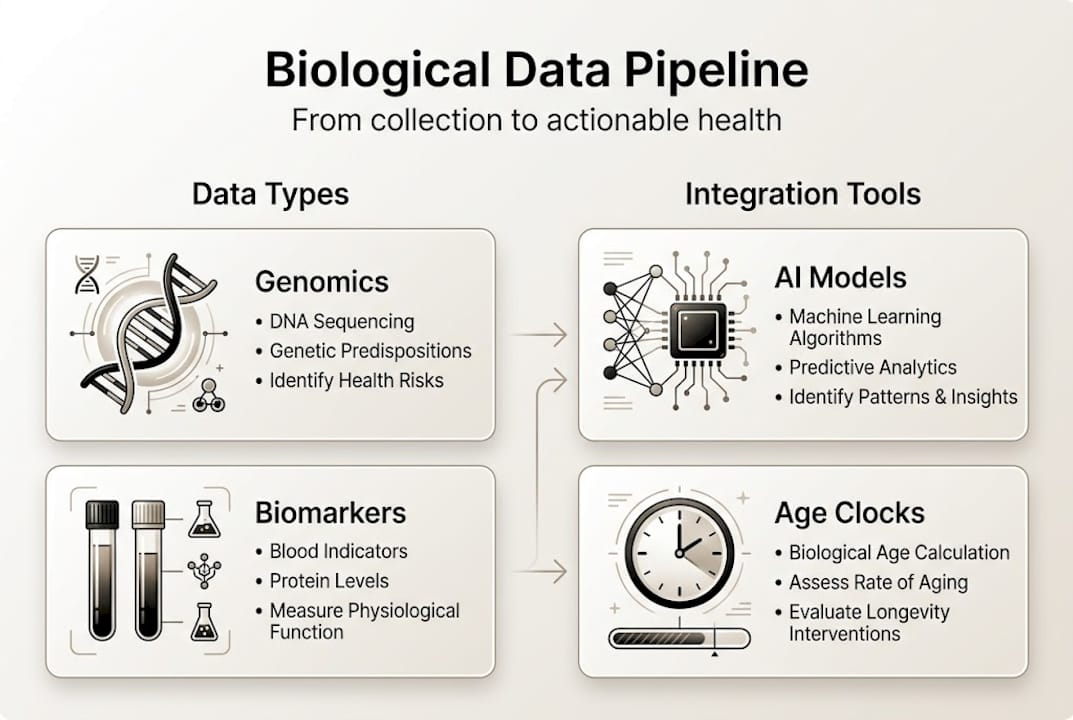
At the most sophisticated end sits multi-omics, a collective term for several interconnected data streams:
- Genomics: your DNA sequence, revealing genetic predispositions to disease, nutrient metabolism, and training response
- Transcriptomics: which genes are actively expressed in your cells at any given time
- Proteomics: the proteins your body is currently producing, reflecting real-time cellular activity
- Metabolomics: small molecules generated by metabolic processes, closely tied to energy, inflammation, and disease states
Beyond multi-omics, wearable devices now capture continuous physiological signals that were previously confined to clinical settings. Heart rate variability (HRV), sleep architecture, daily step counts, and oxygen saturation are no longer one-off snapshots. They are rolling, longitudinal datasets that reveal how your body responds to stress, recovery, and lifestyle inputs over time.
Blood biomarkers remain one of the most accessible and clinically validated data sources. Markers such as hs-CRP (high-sensitivity C-reactive protein, a marker of systemic inflammation), HbA1c (average blood glucose over three months), and HOMA-IR (an index of insulin resistance) offer a window into metabolic and cardiovascular risk that standard GP panels often miss.
Together, these datasets enable personalised enhancements and longevity by shifting medicine from reactive to proactive. Rather than waiting for symptoms, you can identify risk trajectories years before they become clinical problems.
“The real power of biological data is not in any single measurement. It is in how multiple streams, when interpreted together, reveal patterns invisible to isolated tests.”
The importance of biomarker analysis cannot be overstated here. When biomarkers are read in context with genomic predispositions and wearable trends, the result is a genuinely personalised health profile. This framework also allows for progress tracking: interventions can be tested, measured, and refined based on your biological response rather than guesswork.
| Data type | Examples | Primary use |
|---|---|---|
| Genomics | SNPs, gene variants | Disease risk, nutrition response |
| Blood biomarkers | hs-CRP, HbA1c, HOMA-IR | Metabolic and inflammatory status |
| Wearables | HRV, sleep stages, VO2 max | Real-time recovery and performance |
| Metabolomics | Amino acids, lipid metabolites | Energy production, gut health |
For those interested in health longevity insights, understanding these data categories is the essential first step before any intervention is designed.
How biological data is integrated: tools, AI, and age clocks
With the basics of biological data explained, it is time to understand how this information becomes actionable by integrating advanced technologies and predictive models.
Raw biological data is complex, noisy, and often contradictory across sources. The real transformation happens when AI and systems biology take over the interpretation. State-of-the-art integrative approaches include methods such as MoDAmix, SNF (Similarity Network Fusion), and MOFA (Multi-Omics Factor Analysis), each designed to extract meaningful biological signals from multi-layered datasets that no clinician could manually process.
Wearable foundation models are a newer development. Trained on millions of hours of time-series physiological data, these models learn the subtle signatures of metabolic dysfunction, overtraining, or poor recovery before you consciously notice symptoms.
Then there are biological age clocks, arguably the most compelling development in longevity science. These are not simply estimates of how old you look or feel:
- PpgAge: derived from wearable photoplethysmography signals; linked to predictions of heart disease and type 2 diabetes risk
- LinAge2: a clinical multi-omics clock with an AUC of 0.8684 for all-cause mortality prediction, outperforming many epigenetic clocks
- Systems Age: integrates organ-specific biological age across multiple physiological systems simultaneously
Large language models (LLMs) have begun serving as contextualisation layers, translating raw clock outputs and biomarker panels into plain, tailored recommendations. They do not replace clinical judgement but they dramatically reduce the gap between data and understanding.
Pro Tip: When reviewing your biological age clock output, focus on trajectory rather than absolute numbers. A clock that shows improvement over six months is far more meaningful than a single reading.
Here is how AI-driven wellness strategies turn raw data into a protocol:
| Stage | What happens |
|---|---|
| Data collection | Blood draws, wearable sync, omics testing |
| Integration | AI models merge data streams and remove noise |
| Clock analysis | Biological age and mortality risk are calculated |
| LLM contextualisation | Findings are translated into actionable recommendations |
| Monitoring | Ongoing tracking adjusts recommendations over time |
This pipeline represents a fundamental shift in what precision health for optimisation can achieve at an individual level.

Real performance and longevity wins: empirical evidence
Understanding the tools is only valuable if they deliver results, so what does the evidence actually say about using biological data?
The performance gains are measurable and, in several cases, striking. Using a combination of wearables and blood biomarkers, an insulin resistance prediction model achieved an AUROC of 0.80, which is clinically significant for a condition that affects metabolic performance and long-term disease risk. This means that before overt symptoms appear, targeted data can flag your risk with high reliability.
Biological age clocks trained on mortality outcomes rather than chronological age consistently outperform traditional clinical tests:
- LinAge2 achieved an AUC of 0.8684 for all-cause mortality, outperforming PhenoAge and standard clinical panels
- PpgAge, derived from wearable data alone, predicts heart disease and diabetes risk without a single blood draw
- Epigenetic clocks have now been linked to risk markers for 57 distinct diseases, including cancers, neurological conditions, and autoimmune disorders
Key stat: Targeted, data-driven lifestyle interventions have demonstrated 18 to 32% reductions in hs-CRP, a primary inflammatory marker associated with cardiovascular and metabolic disease.
For those monitoring key health biomarkers, this kind of reduction is not cosmetic. Lower hs-CRP translates directly to reduced arterial inflammation, improved recovery capacity, and a measurable shift in long-term disease trajectory.
| Clock or metric | Predictive power | Key use case |
|---|---|---|
| LinAge2 | AUC 0.8684 (mortality) | All-cause mortality risk |
| PpgAge | Heart disease, diabetes | Non-invasive longevity tracking |
| IR model | AUROC 0.80 | Insulin resistance detection |
| hs-CRP reduction | 18 to 32% via lifestyle | Inflammation and cardiovascular risk |
For anyone serious about analysing health data, these benchmarks offer a concrete sense of what becomes possible when biological data guides decision-making.
Nuances, challenges, and expert recommendations
Even as the evidence mounts, applying biological data in real life means facing nuance and technical hurdles. Here are the critical considerations.
No technology is without its blind spots, and biological data integration is no exception. Several factors can significantly distort results if not managed carefully:
- Batch effects: when samples are processed at different times or in different labs, technical variation can masquerade as biological signal
- Missing data: multi-omics datasets are often incomplete, and imputation methods introduce their own uncertainties
- Population bias: many clocks and models were developed on predominantly white, male, or Western cohorts, which can reduce their accuracy across different populations
- Sex-specific differences: hormonal influences on biomarkers mean that reference ranges calibrated for one sex can mislead interpretation for another
The debate between epigenetic clocks and clinical clocks is worth understanding. Epigenetic clocks (based on DNA methylation patterns) are biologically rich but expensive, often requiring specialist labs and invasive sampling. Clinical and wearable clocks, whilst less granular, are scalable and more actionable for most individuals and outperform epigenetic options specifically for mortality prediction.
Integrating multiple data sources solves many of these gaps but introduces its own challenge: dimensionality. When you combine genomics, wearables, metabolomics, and bloodwork, the resulting dataset can be so large that standard analytical methods lose statistical power. Robust integration methods such as MOFA or SNF are specifically designed to handle this, but they require proper implementation.
Pro Tip: If you are deciding where to invest your testing budget, prioritise mortality-predictive clocks combined with routine blood biomarkers over expensive epigenetic panels alone. The combined approach offers the best signal-to-noise ratio for practical decision-making.
For those pursuing personalised risk profiling, the key is not to seek perfect data but to build a layered picture using the most robust and complementary sources available.
Our perspective: The real world path to actionable longevity
Here is something the industry rarely says plainly: you do not need perfect data to make meaningful progress. Waiting for flawless multi-omics integration before acting is one of the most common ways people delay genuine health gains.
What actually works is iterative, layered feedback. Start with a few well-chosen blood markers and a reliable wearable. Track trends over months, not snapshots. Add omics data when the budget and clinical context support it. This approach consistently outperforms expensive one-off testing with no follow-through.
The biggest mistake we see is treating biological data as a verdict rather than a compass. A high hs-CRP or an unfavourable biological age reading is not a sentence. It is information. Used correctly, it tells you where to focus first.
Wearables paired with key bloodwork are, in our experience, the most powerful entry point. They provide continuous feedback on whether interventions are working, something a yearly blood panel simply cannot do. Balance this with periodic deeper testing, and you have a system that genuinely compounds over time. For those curious about practical application, data-driven performance examples illustrate how this plays out in real client contexts.
Next steps: Make your data work for you
Understanding biological data intellectually is valuable. Applying it to your own physiology is where the real returns emerge.
AI Healthician offers a structured route from insight to action. Whether you are starting with DNA health testing options to uncover genetic predispositions, or opting for metabolic and body scan tests to map your current metabolic baseline, every service is designed to translate raw data into precise, personalised protocols. No generic wellness plans. No guesswork. Just evidence-informed strategy built around your biology, with ongoing support to refine recommendations as your data evolves.
Frequently asked questions
What is the most actionable type of biological data for personal health?
Wearables and blood biomarkers are the most practical starting point, offering continuous and periodic insights that directly inform lifestyle and supplementation decisions without requiring specialist lab access.
How accurate are biological age clocks compared to standard tests?
Mortality-predictive clocks like LinAge2 (AUC 0.8684) substantially outperform both chronological age and standard clinical panels in forecasting real health risk, making them a superior tool for longevity planning.
Can using only wearables provide an accurate health picture?
Wearables offer valuable daily monitoring but may conflate behaviour with biology; combining them with periodic blood biomarker panels significantly deepens the accuracy and clinical relevance of your health picture.
What is the biggest limitation of current biological data strategies?
Batch effects, missing values, and population bias remain the most common sources of error, which is why robust integration methods and expert interpretation are essential rather than optional.
Recommended
- Set precise health goals: use data for lasting results – Aihealthician
- The Longevity Blueprint - Personalised Health Consultation | Aihealthician
- Biological data analysis examples for health optimisation – Aihealthician
- Emerging health trends for peak performance in 2026 – Aihealthician
- BIOHACKING CONFERENCE - THE NEW ERA OF HEALTH - Brainwellness


