


 matt@aihealthician.co.uk


TL;DR:
- Personalised health goals based on biomarker data are more effective than vague, generic targets.
- Regular testing and data analysis enable precise, adaptable, and sustainable health improvements.
- Combining behavioural SMART goals with biological targets optimizes long-term performance and longevity.
Most people set health goals the way they book holidays without a destination. They know they want to feel better, perform at a higher level, or reduce disease risk, but they lack the specific coordinates to get there. Vague intentions like “get fitter” or “eat healthier” dissolve within weeks because they offer no feedback loop, no measurable signal, and no biological context. When your goals are anchored to your own physiological data, everything changes. You stop guessing and start responding to what your body is actually telling you.
Table of Contents
- Why generic health goals fail and personalised targets succeed
- Gathering your baseline: Essential biological data for health goals
- Building health goals with the SMART and data-driven approach
- Troubleshooting common mistakes and making goals sustainable
- What most guides miss: Adapting health goals for peak performance and longevity
- Take the next step with personalised health testing
- Frequently asked questions
Key Takeaways
| Point | Details |
|---|---|
| Personalisation matters | Using biological data to set health goals makes them far more effective and tailored to your needs. |
| SMART meets science | Combining the SMART framework with biomarker targets creates actionable and sustainable outcomes. |
| Baseline is essential | Gathering and tracking baseline data allows your goals to be measurable, realistic, and adaptable. |
| Sustainability wins | Small, consistent changes and regular data checks make your health goals last and your progress visible. |
| Next steps available | Professional biomarker and metabolic testing can refine your protocols for optimal performance and longevity. |
Why generic health goals fail and personalised targets succeed
The standard advice is to set SMART goals: Specific, Measurable, Achievable, Relevant, and Time-bound. It is a solid framework, and it does help. But the SMART framework provides structure without accounting for individual biology, which is where most people hit a wall. Two people can follow the same SMART goal and get completely different results because their metabolic rate, hormonal profile, and recovery capacity differ significantly.
Generic goals focus on behaviour in isolation. “Walk 10,000 steps a day” or “cut out sugar” are behaviours, not biological targets. They ignore the fact that your HbA1c, cortisol rhythm, or thyroid function may be the actual driver of your fatigue or weight resistance. Without that context, you are optimising the wrong variable.
Personalised goals, by contrast, are built on biological data that enables customisable goal-setting to maximise performance and longevity. When you know your fasting insulin is elevated, your goal shifts from “exercise more” to “reduce postprandial glucose spikes through specific dietary timing and resistance training.” That is a fundamentally different level of precision.
Here is a direct comparison between the two approaches:
| Feature | Generic goal | Personalised goal |
|---|---|---|
| Basis | General behaviour | Individual biomarker data |
| Measurability | Steps, calories | HbA1c, HRV, ApoB levels |
| Adaptability | Fixed | Adjusted every 3 to 6 months |
| Feedback mechanism | Self-reported | Lab results and wearable data |
| Long-term relevance | Low | High |
The most effective approach combines both layers. Behaviour change provides the daily mechanism; biomarker targets provide the biological benchmark. Together, they create a system where you can track your metabolic health improvement workflow with genuine precision rather than approximation.
Key advantages of personalised, data-driven goal setting include:
- Accountability to biology, not willpower: Your targets are grounded in measurable physiology, not motivation alone.
- Early course correction: Biomarker shifts signal when a protocol is working before you feel the difference.
- Reduced wasted effort: You target the systems that actually need intervention, not generic lifestyle upgrades.
- Longevity alignment: Goals are tied to disease risk markers, not just short-term aesthetics.
“The most successful health protocols combine behavioural frameworks with biological data. One tells you what to do; the other tells you whether it is working.” This is the distinction that separates temporary improvement from lasting physiological change.
Learning to analyse biomarkers for personalised health is the skill that turns raw numbers into actionable direction. Without it, even the best data sits unused.
Gathering your baseline: Essential biological data for health goals
Once you understand why personalised goal-setting outperforms generic approaches, the practical question becomes: what data do you actually need, and how do you get it?
Establishing your baseline is not optional. It is the foundation everything else rests on. Without it, you are setting targets in the dark. A strong baseline covers four core data domains: bloodwork, wearable metrics, genetic information, and microbiome analysis. Each layer adds a different dimension to your physiological picture.
Tracking 70 or more biomarkers such as HOMA-IR, ApoB, and hsCRP enables truly tailored protocols. These are not vanity metrics. HOMA-IR reflects insulin resistance before it becomes diagnosable diabetes. ApoB is a more accurate cardiovascular risk marker than standard LDL cholesterol. hsCRP signals systemic inflammation that undermines recovery, cognition, and metabolic function.

Here is a breakdown of the key biomarker categories and how to collect them:
| Biomarker type | Examples | Testing method | Recommended frequency |
|---|---|---|---|
| Metabolic markers | HbA1c, fasting insulin, HOMA-IR | Blood draw | Every 3 to 6 months |
| Cardiovascular | ApoB, hsCRP, lipid panel | Blood draw | Every 6 months |
| Hormonal | Cortisol, testosterone, thyroid | Blood or saliva | Every 6 months |
| Wearable metrics | HRV, sleep stages, resting HR | Wearable device | Continuous |
| Genetic data | MTHFR, APOE, CYP variants | Saliva (one-off) | Once, with periodic review |
| Microbiome | Gut diversity, pathogen load | Stool sample | Annually |
Follow these steps to collect your baseline data systematically:
- Book a comprehensive blood panel that goes beyond standard NHS testing. Include fasting insulin, ApoB, hsCRP, full thyroid panel, and vitamin D.
- Set up a wearable device capable of tracking HRV, sleep architecture, and resting heart rate continuously.
- Request or commission genetic testing to identify variants that affect nutrient metabolism, inflammation response, and cardiovascular risk.
- Consider a microbiome test to understand gut health, which directly influences immune function, mood, and metabolic efficiency.
- Document everything in one place so trends become visible across time rather than isolated snapshots.
Using accurate health diagnostics at this stage is critical. The quality of your baseline determines the quality of every goal you set from it. Cutting corners here means building on an unstable foundation.
Pro Tip: Retest your core bloodwork every 3 to 6 months. This is not about obsessing over numbers. It is about creating a feedback loop that tells you whether your interventions are shifting your biology in the right direction. Without retesting, you are flying blind.
For practical biological data analysis examples, reviewing how specific biomarker patterns translate into protocol adjustments will sharpen your ability to interpret your own results meaningfully.
Building health goals with the SMART and data-driven approach
With your baseline data in hand, you are now in a position to set goals that are both behaviourally actionable and biologically meaningful. The key is layering the two frameworks rather than choosing between them.
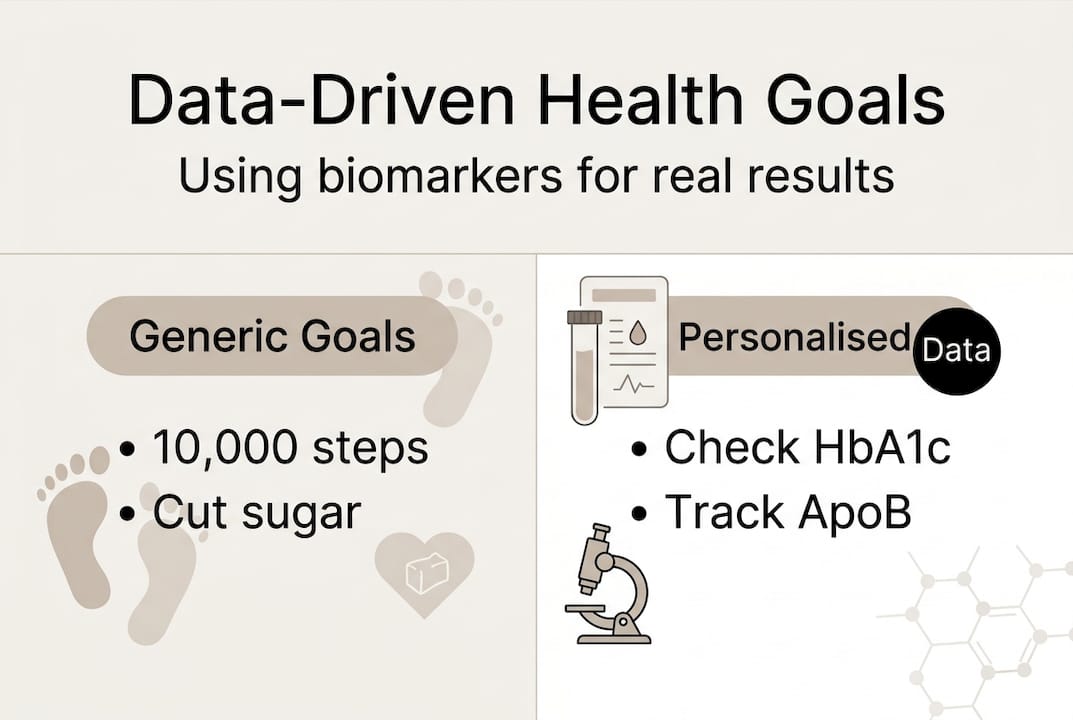
SMART goals break larger ambitions into actionable steps that are easier to sustain. A goal like “improve cardiovascular health” becomes “complete three 30-minute zone 2 cardio sessions per week for 12 weeks, targeting a 10% reduction in resting heart rate.” That is specific, measurable, and time-bound. Now add the biomarker layer: “reduce hsCRP from 3.2 to below 1.0 mg/L over the same period.” Suddenly you have a behavioural target and a biological benchmark working together.
Incremental goals such as 10 to 15 minutes of daily activity significantly increase motivation and adherence compared to large, sudden commitments. This is not a minor point. Starting with 10 to 15 minutes of daily movement and building from there is far more effective than committing to daily hour-long sessions that collapse within a fortnight.
Follow this step-by-step process to combine both approaches:
- Identify your primary biological priority from your baseline data. Is it insulin sensitivity, inflammation, hormonal balance, or cardiovascular risk?
- Set a biomarker target for that priority. Use clinical reference ranges as a minimum and optimal performance ranges as your actual goal.
- Design a SMART behavioural goal that directly supports the biomarker target. Link the behaviour to the biology explicitly.
- Break it into weekly milestones. Week one might be 10 minutes of resistance training daily. Week four might be 25 minutes with progressive load.
- Schedule your retest date before you start. Knowing when you will measure progress keeps the goal alive and accountable.
- Review and adjust at each retest point based on what the data shows, not what you feel.
Pro Tip: Weekly tracking of both behaviour and biomarker proxies (such as wearable HRV and sleep scores) yields significantly higher motivation and long-term adherence than monthly check-ins. The feedback loop keeps you engaged and responsive.
For practical frameworks on lifestyle changes for disease prevention, combining behavioural and biological targets is the approach that consistently produces durable results. The health optimisation steps that work long-term are always rooted in both layers simultaneously.
Troubleshooting common mistakes and making goals sustainable
Even with a solid framework, most people encounter predictable obstacles. Knowing what they are in advance gives you a significant advantage.
The most common mistakes when applying data-driven health goal frameworks include:
- Setting overambitious initial targets: Aiming to drop HbA1c by 20% in six weeks or lose 10 kg in a month creates a failure cycle that erodes confidence and consistency. Start with a 5 to 10% improvement in your target biomarker over 12 weeks.
- Neglecting to retest: Setting a goal based on baseline data and then never measuring again means you have no idea whether your protocol is working. Retesting is non-negotiable.
- Ignoring baseline data entirely: Many people set goals based on what they want to look like rather than what their biology actually needs. This leads to misaligned effort.
- Treating all biomarkers as equally urgent: Prioritise the markers with the highest impact on your specific risk profile. Not every number needs immediate intervention.
- Confusing effort with progress: Training harder or eating more restrictively does not automatically improve biomarkers. The data tells you what is actually moving.
Weekly progress tracking and incremental adjustments are the most reliable predictors of long-term sustainability. This applies to both behavioural habits and biological targets.
Pro Tip: Revisit and formally adjust your goals every 3 to 6 months based on new biomarker data. Your biology changes as your protocol works. A goal that was appropriate at baseline may need recalibrating once your insulin sensitivity improves or your inflammation markers normalise.
“Sustainability beats intensity every time. The individual who makes modest, consistent changes guided by data will always outperform the one who pursues aggressive short-term protocols without a feedback mechanism.”
Habit-building is the infrastructure beneath your goals. The goal tells you where to go; the habit is the vehicle that gets you there. Pair every biomarker target with a specific daily behaviour that is small enough to be non-negotiable. For effective lifestyle changes that stick, the behaviour must feel manageable even on your worst day.
What most guides miss: Adapting health goals for peak performance and longevity
Most health goal guides stop at the framework. They give you the SMART template, maybe a list of biomarkers to track, and leave you to figure out the rest. What they rarely address is the ongoing, iterative nature of true personalisation.
Your biology is not static. Stress, sleep, training load, seasonal variation, and ageing all shift your physiological baseline. A goal set in January based on your current cortisol and testosterone levels may be entirely inappropriate by July if your training volume or life circumstances have changed significantly. This is why we believe that AI in personalised wellness is not a trend but a necessity. Static protocols cannot keep pace with dynamic biology.
The individuals who achieve genuine high performance and longevity outcomes are those who treat goal-setting as a continuous process rather than a one-time event. Change is not linear. Plateaus are data points, not failures. Every retest gives you new information to refine your approach. That is not a flaw in the system. It is the system working exactly as it should.
Take the next step with personalised health testing
Understanding the framework is one thing. Having the data to make it work is another entirely.
At AI Healthician, we provide the precise biological data your goals need to be genuinely meaningful. Whether you are starting with DNA health testing to understand your genetic predispositions, using our 3D metabolic test to map your body composition and metabolic capacity, or running an RMR metabolic analysis to calibrate your energy expenditure with precision, each test gives you the coordinates your goals have been missing. Stop estimating. Start measuring.
Frequently asked questions
How do I know if my health goals are realistic?
Using objective biomarker data alongside the SMART framework for goal setting ensures your targets are grounded in your actual physiology rather than aspiration alone. If your baseline data supports the target, it is realistic.
How often should I retest my biomarkers when working towards health goals?
Retesting every 3 to 6 months allows you to monitor whether your protocol is shifting your biology in the intended direction and adjust your goals accordingly.
What types of biological data are most useful for personalised health goal setting?
Bloodwork covering HbA1c, lipids, and hormones, alongside genetic, microbiome, and wearable data such as HRV and sleep metrics, provides the most complete physiological picture for goal setting.
Is it better to set behaviour goals or biomarker targets?
Combining both creates the most effective protocol. SMART goals versus biomarker targets are not competing approaches. Behaviour goals drive daily action; biomarker targets confirm whether that action is producing real physiological change.
How can I track progress towards my health goals each week?
Monitoring wearable metrics daily and reviewing biomarker proxies weekly, combined with weekly tracking for motivation, keeps your feedback loop active and helps you identify when a goal needs recalibrating before you lose momentum.


