


 matt@aihealthician.co.uk


TL;DR:
- Proactive health management is an ongoing, personalized process using data to prevent disease before symptoms appear. It combines diagnostics, genetic profiling, and habit tracking to identify risks and tailor interventions. Balanced proactivity, guided by meaningful biomarkers, improves long-term resilience and outcomes.
Most people assume that booking more check-ups or ordering extra tests is what separates proactive health management from reactive care. It isn’t. 40% of chronic diseases are preventable through genuinely proactive strategies, yet the majority of people still wait for symptoms before acting. Real proactivity is a continuous, data-informed process built around your unique biology, not a one-off scan or an annual GP visit. This article defines what proactive health management actually means, examines the evidence that supports it, addresses the nuances most guides skip, and gives you a practical framework for turning biological data into daily action.
Table of Contents
- Defining proactive health management
- The science and evidence behind proactive strategies
- Critical nuances: balancing proactivity and practicality
- Personalising proactive health: from data to daily action
- Why most people misunderstand proactive health management
- Personalised health solutions to take the next step
- Frequently asked questions
Key Takeaways
| Point | Details |
|---|---|
| Data-driven prevention | Proactive health means using real metrics to prevent disease, not just reacting to symptoms. |
| Balance is key | The most effective care blends regular check-ins and data review without going overboard. |
| Personalisation matters | Tailored plans and diagnostics offer greater results than generic health advice. |
| Evidence supports action | Up to 40% of chronic diseases can be avoided with the right proactive measures. |
Defining proactive health management
Proactive health management is an ongoing, personalised process of identifying risk, tailoring interventions, and continuously refining your approach using objective data. It is not the same as simply attending more appointments or buying the latest wearable. The role of preventative health sits at its core: acting before dysfunction appears rather than treating it after it does.
The contrast with reactive healthcare is stark. Reactive care responds to symptoms, diagnoses conditions, and prescribes treatment. Proactive management uses advanced diagnostics, such as metabolic panels, DNA testing, and continuous health metric tracking, to identify vulnerabilities long before they become clinical problems.
| Feature | Proactive management | Reactive care |
|---|---|---|
| Timing | Before symptoms appear | After symptoms appear |
| Goal | Prevention and optimisation | Diagnosis and treatment |
| Tools | Diagnostics, genetics, wearables | Clinical tests, imaging |
| Frequency | Ongoing and iterative | Episode-based |
| Outcome focus | Long-term resilience | Immediate recovery |
A practical proactive framework follows three phases:
- Stratify risk: Identify your personal disease vulnerabilities using genetic, metabolic, and lifestyle data
- Tailor interventions: Build targeted protocols around nutrition, movement, sleep, and supplementation
- Monitor and refine: Track biomarkers over time and adjust based on results, not assumptions
Importantly, proactive management does not replace reactive care. Proactive behaviours integrate with acute treatment when needed. If you sustain an injury or develop an infection, reactive medicine is exactly what you need. The two approaches work best together, not in competition.
The science and evidence behind proactive strategies
With definitions in place, real-world evidence shows how proactive management changes outcomes, sometimes even the course of entire populations.
The numbers are striking. Up to 40% of chronic diseases are preventable through proactive strategies, and China’s national stroke prevention programme demonstrated a 12% reduction in stroke incidence through structured, population-level proactive health initiatives. These are not marginal gains.
| Intervention type | Disease risk reduction | Key health improvement |
|---|---|---|
| Metabolic monitoring | Up to 35% reduction in type 2 diabetes risk | Improved insulin sensitivity |
| Genetic risk profiling | Earlier detection of cardiovascular risk | Targeted lifestyle modification |
| Structured lifestyle protocols | 20-30% reduction in all-cause mortality risk | Enhanced energy and resilience |
| Proactive stroke programmes | 12% stroke incidence reduction | Improved neurological outcomes |
Evidence is particularly strong for high-risk groups: older adults, those with family histories of cardiovascular or metabolic disease, and women navigating hormonal transitions. Comprehensive practitioners working with these groups see the clearest benefit from lifestyle changes for disease prevention when interventions are guided by actual data rather than generic advice.

What makes targeted health strategies so much more effective than broad wellness recommendations is specificity. A person with elevated homocysteine and a genetic variant affecting folate metabolism needs a very different protocol to someone with normal markers and no family history. Generic advice serves neither well.
Pro Tip: Before overhauling your lifestyle, start with a risk profile. Knowing where your vulnerabilities actually lie means every change you make has a measurable purpose rather than being a shot in the dark.
Critical nuances: balancing proactivity and practicality
While the science is promising, effective proactive health management depends on the right level of engagement. Here is what most guides miss.
More is not always better. Moderate proactivity maximises benefits, while excessive check-ups and constant monitoring can actually reduce care quality, increase health anxiety, and lead to unnecessary interventions. The goal is clarity and direction, not obsession.
There are also real gaps in health literacy and access to technology. Not everyone can interpret a continuous glucose monitor readout or understand what a polygenic risk score means. Without proper interpretation, data becomes noise.
The optimal approach blends regular, meaningful review with the freedom to live your life. Health management should inform your decisions, not dominate them.
Here is a numbered framework for finding your personal sweet spot:
- Establish a baseline: Complete a thorough initial assessment covering metabolic, genetic, and lifestyle factors
- Set a review cadence: Quarterly or biannual check-ins are sufficient for most; monthly for those managing active conditions
- Prioritise signal over noise: Focus on biomarkers with strong predictive value, not every available metric
- Work with a specialist: Health optimisation protocols are most effective when guided by someone who can contextualise your data
- Adjust, don’t overreact: A single out-of-range result is rarely cause for alarm; trends over time matter far more
Pro Tip: Quality outweighs quantity every time. A focused panel of meaningful biomarkers reviewed consistently will tell you far more than a scattergun approach to testing. Use a step-by-step optimisation framework to build structure without overwhelm.
Personalising proactive health: from data to daily action
This is where the approach becomes concrete. Here is how you turn biological insight into action that actually fits your life.
Personalisation starts with health risk profiling, which maps your genetic predispositions, current metabolic status, and lifestyle exposures onto a single picture of your risk landscape. From there, interventions can be ranked by impact and feasibility rather than guesswork.
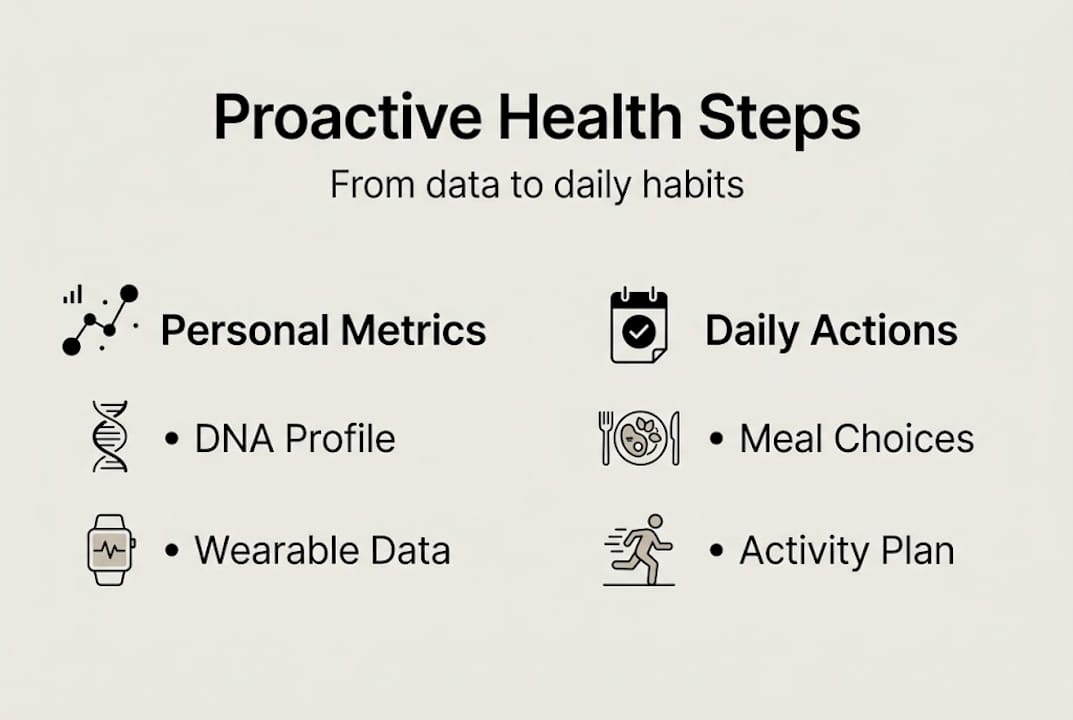
Genetic data tells you what you are predisposed to. Metabolic data tells you what is actually happening right now. Wearable data tells you how your daily habits are influencing both. Used together, they create a feedback loop that makes setting precise health goals genuinely achievable rather than aspirational.
The PHM cycle of stratify, tailor, and evaluate has been shown to improve equity in health outcomes, though implementation gaps and limitations in early warning systems remain real challenges. The practical implication: the framework works, but it requires thoughtful application and honest evaluation of what your data can and cannot tell you.
A practical week of proactive habits might look like this:
- Monday: Review last week’s sleep and HRV (heart rate variability) trends from your wearable
- Wednesday: Log dietary intake against your metabolic targets for a single day to check alignment
- Friday: Complete your structured exercise session based on your recovery score, not a fixed schedule
- Sunday: Spend ten minutes reviewing your energy, mood, and performance against your weekly goals
Understanding the role of data in diagnostics is essential here. Raw numbers without context are misleading. Learning to analyse your health data in relation to your own baseline, rather than population averages, is what separates meaningful insight from noise.
Why most people misunderstand proactive health management
Stepping back from the practical steps, the most common failure in proactive health management is treating it as a checklist rather than a mindset. People complete a DNA test, feel briefly informed, and then return to the same habits. Nothing changes because the data was never integrated into a living, evolving strategy.
Mainstream guides also overstate the immediate cost savings of going proactive. The evidence on actual costs and outpatient use is genuinely mixed, and real success requires a cultural shift in how you relate to your own health, not just a financial calculation. The value is in long-term resilience and performance, not a short-term return on investment.
What actually drives sustained success is a combination of reasonable habits, smart data application, and patience. AI in health strategies is accelerating the personalisation of this process, but technology is a tool, not a substitute for consistent, informed action. The people who see the greatest long-term gains are not those chasing every new test or trend. They are the ones who build a coherent, evidence-based system and stick to it.
Personalised health solutions to take the next step
Putting proactive health management into practice requires more than intention. It requires the right tools, the right data, and expert guidance to make sense of both.
At AI Healthician, we offer DNA health testing and active metabolic analysis to give you a precise picture of your biological starting point. For those ready to build a complete, long-term strategy, The Longevity Blueprint combines advanced diagnostics with one-to-one expert consultation to create a protocol built entirely around your data. If you are ready to move from knowing to doing, this is where that journey starts.
Frequently asked questions
What is proactive health management in simple terms?
It means taking ongoing, data-driven steps to prevent illness, reduce risk, and maximise your health rather than waiting to react to problems as they arise.
Does proactive health management really prevent diseases?
Yes. Evidence shows up to 40% of chronic diseases are preventable with proactive strategies, particularly when interventions are guided by individual biological data rather than population-level recommendations.
Is there such a thing as too much proactivity?
Yes. Research found that excessive check-ups reduce care quality and can increase health anxiety; a balanced, personalised plan focused on meaningful biomarkers consistently outperforms high-volume testing.
Who benefits most from proactive health management?
People at higher risk, such as older adults or those with a family history of chronic conditions, see the greatest gains, but a tailored approach delivers measurable benefits across all demographics when implemented correctly.
What tools are essential for a proactive approach?
Personalised risk assessments, genetic and metabolic tests, and habit-tracking devices are the foundation, but risk profiling and tailored interventions only deliver results when the data is properly interpreted and built into a coherent action plan.
Recommended
- Step-by-step health optimisation for peak performance – Aihealthician
- Top health optimisation protocols for longevity in 2026 – Aihealthician
- Metabolic Health Improvement Workflow for Peak Performance – Aihealthician
- Role of Preventative Health – Personalised Strategies For Longevity – Aihealthician


