


 matt@aihealthician.co.uk


Most people trying to improve their health are doing the right things in the wrong order. They track calories, buy supplements, and wear the latest devices, yet their energy, body composition, and biomarkers barely shift. The problem is rarely effort. It is the absence of a structured, data-driven framework that accounts for your unique physiology. Generic advice produces generic results. What actually moves the needle is a repeatable, evidence-informed process: assess, plan, execute, and iterate. This article walks through each stage so you can stop guessing and start making measurable, lasting progress.
Table of Contents
- Start with a comprehensive baseline assessment
- Develop your personalised action plan for quick gains
- Implement and refine: track nutrition, exercise, and supplements
- Monitor results and iterate your protocols for true optimisation
- What most get wrong about health optimisation (and how to do it right)
- Take the first step beyond generic advice
- Frequently asked questions
Key Takeaways
| Point | Details |
|---|---|
| Start with diagnostics | Baseline testing is the cornerstone of an effective and personalised plan. |
| Target big levers | Make meaningful change by focusing on sleep, activity, nutrition, and stress first. |
| Personalisation matters | Track your metrics and adjust habits to suit your unique physiology. |
| Iterate for results | Regularly review and refine your protocol for continual improvement. |
Start with a comprehensive baseline assessment
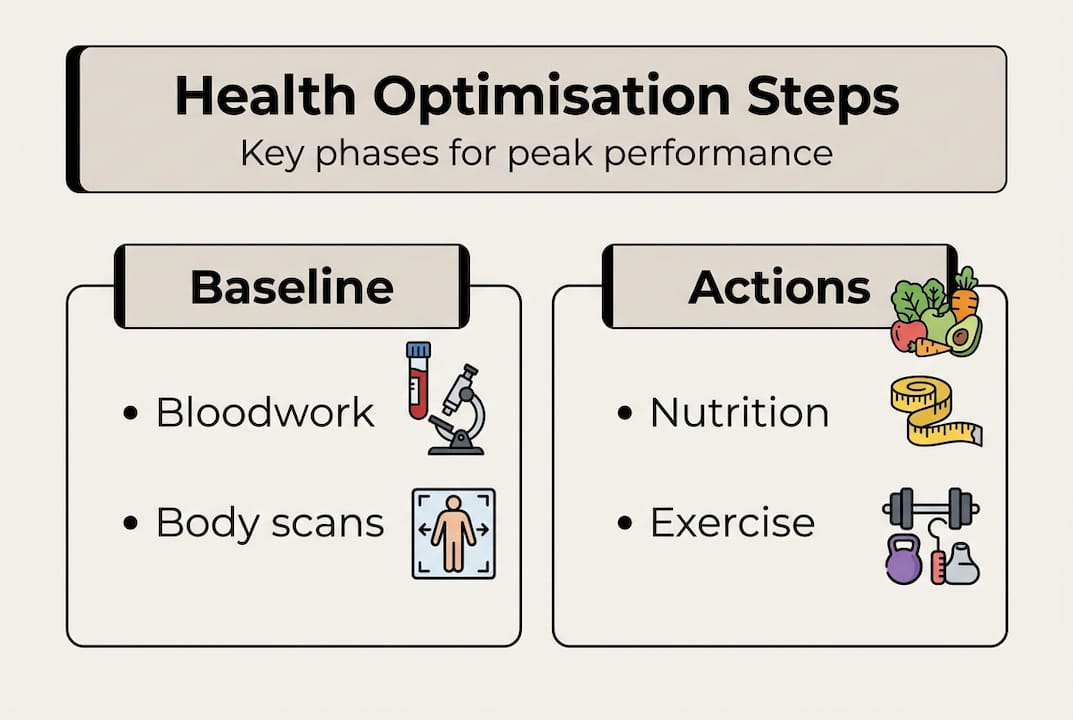
You cannot optimise what you have not measured. This sounds obvious, yet most people skip straight to interventions without any objective data about where they currently stand. A proper baseline does not mean a single cholesterol reading. It means building a full physiological picture across multiple systems.
The most clinically relevant blood biomarkers to capture include fasting glucose, HbA1c, a full lipid panel with ApoB, high-sensitivity CRP (a marker of systemic inflammation), and a hormone panel covering cortisol, testosterone, SHBG, and thyroid function. New thinking on blood tests supports expanding beyond standard panels to include markers that better predict long-term risk. These give you a metabolic fingerprint that no generic protocol can replicate.
Beyond blood work, advanced diagnostics such as DEXA body composition scanning, resting metabolic rate (RMR) testing, and VO2 max assessment add crucial layers. DEXA reveals visceral fat and lean mass distribution with precision that a bathroom scale simply cannot. RMR tells you how many calories your body actually burns at rest, not what an algorithm estimates. VO2 max is one of the strongest predictors of cardiovascular longevity available.
Wearables fill the continuous monitoring gap. Sleep staging data, heart rate variability (HRV), and daily step counts give you behavioural context that blood tests alone cannot provide.
| Diagnostic | Key markers | Target range | Review frequency |
|---|---|---|---|
| Blood biomarkers | Glucose, HbA1c, ApoB, CRP | Glucose <5.6 mmol/L, HbA1c <39 mmol/mol | Every 3 to 6 months |
| Body composition | Visceral fat, lean mass | Visceral fat rating <13 | Every 6 months |
| Metabolic rate | RMR, VO2 max | VO2 max >50 mL/kg/min (active adults) | Annually |
| Wearable data | HRV, sleep stages, steps | HRV trending upward, 7 to 9 hrs sleep | Ongoing |
Once collected, consolidate everything into a personal health profile. This becomes your reference document. Every intervention you make should trace back to a specific gap identified in this profile. Reviewing essential health diagnostics can help you prioritise which tests to run first based on your risk profile and goals.
Pro Tip: Do not skip the baseline because it feels expensive or time-consuming. Without it, you are making decisions blind. The baseline is the single investment that makes every subsequent decision more accurate and cost-effective.
Develop your personalised action plan for quick gains
Once your baseline is clear, you need a tactical plan. Here is how to design it for success.
The biggest mistake at this stage is trying to change everything at once. Instead, focus on the four levers with the greatest physiological return: sleep, nutrition, exercise, and stress management. Each should be addressed with SMART goals tied directly to your biomarker gaps.
Here is a step-by-step process for building your initial plan:
- Anchor your sleep schedule. Aim for 7 to 9 hours with a consistent wake time. Poor sleep elevates cortisol, disrupts glucose regulation, and blunts recovery. Fix this first.
- Set a protein target. Research supports 1.6g per kilogram of bodyweight daily to preserve lean mass and support metabolic rate.
- Build your exercise base. Start with 150 minutes per week of Zone 2 cardio (conversational pace) combined with two to three resistance training sessions. This combination improves insulin sensitivity and cardiovascular capacity simultaneously.
- Address stress systematically. Elevated cortisol directly impairs glucose metabolism and sleep quality. Identify your top two stress sources and assign a mitigation strategy to each.
- Set a body composition target. Even modest weight loss of 3 to 5% meaningfully reduces insulin resistance, making this an early priority for anyone with elevated fasting glucose.
It is worth noting that self-care fundamentals consistently outperform cutting-edge interventions when the basics are not yet solid. No supplement or device replaces consistent sleep, structured training, and adequate protein. There is no universal optimum either. Your plan must reflect your data, not someone else’s protocol.
For context on how these habits connect to longer-term outcomes, explore disease prevention strategies and what metabolic health actually means at a physiological level.
Pro Tip: Use habit stacking to make new behaviours automatic. Attach a new habit to an existing one. For example, take your omega-3 supplement immediately after your morning coffee. Small anchors prevent the plan from collapsing under daily friction.
Implement and refine: track nutrition, exercise, and supplements
With your action plan in hand, success depends on smart execution and ongoing refinement.

The metrics worth monitoring daily or weekly go beyond weight. Track blood pressure, waist-to-height ratio, subjective energy levels, and training performance. These give you real-time signals that your interventions are working before your next blood panel.
For nutrition, personalised eating strategies consistently outperform generic dietary templates. A few high-impact tactics backed by evidence:
- Eat fibre and protein before carbohydrates at each meal to blunt post-meal glucose spikes without eliminating any food groups.
- Consider time-restricted eating (typically an 8 to 10 hour eating window) if your fasting glucose or HbA1c is elevated. This approach improves insulin sensitivity and reduces caloric intake naturally.
- Prioritise whole food protein sources at breakfast to reduce mid-morning energy crashes and support lean mass retention.
- Supplement only where deficient. Omega-3 fatty acids (if ApoB or triglycerides are high), vitamin D (if serum levels are below 75 nmol/L), and magnesium (if sleep quality is poor) are the three most commonly indicated.
For exercise, use VO2 max as your north star. Model your current trajectory using age-related decline rates and work backwards to set annual targets. This is called backcasting, and it turns a vague goal like “get fitter” into a specific weekly training prescription.
The metabolic workflow and step-by-step metabolic improvement resources can help you sequence these interventions in the right order for your specific profile.
Pro Tip: A continuous glucose monitor (CGM) worn for two to four weeks gives you personalised data on which foods and meal timings spike your glucose most. This single tool often changes dietary behaviour more effectively than any generic nutrition plan.
Monitor results and iterate your protocols for true optimisation
No plan is perfect out of the gate. Continuous feedback enables lasting success.
Retest your core biomarkers every 3 to 6 months. This interval is long enough for meaningful physiological change to occur, but short enough to catch problems before they compound. Use the comparison below to guide your review cycle:
| Metric | Retest frequency | Signal to act |
|---|---|---|
| Fasting glucose and HbA1c | Every 3 months | No improvement after 12 weeks of dietary change |
| ApoB and lipid panel | Every 6 months | ApoB above 0.9 g/L despite lifestyle changes |
| VO2 max | Every 6 to 12 months | Plateau or decline despite consistent training |
| Body composition (DEXA) | Every 6 months | Lean mass loss alongside fat loss |
| HRV and sleep staging | Ongoing via wearable | Sustained downward HRV trend over 2 weeks |
Data from Holistic Performance Teams demonstrated a 61% reduction in musculoskeletal injury rates and an 8:1 return on investment through structured, iterative monitoring protocols. The methodology is directly applicable to individual health optimisation.
“Test-Act-Track-Refine is the missing loop in health optimisation.”
This cycle, supported by stepwise personalisation research, consistently outperforms generic advice because it treats your body as a dynamic system rather than a fixed problem to solve once.
When your data plateaus or you hit a barrier you cannot explain, that is the signal to seek expert input. A personalised diagnostic re-assessment can reveal whether you need a protocol adjustment, a new diagnostic layer, or simply more time.
Here is how to structure each review cycle:
- Pull together all data: blood results, wearable trends, training logs, and body composition.
- Compare against your baseline and previous review.
- Identify the one or two metrics furthest from target.
- Adjust only the interventions tied to those specific gaps.
- Set a date for the next review before closing the current one.
What most get wrong about health optimisation (and how to do it right)
The most common pattern we see is people investing in the most sophisticated tools before they have mastered the most basic behaviours. They buy a CGM before they have consistent sleep. They spend money on peptides before they are hitting their protein target. They optimise their HRV score while chronically under-recovering.
Fundamentals consistently outperform cutting-edge interventions when the foundations are absent. There is no shortcut around this. The physiology does not care how expensive your protocol is.
What actually works is layering. Get your sleep, protein, and training consistent first. Then use diagnostics to identify the specific gaps that lifestyle alone cannot close. Then, and only then, introduce targeted supplementation or advanced tools. This sequence feels slower but produces compounding results rather than expensive dead ends.
Personalisation also means accepting that your optimal is not someone else’s. What works brilliantly for one person’s glucose regulation may do nothing for yours. This is not a failure of the method. It is the method working correctly, revealing what your physiology actually needs.
Take the first step beyond generic advice
You now have the framework. But knowing the steps and executing them with precision are two different things. Expert-guided diagnostics and tailored protocols can compress months of trial and error into a clear, targeted plan from day one.

At AI Healthician, we combine functional testing with evidence-informed strategy to build protocols around your biology, not population averages. Whether you start with the Longevity Blueprint consultation, an Active Metabolic Analysis to establish your true metabolic baseline, or DNA Health Testing for genetic insight, each pathway is designed to give you data that generic advice simply cannot provide.
Frequently asked questions
Which blood tests matter most for health optimisation?
Fasting glucose, HbA1c, a full lipid panel including ApoB, inflammation markers such as high-sensitivity CRP, and key hormones form the essential comprehensive baseline for meaningful health optimisation.
How often should you retest your biomarkers?
Retesting every 3 to 6 months gives you enough time for genuine physiological change to occur while keeping your feedback loop tight enough to course-correct before problems compound.
Is it better to start with basics or advanced supplements?
Mastering the basics of sleep, nutrition, and exercise consistently delivers greater results than starting with advanced or experimental interventions when the foundations are not yet established.
Can wearables and apps really help personalise health?
Yes. Wearables provide continuous data on sleep staging, HRV, and activity patterns that blood panels alone cannot capture, allowing you to tailor recovery and training strategies in real time.


