


 matt@aihealthician.co.uk


TL;DR:
- Personalised health protocols address individual genetic, physiological, and environmental differences more effectively than generic guidelines.
- They use diverse data sources and AI models to create tailored interventions, improving outcomes in mental health, chronic disease, and performance.
- However, limitations include high costs, access disparities, validation gaps, AI bias, and privacy concerns.
Most people assume that following general health guidelines is enough. Eat well, exercise regularly, sleep eight hours. Yet multifactorial disease heterogeneity means that what works brilliantly for one person can be entirely ineffective, or even counterproductive, for another. Your genome, your gut microbiome, your stress exposures, and your metabolic quirks are yours alone. Generic protocols were never designed with that in mind. In this article, we break down why standardised approaches fall short, how personalised health protocols actually work, what the evidence shows about real-world outcomes, and what honest limitations you should factor into any decision.
Table of Contents
- Why one-size-fits-all health approaches fall short
- How personalised health protocols work
- Evidence: Real-world benefits of personalised protocols
- Limitations and ethical considerations
- Our take: What personalisation means for your health journey
- Taking the next step: Personalised protocols for you
- Frequently asked questions
Key Takeaways
| Point | Details |
|---|---|
| Personalisation outperforms generic | Protocols based on your biology get better results than one-size-fits-all health plans. |
| Data and technology enable tailoring | Genetic tests, biomarkers, and AI now make evidence-based custom guidance possible. |
| Clear benefits and real challenges | Outcomes improve, but access, equity, and evidence quality still need work. |
| Balance high-tech with habits | For lasting benefit, combine personalisation with consistent healthy routines. |
Why one-size-fits-all health approaches fall short
The appeal of a universal health plan is obvious. Simple rules feel manageable. But human biology is not uniform, and the gap between a standard recommendation and what your body actually needs can be enormous.
Individual differences that determine health outcomes span several dimensions:
- Genetics: Variants in genes like MTHFR, APOE, and ACTN3 influence everything from cardiovascular risk to how efficiently you recover from training.
- Environment and exposome: Pollution, toxin exposure, and socioeconomic stressors shape disease risk in ways that a generic diet plan cannot address.
- Behaviour and psychology: Adherence patterns, stress responses, and sleep architecture vary dramatically between individuals.
- Physiology: Metabolic rate, hormonal baselines, and inflammatory markers differ even among people of identical age, sex, and weight.
Research confirms that personalised protocols address genetic, molecular, physiological, behavioural, and exposure heterogeneity in ways that population-level guidelines simply cannot. In chronic disease management, one standardised drug dose produces wildly different blood concentrations across patients. In sport, a single periodisation model applied to a team will optimise some athletes while overtraining others. In mental health, a blanket first-line antidepressant works for roughly half of patients at best.
“The failure of one-size-fits-all is not a failure of medicine. It is a failure to account for the biological complexity that makes each person distinct.”
This is not a fringe argument. It is the scientific consensus driving a shift towards health optimisation for longevity at both clinical and performance levels. The question is no longer whether personalisation matters. It is how to implement it rigorously.
How personalised health protocols work
Personalisation is not simply choosing between two diet plans. It is a structured process that draws on multiple data streams, synthesises them intelligently, and translates findings into targeted interventions.
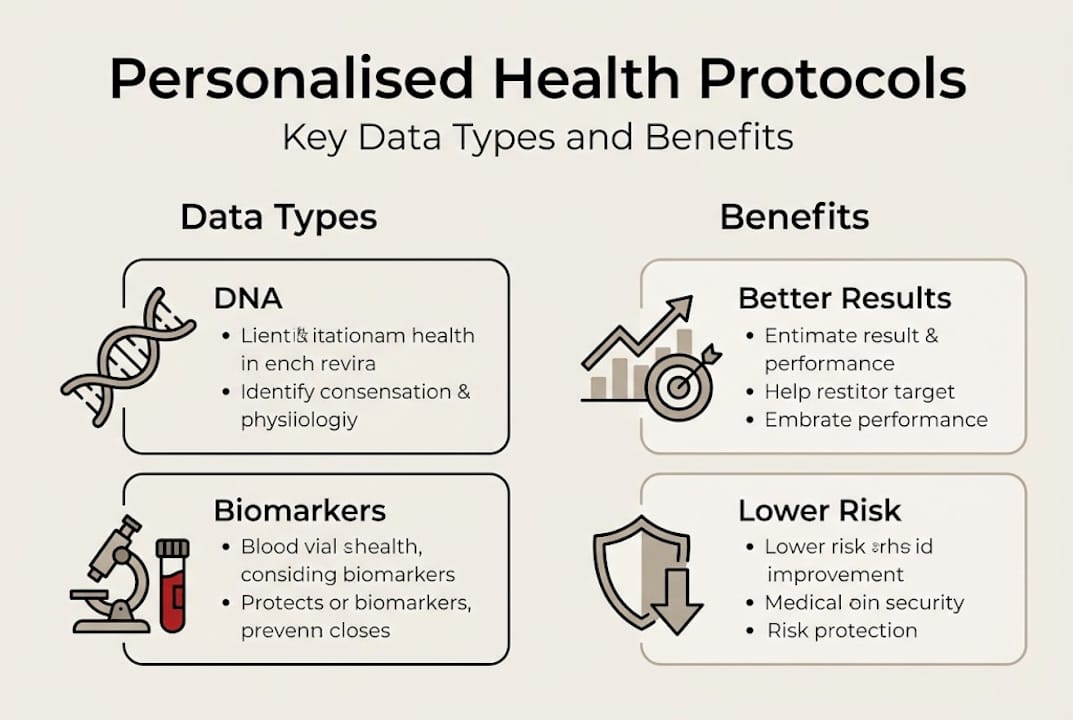
The main data sources include:
| Data type | What it reveals |
|---|---|
| DNA sequencing | Genetic predispositions, nutrient metabolism, injury risk |
| Proteomics and metabolomics | Real-time biological function and stress markers |
| Wearable and activity data | Sleep quality, HRV, training load, recovery patterns |
| Nutritional tracking | Macro and micronutrient gaps relative to your physiology |
| Exposome data | Environmental toxin burden, circadian disruption, air quality |
High-throughput assays including DNA sequencing and proteomics, combined with AI and digital twin modelling, now allow clinicians and performance specialists to synthesise these inputs into protocols that are genuinely tailored. A digital twin is a computational model of your physiology that can simulate how your body is likely to respond to a given intervention before you try it. This is not science fiction. It is being applied in cardiovascular medicine, oncology, and elite sport right now.
The process from raw data to actionable recommendations typically follows these steps:
- Baseline data collection: Functional blood panels, genetic testing, wearable data, and lifestyle questionnaires.
- Biological data analysis: Identifying patterns, deficiencies, and risk signals. Biological data analysis examples show how these patterns translate into specific intervention targets.
- AI-assisted synthesis: Algorithms cross-reference your data against clinical literature to generate ranked recommendations.
- Protocol design: A structured plan covering nutrition, supplementation, training, sleep, and stress management, calibrated to your biology.
- Iterative review: Biomarkers are re-tested at intervals to measure response and refine the protocol. AI for personalised wellness is making this cycle faster and more precise.
Pro Tip: Most people interpret a single biomarker in isolation. The real signal comes from the pattern across multiple markers. A low ferritin reading means something very different when paired with elevated CRP versus when it appears alongside normal inflammatory markers. Always read your biomarker analysis for health in context, not in isolation.
Evidence: Real-world benefits of personalised protocols
The science here is not theoretical. Measurable, reproducible improvements are being documented across mental health, chronic disease, and physical performance.
Key benefits supported by empirical data include:
- Mental health: Improved treatment matching in mental health care shows that personalising antidepressant selection based on genetic and psychological profiling significantly outperforms trial-and-error prescribing.
- Chronic disease: Crohn’s disease patients show dramatically different drug responses based on genetic and microbiome profiles, making personalised selection far more effective than standard first-line therapy.
- Physical performance: Tailored exercise interventions produce superior VO2 max gains, strength adaptations, and recovery outcomes compared to generic training plans. Functional health tests for athletes, such as those outlined in types of functional health tests, are central to this process.
| Outcome area | Standard approach | Personalised approach |
|---|---|---|
| Cardiovascular risk | Population-level thresholds | Individual ApoB, Lp(a), and metabolic profiling |
| Exercise adaptation | Generic periodisation | HRV-guided, genotype-informed training loads |
| Medication response | Trial and error | Pharmacogenomic-matched selection |
| Nutritional status | RDA-based guidelines | Metabolomic gap analysis and targeted repletion |
The performance data is particularly striking. A VO2 max increase of 3.5 mL/kg/min correlates with a 13% reduction in all-cause mortality. Separately, 90% of members following structured personalised protocols lowered their ApoB by 29 mg/dL, a cardiovascular risk marker that standard care often overlooks entirely. Tracking metabolic markers for recovery sits at the heart of achieving these results consistently.

Limitations and ethical considerations
Personalised health protocols are powerful. They are not, however, without real and important limitations. Honest engagement with these challenges is what separates credible services from overhyped ones.
The primary limitations include:
- Cost and access: Comprehensive genetic testing, proteomics, and AI-driven analysis remain expensive. High costs and access disparities mean that personalised medicine is still largely available to those with financial resources, creating equity concerns.
- Validation gaps: Not every personalised intervention has robust randomised controlled trial evidence behind it. Some recommendations rest on mechanistic plausibility rather than proven clinical outcomes.
- AI bias: Algorithms trained on non-diverse datasets can produce recommendations that are less accurate for underrepresented populations.
- Privacy: Genomic and health data carries significant sensitivity. How it is stored, shared, and potentially monetised is a legitimate concern.
- Overhyped interventions: The wellness industry moves fast. Some products marketed as personalised have little more than a questionnaire behind them.
Precision health experts consistently note that AI is promising but requires human oversight, and that precise interventions work best when combined with broad, population-level health strategies rather than replacing them. Personalisation does not mean abandoning sleep hygiene, social connection, or physical activity. It means layering targeted precision on top of those foundations.
Pro Tip: Before committing to any personalised protocol, ask three questions. Is there peer-reviewed evidence supporting this intervention? Is the data handling transparent and secure? Does the service combine AI recommendations with qualified clinical review? If the answer to any of these is unclear, proceed with caution. Reviewing AI health trends and advanced insights on health longevity can help you separate signal from noise.
Our take: What personalisation means for your health journey
Here is the uncomfortable truth that most personalised health services will not tell you: data alone does not change your biology. What changes your biology is what you do with it, consistently, over time.
We have seen clients arrive with immaculate test results and zero follow-through. We have seen others with modest data take targeted action and achieve measurable improvements in cardiovascular risk, energy, and body composition within twelve weeks. The difference is never the sophistication of the test. It is the quality of the protocol built from it, and the discipline applied to executing it.
Personalisation is most powerful when it gives you agency, not dependency. Understanding your biomarkers analysis guide should make you a more informed, more motivated participant in your own health, not a passive recipient of algorithmic outputs. The technology is genuinely transformative. But it works best as a tool that sharpens your decision-making, not one that replaces it. Avoid chasing the next breakthrough test until you have fully acted on the insights you already have.
Taking the next step: Personalised protocols for you
The evidence is clear. Personalised health protocols outperform generic plans across performance, disease prevention, and longevity markers. But knowing that is only the beginning.
At AI Healthician, we translate your biological data into precise, actionable protocols grounded in clinical evidence. Whether you are starting with a longevity blueprint consultation, exploring DNA health testing to understand your genetic predispositions, or using an active metabolic test to optimise your training and recovery, every step is guided by your data and reviewed by qualified specialists. This is not wellness advice. It is targeted, measurable intervention built around your biology.
Frequently asked questions
What are personalised health protocols?
Personalised health protocols are plans tailored to your unique genetic and biological profile, covering prevention, performance, and longevity goals with interventions matched to your specific physiology rather than population averages.
What types of data inform personalised protocols?
Genetic tests, biomarker panels, lifestyle tracking, and environmental data all feed into custom recommendations. DNA sequencing and proteomics are among the most informative inputs, alongside psycho-behavioural and nutritional data.
Are personalised health protocols more effective than standard plans?
Yes, in most measured areas. Improved treatment matching in mental health, superior drug response in Crohn’s disease, and better exercise outcomes all demonstrate that personalised approaches consistently outperform generic ones.
What are the downsides or risks of personalised protocols?
High costs and access disparities remain significant barriers, alongside validation gaps for some interventions, AI bias in underrepresented populations, and genuine privacy concerns around genomic data.
Who benefits most from personalised health protocols?
Those with chronic illness, complex health needs, or ambitious performance and longevity goals gain the most. Personalised protocols improve outcomes most dramatically where standard approaches have already failed to deliver meaningful results.


