


 matt@aihealthician.co.uk


TL;DR:
- AI systems are personalising health data to significantly improve energy, recovery, and resilience.
- Combining multiple data sources creates more accurate, actionable health models than single-device tracking.
- Trustworthy platforms include human oversight, validated outcomes, and transparent data integration.
AI-driven health optimisation is no longer a concept reserved for clinical trials or Silicon Valley biohackers. In 2026, multimodal and agentic AI systems are producing documented, measurable improvements in energy, recovery, and resilience for individuals who choose the right platforms. The gap between hype and reality is closing fast, but it is closing unevenly. Not every tool delivers, and not every claim holds up under scrutiny. This article cuts through the noise to show you what is genuinely working, where the risks lie, and how to position yourself to benefit from the most significant shift in personal health optimisation in a generation.
Table of Contents
- The new era: How AI is personalising energy, recovery, and wellness data
- AI agents in action: From automation to daily performance enhancement
- Limits and risks: Understanding bias, drift, and real-world reliability
- Building trust: Data platforms, governance, and safe AI for optimal wellness
- Why personal AI for health is powerful—but not foolproof
- Advance your wellness: Next steps with AI-powered personal health
- Frequently asked questions
Key Takeaways
| Point | Details |
|---|---|
| Data-driven personalisation | AI in 2026 empowers you with tailored health plans by integrating wearable, genetic, and lifestyle data. |
| Human and AI partnership | Maximum benefit comes from using AI systems that include clinician checks, not automation alone. |
| Trustworthy platforms matter | Select validated, transparent AI health solutions with measurable results for better wellness and safety. |
| Beware of blind spots | Understand current AI limitations, including bias and accuracy drift, and focus on safe adoption. |
The new era: How AI is personalising energy, recovery, and wellness data
The shift from generic wellness advice to genuinely personalised health guidance is being driven by AI’s ability to synthesise data streams that would overwhelm any single clinician. Wearables, lab results, genomic markers, sleep patterns, and lifestyle inputs are now being fused into dynamic health models, often called digital twins, that update in real time as your biology changes.
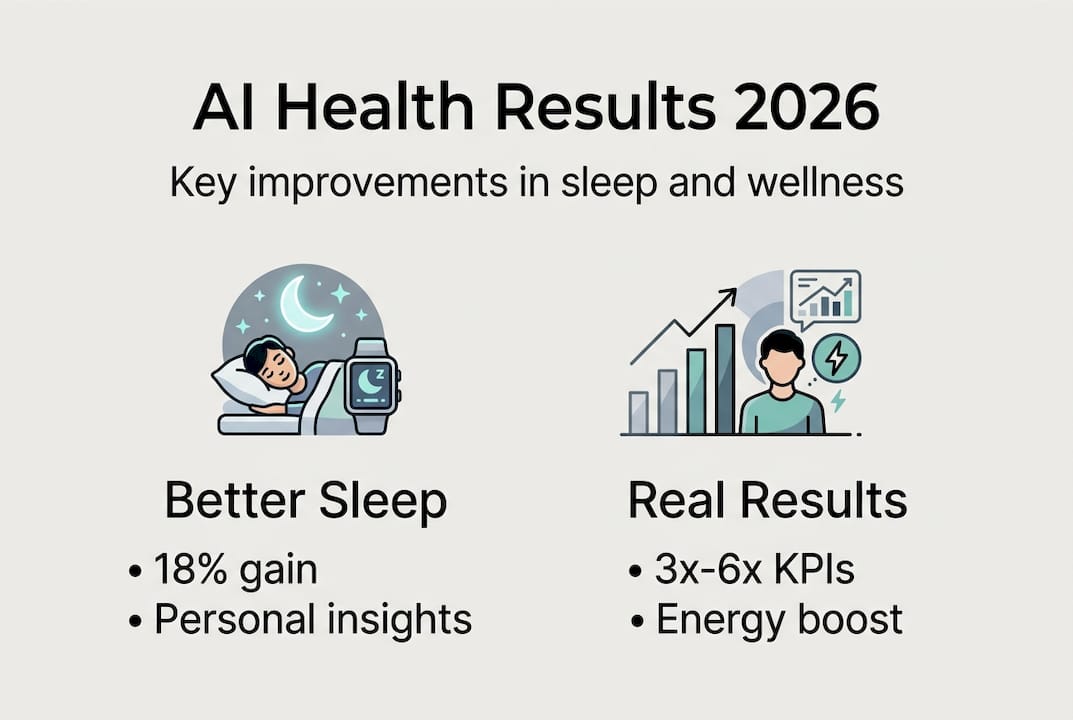
The results are not trivial. Multimodal AI platforms are delivering 3 to 6 times KPI improvement, alongside 18% better deep sleep and 14% gains in reported energy levels. Recovery metrics improve by roughly 9% when AI coaching is integrated consistently. These are not averages pulled from a controlled lab. They reflect real-world users following AI-guided protocols.
What makes this possible is the move away from single-device tracking. A fitness ring measuring heart rate variability tells one story. Combine that with cortisol patterns from a saliva test, inflammatory markers from a blood panel, and genetic variants affecting your circadian rhythm, and the picture becomes far more actionable. This is the foundation of personalised wellness strategies that actually shift your physiology rather than just tracking it.
Key capabilities driving these improvements include:
- Real-time adaptive coaching that adjusts recommendations as your data changes
- Proactive risk flagging before symptoms appear, based on trend analysis across multiple biomarkers
- Circadian and metabolic modelling that personalises timing of nutrition, exercise, and recovery
- Genomic integration that accounts for individual variation in drug metabolism, nutrient absorption, and stress response
“The most significant gains come not from any single data source, but from the synthesis of multiple streams into a coherent, individual-specific model.”
For those serious about data-driven wellness, the practical implication is clear: avoid platforms that rely on a single device or a single data type. The quality of your health intelligence is directly proportional to the breadth and accuracy of the data feeding it. Understanding how analysing health data translates into actionable protocols is what separates meaningful optimisation from expensive number-watching.
AI agents in action: From automation to daily performance enhancement
AI agents are a step beyond passive monitoring. They act. They send behavioural nudges, close care gaps, reschedule missed appointments, and flag when your patterns suggest you are heading towards a stress-related performance dip. The automation is precise, timely, and increasingly effective.

The data on this is compelling. AI agents in health settings are now automating care-gap closure, scheduling, and targeted nudges, with outcomes showing 10 to 20% higher response rates and a 30 to 40% boost in health documentation accuracy. For individuals using these tools personally, that translates to fewer missed interventions and more consistent follow-through on the protocols that actually move the needle.
What distinguishes the best implementations is the clinician-in-the-loop model. AI handles the routine, the repetitive, and the time-sensitive. A qualified practitioner steps in for edge cases, ambiguous results, or decisions that carry real clinical weight. This is not a limitation of AI. It is a feature. Continuous health monitoring works best when the automation is backed by human judgement at the right moments.
Practical benefits you can expect from well-implemented AI agents include:
- Automated reminders calibrated to your circadian rhythm, not a generic alarm
- Real-time feedback on recovery readiness before you commit to a high-intensity session
- Proactive supplementation or nutrition adjustments based on recent lab trends
- Behavioural pattern recognition that identifies stress accumulation before you feel it consciously
Pro Tip: When evaluating any AI health platform, ask specifically whether it combines automated recommendations with access to a qualified practitioner for review. Automation without oversight is where errors compound silently.
The practical takeaway for anyone serious about transforming precision health is to treat AI agents as a performance layer, not a replacement for expert guidance. The best outcomes come from using automation to increase the frequency and consistency of good decisions, while keeping human expertise in the loop for anything that requires genuine clinical judgement.
Limits and risks: Understanding bias, drift, and real-world reliability
AI benchmark performance can be extraordinary. In 2026, certain large language models are achieving 99.5% accuracy on medical imaging recognition tasks and 89% on complex clinical reasoning benchmarks. Those numbers are impressive. They are also somewhat misleading when applied to your personal health decisions.
Hospitals use AI in fewer than 15% of routine care interactions, and accuracy drops noticeably in edge cases, which are precisely the situations where you most need reliable guidance. The gap between benchmark performance and real-world reliability is not a minor technical footnote. It is a critical consideration for anyone using AI to guide health decisions.
The most significant vulnerabilities to understand:
- Anchoring bias: AI models trained on population data may anchor too strongly to common patterns, missing your individual variation.
- Model drift: A model trained on data from six months ago may not reflect your current physiology or recent lifestyle changes.
- Non-urgent case drop-off: Accuracy tends to fall in scenarios that are ambiguous rather than clearly pathological, which covers most everyday wellness decisions.
- Shadow AI usage: Individuals using consumer-grade AI tools for clinical-level decisions without realising the limitations.
“Benchmark wins do not translate automatically to reliable personal health guidance. Real-world validation is a separate and harder test.”
| AI performance area | Benchmark accuracy | Real-world clinical use |
|---|---|---|
| Medical imaging recognition | Up to 99.5% | Limited deployment |
| Clinical reasoning (LLMs) | Up to 89% | Under 15% routine use |
| Behavioural nudge response | 10 to 20% improvement | Varies by platform |
| Non-urgent case accuracy | Drops significantly | Inconsistent |
The role of data in diagnostics matters enormously here. Poor input data, whether from an uncalibrated wearable or a one-off lab result taken out of context, will produce poor outputs regardless of how sophisticated the model is. Understanding when AI health triage is appropriate and when it is not is a skill worth developing. And reading honest critiques of AI readiness will sharpen your judgement considerably.
Building trust: Data platforms, governance, and safe AI for optimal wellness
The platforms worth your attention in 2026 share a set of characteristics that go beyond marketing claims. They are built on interoperable data architectures, validated against real-world outcomes, and governed by transparent audit processes. AI now attracts nearly half of all health technology investment, and the focus is increasingly on data quality and third-party validation rather than feature novelty.
The shift from consumer wellness apps to clinician-validated platforms is not about elitism. It is about reliability. A consumer app that tracks your steps and suggests you sleep more is not in the same category as a platform that integrates your metabolic test results, genomic data, and real-time biomarker trends to generate a protocol reviewed by a practitioner.
| Platform type | Data sources | Validation | Human oversight |
|---|---|---|---|
| Consumer wellness app | Single device | Minimal | None |
| Clinician-validated platform | Multimodal | Peer-reviewed | Practitioner review |
| AI Healthician approach | Functional testing, genomics, labs | Evidence-informed | Integrated |
What to look for when choosing a platform:
- Published outcomes: Not testimonials. Actual data on what users achieve.
- Multimodal data integration: Genomics, metabolic markers, lifestyle, and wearable data combined.
- Transparent audit trails: You should know how a recommendation was generated.
- Ongoing recalibration: The model should update as your data evolves, not remain static.
Pro Tip: Prioritise platforms that publish their methodology and can demonstrate real-life results across diverse users. A digital health prediction is only as credible as the data infrastructure behind it.
For anyone pursuing precision health seriously, the governance question is not optional. You are making decisions about your biology based on algorithmic outputs. The standard of evidence required should reflect that. Platforms offering data analysis for optimisation with transparent, validated methodologies are the ones that will reliably move your health metrics in the right direction.
Why personal AI for health is powerful—but not foolproof
Looking across these trends, the pattern that stands out most clearly is this: the people getting the best results from AI health tools are not the ones who trust the technology most blindly. They are the ones who understand its limits and use it deliberately.
Most individuals overestimate AI’s autonomy. They assume that because a platform produces a confident recommendation, it has accounted for every relevant variable. It has not. AI digital twins require clinician oversight for anything uncertain or safety-critical, and that is not a temporary limitation waiting to be engineered away. It reflects something fundamental about how biological complexity interacts with algorithmic pattern recognition.
The temptation to trust numbers is real, especially when those numbers are your own. But validated, human-supervised AI will reliably improve energy, resilience, and wellbeing in ways that unsupervised consumer tools simply cannot match. The future of health optimisation is not AI alone. It is AI working in partnership with you and with practitioners who understand your full picture. Staying informed about health trends for peak performance means holding both the promise and the caution in view simultaneously.
Advance your wellness: Next steps with AI-powered personal health
If the evidence in this article has shifted how you think about AI-driven health, the logical next step is to apply it with the same rigour you would expect from the platforms you choose.
AI Healthician combines functional testing, genomic analysis, and metabolic data to build protocols that are precise, validated, and reviewed by practitioners. Whether you start with DNA health testing to understand your genetic baseline or a metabolic test with body scan to map your current physiological state, every intervention is grounded in your actual biology. This is how you move from reading about AI health gains to experiencing them.
Frequently asked questions
What makes AI-powered health solutions effective in 2026?
Multimodal AI combines diverse data from genomics, wearables, and lab results to generate personalised wellness plans with validated, measurable outcomes rather than generic recommendations.
Are there risks with relying on AI for personal health decisions?
Yes. AI models show drift and reduced accuracy in real-world scenarios, which is why platforms with human oversight and ongoing validation are essential for decisions that affect your health.
What is a ‘digital twin’ in health AI, and why does it matter?
A digital twin is a continuously updated model of your health built from your own biological data, enabling proactive, personalised health monitoring that responds to how your physiology actually changes over time.
How do I choose a trustworthy AI health platform?
Trustworthy AI platforms prioritise multimodal data integration, transparent methodology, published peer-reviewed results, and clinician oversight built into the recommendation process.


