


 matt@aihealthician.co.uk


Every committed endurance athlete knows there is more to peak performance than hitting training targets and eating well. When your competition hinges on seconds and your body absorbs high training loads, understanding what truly limits your progress becomes crucial. Deep health testing stands apart by examining not just standard fitness markers but also your unique biochemical and physiological responses under real-world training conditions, providing actionable insights that ordinary check-ups simply cannot reveal.
Table of Contents
- Defining Deep Health Testing For Athletes
- Key Testing Modalities And Biomarker Categories
- Personalised Interpretation For Performance Gains
- Long-Term Health Risk Assessment And Prevention
- Common Pitfalls And Safety Considerations
Key Takeaways
| Point | Details |
|---|---|
| Comprehensive Assessment | Deep health testing evaluates multiple physiological and biochemical markers to create a complete picture of an athlete’s performance limitations. |
| Personalisation is Key | Results from deep health testing are used to develop individualised training interventions tailored to the athlete’s specific needs and recovery capacity. |
| Performance Monitoring | Regular testing helps identify potential performance barriers early and ensures that current training approaches remain sustainable over the long term. |
| Long-Term Health Focus | Deep health testing also assesses long-term health risks, allowing for early intervention and prevention of chronic diseases linked to endurance training. |
Defining Deep Health Testing for Athletes
Deep health testing isn’t about checking a few basic markers and calling it complete. It’s a comprehensive evaluation that goes far beyond standard fitness tests, examining your body’s biochemical and physiological state to uncover what actually limits your performance.
At its core, deep health testing involves assessing biochemical and hematological markers that reveal how your body responds to the extreme stress of endurance training. This means looking at metabolic capacity, recovery markers, energy substrate utilization, and risk factors that traditional coaching rarely addresses.
Unlike generic fitness assessments, deep health testing combines multiple measurement approaches:
- Biochemical markers that show how your metabolism adapts to training
- Hematological measurements revealing oxygen-carrying capacity and recovery status
- Nutritional assessment indicating fuel availability and micronutrient deficiencies
- Musculoskeletal screening to identify injury vulnerabilities before they emerge
- Psychosocial factors affecting training consistency and stress resilience
Real-world testing matters here. Elite athletes benefit from assessment in field-based environments using portable technologies and wearables, not just lab conditions. This approach captures your actual physiological state during training, not under artificial resting conditions.
What makes deep health testing different from typical medical check-ups is personalisation. Your results aren’t compared to population averages—they’re used to build training interventions specific to your unique metabolic profile, training load, and recovery capacity.
Deep health testing identifies the specific physiological barriers limiting your performance, then guides targeted interventions to remove them systematically.
The testing aims to achieve three critical outcomes for endurance athletes. First, it identifies performance limiters before they become race-day problems. Second, it monitors whether your current training approach is sustainable long-term. Third, it catches health risk factors early when interventions are most effective.
Many competitive athletes discover through deep testing that their limiting factor isn’t aerobic capacity—it’s something completely different. Perhaps inadequate iron stores despite feeling fine, or hormonal imbalances affecting recovery, or persistent inflammatory markers suggesting overtraining.
This data-driven approach fundamentally changes how you train. Instead of following generic periodisation, you make decisions based on your actual physiological readiness, nutrient status, and recovery trajectory.
Pro tip: Request baseline testing before your major competition block begins, not mid-season, so you have time to address any identified issues without disrupting your training momentum.
Here is a summary of how deep health testing differs from standard athletic assessments:
| Aspect | Standard Fitness Tests | Deep Health Testing |
|---|---|---|
| Focus | General fitness metrics | Individual physiological profile |
| Biomarker Analysis | Rarely included | Central to the assessment |
| Real-World Relevance | Often lab-based | Field-based, includes wearables |
| Personalisation | Population averages | Customised to the athlete |
| Intervention Guidance | Generic recommendations | Targeted, actionable changes |
Key Testing Modalities and Biomarker Categories
Deep health testing isn’t a single test—it’s a coordinated battery of assessments that together reveal your complete physiological picture. Each modality captures different aspects of how your body adapts to endurance training.

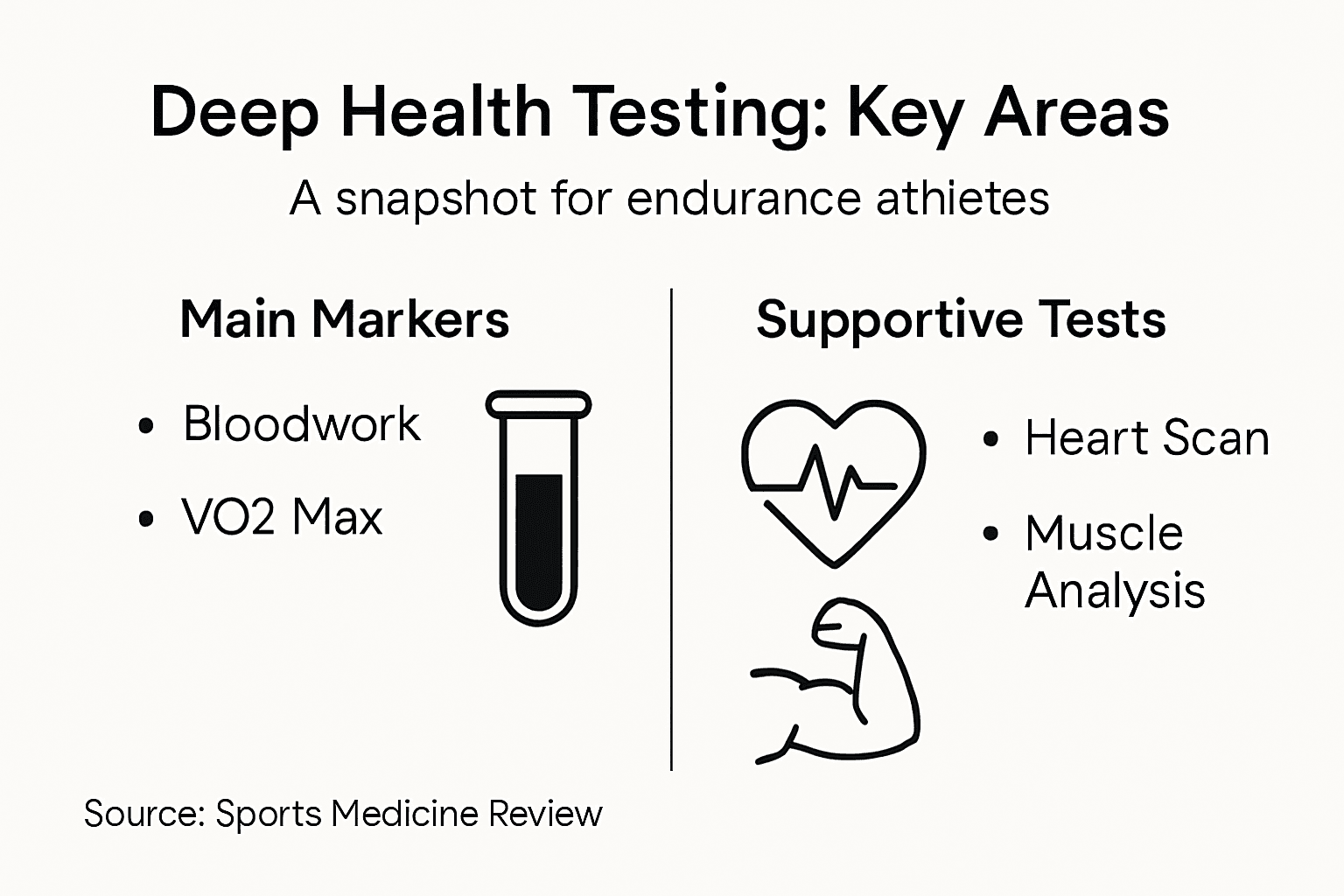
The core modalities form the foundation of comprehensive assessment. Biochemical profiles measure metabolic, hematological, and inflammatory markers alongside cardiovascular and respiratory parameters, giving you data on how your body’s systems are functioning under training stress.
Here’s what a typical deep health testing protocol includes:
- Blood biomarkers tracking metabolism, oxygen transport, and recovery status
- Cardiovascular assessments via ECG and exercise testing to evaluate heart function
- Musculoskeletal screening identifying structural weaknesses before injury emerges
- Functional performance tests assessing real-world movement capacity
- Tissue damage and oxidative stress markers revealing training load tolerance
Biomarker categories span from traditional measurements to emerging indicators. Your lipid profile shows cardiovascular risk. Glucose metabolism indices reveal energy substrate handling. Cardiac markers detect heart stress. Hematologic parameters indicate oxygen-carrying capacity and recovery status.
Periodic health evaluations combine ECGs, blood panels, exercise testing, and musculoskeletal assessments to detect physiological adaptations and catch early pathology signs before symptoms appear.
But here’s what separates good testing from great testing: context matters. A single ferritin result means little without knowing your training volume, dietary iron intake, and menstrual status if applicable. Your lactate threshold value needs interpreting against your specific event demands.
The most valuable biomarkers aren’t exotic—they’re the traditional ones measured consistently over time, showing whether your training is producing adaptation or accumulating fatigue.
Many athletes obsess over cutting-edge markers when conventional ones tell the real story. Iron stores, inflammatory markers, and recovery hormones consistently predict performance better than experimental tests.
The testing timeline matters too. Baseline testing establishes your individual normal ranges, then periodic retesting (typically every 6-8 weeks during heavy training blocks) tracks whether adaptations are occurring or warning signs emerging.
Pro tip: Request results explained in context of YOUR specific endurance discipline—what matters for a marathon runner differs from a triathlete, so ensure your testing provider understands your competition demands.
Personalised Interpretation for Performance Gains
Numbers alone don’t win races. A VO2 max result means nothing without understanding your training responsiveness, your specific event demands, and whether you’re actually trending upward. Raw data becomes power only through personalised interpretation.
Personalised interpretation of test results is critical to tailoring training prescription, recovery strategies, and injury prevention. This means applying a multidimensional approach that considers your individual variability, sport-specific demands, and contextual factors—not comparing yourself against population averages.
Here’s what proper interpretation looks like in practice:
- Contextual analysis examining how results fit your training block and life stress
- Trend identification tracking whether markers are improving, stable, or declining
- Sport-specific application linking findings to your actual competition demands
- Individual responsiveness recognising how you personally adapt versus typical athletes
- Decision-making support converting data into specific training, nutrition, and recovery adjustments
Your test results should answer one question: what changes do I make to train smarter this week? A low iron result triggers dietary strategy and possible supplementation. Elevated inflammatory markers suggest reducing volume or improving sleep. A plateaued lactate threshold indicates you need a different training stimulus.
Personalised data interpretation supports decision-making by offering actionable insights that account for athlete-specific characteristics and training responsiveness. This framework links measurement validity directly to competitive outcomes.
The difference between mediocre and exceptional testing lies in interpretation depth. Generic reports listing reference ranges are useless. You need analysis showing whether your current training approach is working specifically for you.
Your testing data is only valuable when it drives concrete changes to training, nutrition, recovery, or injury prevention—not when it sits in a file uninterpreted.
Many athletes receive beautiful reports with impressive graphs but no actionable guidance. You need interpretation that explains what each result means for your performance, what changes to make, and when to retest to verify those changes worked.
Timing matters too. Results captured mid-taper look different from results during heavy training blocks. A coach interpreting your data must know your training context, not just the numbers.
The best interpretation also identifies unexpected findings worth investigating further. A blood marker outside normal range might indicate subclinical infection, nutritional deficiency, or simply individual variation. Quality practitioners distinguish between noise and signal.
Pro tip: Request not just results but a personalised action plan showing specifically which training variables, nutrition interventions, or recovery adjustments to modify based on YOUR unique profile and competition timeline.
Long-Term Health Risk Assessment and Prevention
Endurance training places extraordinary stress on your body. Most athletes focus on performance gains and ignore what deep health testing reveals about long-term disease risk lurking beneath the surface.
The critical distinction in health testing is separating normal training adaptation from genuine pathology. Long-term health risk assessment involves systematic evaluations to distinguish physiological adaptations from pathological conditions, especially cardiac anomalies detectable via ECG and imaging. This prevents misdiagnosing an athlete’s heart as diseased when it’s simply adapted.
What are the actual risks you’re screening for?
- Cardiac abnormalities that may predispose you to sudden events under intense effort
- Metabolic dysfunction indicating future diabetes or cardiovascular disease risk
- Inflammatory markers suggesting chronic disease development patterns
- Hormonal imbalances affecting long-term bone health and metabolic stability
- Subclinical infections that strain recovery and increase injury susceptibility
Pre-participation medical evaluations identify congenital or acquired disorders that may lead to adverse events, forming a cornerstone of preventive sports medicine. These assessments facilitate early interventions when you can actually prevent problems.
Here’s what most athletes miss: the markers visible today predict your health trajectory in 20 years. Elevated cholesterol at 32 becomes heart disease at 52. Chronic inflammation during your racing years accelerates ageing. Early detection changes everything.
The prevention strategy isn’t complicated. You establish baseline measurements, identify any concerning trends, then implement targeted interventions addressing root causes rather than symptoms.
Prevention requires data, time, and commitment to address issues when they’re small problems, not when they’ve become diagnoses.
Many endurance athletes develop unexpected health issues after retirement because they spent years ignoring warning markers. Deep testing catches these patterns early when lifestyle modifications and targeted supplementation actually work.
Testing should repeat on a structured schedule. Annual screening during heavy training blocks catches seasonal variations. Biennial comprehensive assessments track longer-term trends. This continuity reveals whether your training is building resilience or accumulating damage.
The cost of prevention is minimal compared to treating disease. A single cardiovascular event, metabolic disorder diagnosis, or chronic inflammatory condition costs exponentially more in medical care, lost training time, and reduced quality of life.
Pro tip: Request that your deep health testing includes a risk projection assessment comparing your current biomarker trends to disease development patterns, so you understand exactly which prevention interventions matter most for your specific risk profile.
This table overviews key health risks that deep health testing can detect early:
| Health Risk | Early Marker Identified | Long-Term Impact If Undetected |
|---|---|---|
| Cardiac Abnormalities | ECG changes, abnormal heart rhythm | Sudden cardiac events, reduced lifespan |
| Metabolic Dysfunction | Elevated glucose or lipid markers | Type 2 diabetes, cardiovascular disease |
| Chronic Inflammation | Persistent high CRP/ESR | Accelerated ageing, chronic illness |
| Hormonal Imbalance | Altered recovery hormone levels | Poor bone health, fatigue |
| Subclinical Infection | Raised white cell count, symptoms | Increased injury risk, poor recovery |
Common Pitfalls and Safety Considerations
Deep health testing sounds straightforward until you realise how easily results get misinterpreted, tests get poorly selected, or safety protocols slip. These mistakes can undermine your entire testing strategy and lead to wrong decisions.
The first major pitfall is inadequate standardisation. Common pitfalls in deep health testing include misinterpretation of results due to inadequate standardisation, poor test selection, and failure to consider confounding variables such as hydration or recent activity. Your cortisol levels differ dramatically based on time of day. Iron tests vary with hydration status. Lactate thresholds change after recent hard efforts.
Watch out for these common mistakes:
- Ignoring testing context like time of day, meal timing, or recent training intensity
- Comparing results across different labs using different methodology and reference ranges
- Missing confounding variables that explain marker changes (illness, stress, poor sleep)
- Over-investigating benign findings that are simply normal individual variation
- Misinterpreting adaptation as pathology when your heart changes are training responses, not disease
The second critical pitfall involves safety during physical assessments. Maximal exercise testing demands proper medical supervision, equipment availability, and practitioner certification. An untrained assessor conducting a VO2 max test on a fatigued athlete creates genuine injury risk.
Safety considerations when interpreting athlete health data focus on distinguishing benign physiological adaptations from pathological findings that require intervention. Misdiagnosis can trigger unnecessary anxiety and wrongly restrict your participation.
Testing providers should demand standardised protocols. Same time of day for baseline and repeat testing. Consistent pre-test requirements (no exercise, adequate sleep, normal hydration). Documented procedures ensuring reproducibility.
Standardised testing reveals true changes in your physiology; non-standardised testing reveals noise and confounds that waste your money and time.
Another pitfall: selecting tests that sound impressive but don’t predict performance. A genetic test showing muscle fibre type tells you nothing actionable. Advanced inflammation markers mean nothing without context. Choose tests directly linked to your competition demands.
Finally, safety means having qualified practitioners interpret data. A physician or sports scientist trained in athlete physiology understands the difference between normal adaptation and genuine concern. A generic lab report without clinical context creates confusion.
Pro tip: Before purchasing any deep health testing, request the standardisation protocol and ask whether testing will occur at the same time of day in identical pre-test conditions across all future retesting sessions.
Unlock Your Full Potential with Precise Deep Health Testing
Endurance athletes face the challenge of uncovering hidden physiological barriers that limit performance and recovery. From optimising iron stores and managing inflammation to identifying personalised metabolic profiles, deep health testing provides the targeted insights you need to train smarter and prevent long-term health risks. At AI Healthician, we specialise in transforming these complex biomarker assessments into clear, actionable strategies tailored specifically for your unique endurance demands.

Discover how our DNA Health Testing and advanced diagnostics integrate functional data with scientific interpretation to deliver personalised protocols that improve energy, resilience and recovery. Dont wait until small issues become setbacks. Visit AI Healthician today and take the first step towards optimising your performance and longevity with expert guidance designed for serious athletes.
Frequently Asked Questions
What is deep health testing for endurance athletes?
Deep health testing is a comprehensive evaluation that assesses an athlete’s biochemical and physiological state to identify specific performance limiters, recovery markers, and health risks that can be overlooked in standard fitness assessments.
How does deep health testing differ from standard fitness tests?
Unlike standard fitness tests, which focus on general fitness metrics and population averages, deep health testing provides a personalised physiological profile, includes detailed biomarker analyses, and offers targeted recommendations to optimise training and recovery specific to the athlete’s needs.
What key markers are analysed in deep health testing?
Core markers in deep health testing include blood biomarkers for metabolism and recovery, cardiovascular assessments, musculoskeletal screenings, and functional performance tests. These help identify your body’s adaptations to training and any potential risk factors.
Why is personalised interpretation of test results important?
Personalised interpretation is crucial as it allows for contextual analysis of results tailored to an athlete’s specific training demands and individual responsiveness. This insight helps in making informed decisions about training adjustments, nutrition, and recovery strategies.


