


 matt@aihealthician.co.uk


Striving for elite performance or sustained vitality demands more than intuition; it requires clarity from within. The shift towards advanced diagnostics empowers you to act before symptoms threaten your results or long-term health. By revealing physiological patterns and risk markers invisible to traditional blood tests, these sophisticated data-driven interventions unlock opportunities for tailored prevention and measurable adaptation. Whether you’re a professional athlete or a health-focused executive, understanding the true scope of advanced diagnostics offers actionable insight and greater control over your performance journey.
Table of Contents
- Defining Advanced Diagnostics In Modern Health
- What Sets Advanced Diagnostics Apart
- The Role of Early Detection
- Modern Diagnostic Technologies
- Why This Matters For Your Performance
- Precision Testing: Tools And Methodologies
- Core Testing Methodologies
- AI-Driven Data Integration
- Implementation In Practice
- What Makes Testing Precise
- Integrating Biological Data For Personalisation
- The Multi-Dimensional Approach
- Why Integration Changes Everything
- Building Your Personal Data Model
- Data-Driven Decision Making
- Real-World Benefits For Performance And Longevity
- Performance Benefits For Athletes
- Longevity And Healthspan For Executives
- Cognitive Health And Physical Resilience
- Practical Outcomes
- Risks, Limitations, And Informed Decision-Making
- Key Limitations Of Advanced Diagnostics
- The Automation Complacency Risk
- Cognitive Biases In Interpretation
- Fragmented Care Systems
- Actionable Risk Management
Key Takeaways
| Point | Details |
|---|---|
| Advanced Diagnostics Enhance Health Intervention | They allow for early detection of physiological issues, enabling proactive, personalised health management for athletes and executives. |
| Integration of Multiple Data Sources is Crucial | Combining genomic, metabolic, and lifestyle data leads to tailored health strategies that are more effective than generic approaches. |
| Data-Driven Decision Making Improve Outcomes | Objective physiological trends from advanced diagnostics can transform vague health concerns into actionable insights. |
| Awareness of Limitations is Important | Misinterpretation of data or over-reliance on technology can lead to poor decision-making; critical thinking remains essential. |
Defining Advanced Diagnostics In Modern Health
Advanced diagnostics represent a fundamental shift in how we detect, understand, and respond to health challenges. Rather than waiting for symptoms to emerge, these sophisticated testing methods reveal what’s actually happening inside your body before problems become serious. For high-performing athletes and executives managing complex health profiles, this distinction changes everything.
Traditional diagnostics focus on identifying disease once it’s symptomatic. Advanced diagnostics go deeper, uncovering physiological patterns, metabolic irregularities, and risk markers that standard blood work misses entirely. This allows you to intervene when it matters most: before dysfunction becomes diagnosis.
To clarify the main differences between traditional and advanced diagnostics, here’s a concise comparison table:
| Aspect | Traditional Diagnostics | Advanced Diagnostics |
|---|---|---|
| Detection Timeline | After symptoms appear | Before symptoms or dysfunction |
| Data Depth | Limited biochemical analysis | Molecular, genetic, multi-layer |
| Actionability | Reactive treatment decisions | Preventive & personalised action |
| Interpretation | General population averages | Contextualised to individual |
What Sets Advanced Diagnostics Apart
Advanced diagnostics differ from conventional testing in scope, precision, and actionability. Where standard tests answer “Do I have this disease?”, advanced diagnostics ask “How is my system performing, and what’s trending?”.
Key distinctions include:
- Molecular and genetic insights beyond basic pathology, revealing how your body processes nutrients, handles stress, and repairs tissue
- Functional markers that detect early dysfunction before traditional disease markers appear
- Integrated data analysis combining multiple test results to identify patterns invisible in single tests
- Longitudinal tracking measuring changes over weeks and months to reveal your actual health trajectory
- Personalised interpretation contextualised to your age, genetics, sport, and performance goals
Advanced diagnostics expose physiological reality; conventional testing confirms pathology. By then, damage has often begun.
The Role of Early Detection
Early detection through advanced diagnostics fundamentally changes your intervention window. An athlete discovering a metabolic vulnerability months before it causes overtraining syndrome can adjust training volume and nutrition protocols immediately. An executive spotting inflammatory markers trending upward can address sleep, stress, and diet before coronary risk escalates.

This is where advanced diagnostics prove their value. The data arrives before your body forces the issue through injury, illness, or performance collapse.
Modern Diagnostic Technologies
The toolkit of advanced diagnostics has expanded dramatically beyond standard blood analysis. Your health picture now emerges from multiple technologies working in concert:
- Functional blood work measuring metabolic efficiency, nutrient status, and inflammation patterns
- Hormone profiling tracking cortisol patterns, thyroid function, and reproductive hormone balance
- Genetic analysis revealing metabolic capacity, injury risk, and treatment response potential
- Microbiome assessment understanding gut health’s influence on immunity and energy
- Advanced imaging identifying structural changes or tissue quality issues
- Continuous monitoring capturing real-world data on sleep, movement, and recovery
When properly synthesised through data-driven analysis frameworks, these technologies paint a comprehensive picture of your physiological reality.
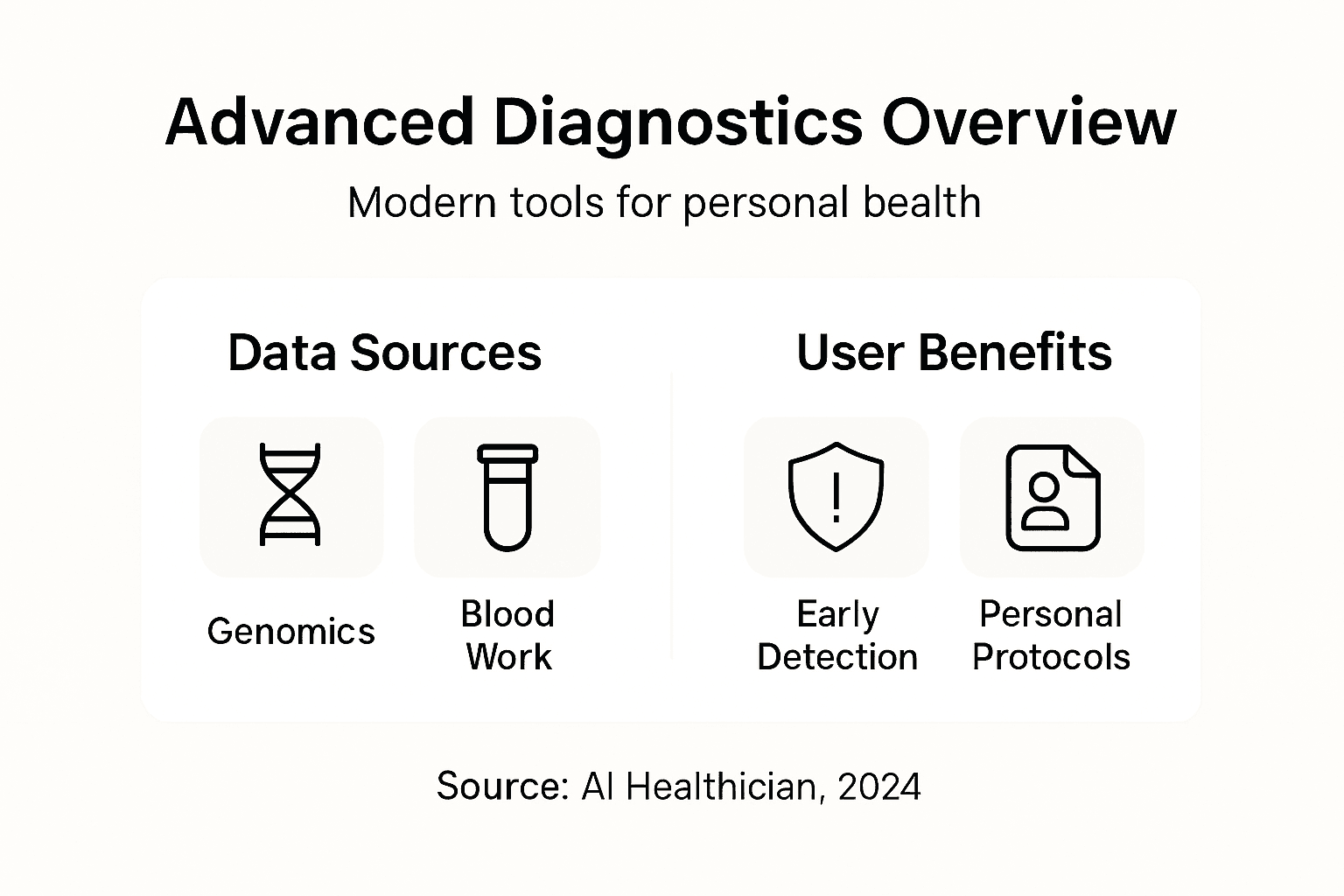
For a quick reference, here is a table summarising key modern diagnostic technologies and their practical application:
| Technology | Main Purpose | Typical User Benefit |
|---|---|---|
| Functional Blood Work | Assess metabolism and inflammation | Early detection of stress/fatigue |
| Genetic Analysis | Reveal inherited health risks | Tailored intervention strategies |
| Microbiome Assessment | Understand gut health profile | Improved immunity and energy levels |
| Continuous Monitoring | Track real-world recovery patterns | Immediate adjustment of lifestyle |
Why This Matters for Your Performance
You don’t optimise what you don’t measure. Advanced diagnostics transform vague feelings (“I’m just not recovering well”) into concrete data (“Your sleep architecture is compromised, cortisol isn’t suppressing properly, and you’re systemically low in magnesium”). That specificity becomes actionable protocol.
For professional athletes, this difference determines whether training adaptations actually stick or whether you’re chasing ineffective interventions. For executives managing health alongside demanding schedules, precision diagnostics prevent the slow decline that looks like normal ageing but often reflects correctable dysfunction.
Pro tip: Request baseline advanced diagnostics before beginning any major training cycle or health optimisation programme; without baseline data, you can’t identify meaningful change or validate whether interventions actually work.
Precision Testing: Tools And Methodologies
Precision testing transforms raw biological data into actionable intelligence about your health. Rather than relying on generic population averages, precision testing reveals your individual physiological patterns, vulnerabilities, and strengths. For athletes optimising performance and executives managing long-term health, this personalised approach fundamentally changes what interventions actually work.
Modern precision testing integrates multiple data streams simultaneously. Your genetic blueprint, current metabolic state, immune function, and microbiome composition paint a complete picture when analysed together. Standalone tests miss patterns that emerge only across multiple biological systems.
Core Testing Methodologies
Precision testing relies on several interconnected approaches, each revealing different layers of physiological reality.
Key methodologies include:
- Functional blood analysis measuring specific markers of metabolic efficiency rather than just disease presence
- Genetic profiling identifying your inherited capacity for nutrient absorption, detoxification, and stress resilience
- Hormone tracking capturing daily fluctuations in cortisol, thyroid, and reproductive hormones through saliva or serum testing
- Microbiome sequencing revealing which bacterial species support or undermine your energy and immunity
- Inflammatory markers detecting systemic inflammation before it manifests as clinical symptoms
- Continuous monitoring using wearables and trackers to capture real-world data on sleep quality, movement patterns, and recovery metrics
AI-Driven Data Integration
AI-driven analytics optimising therapies through integrated genetic and clinical profiles represent the frontier of precision testing. Artificial intelligence identifies patterns in your data that humans would miss, connecting seemingly unrelated markers into coherent physiological stories.
This integration changes how you interpret results. Rather than reading isolated numbers, you see how your genetics influence nutrient processing, how your sleep quality affects immune function, and how your microbiome composition influences cortisol regulation. Context transforms data into insight.
Implementation in Practice
Precision testing becomes powerful only when properly sequenced. Most practitioners start with functional blood work capturing metabolic baseline, then add genetic testing to understand inherited vulnerabilities, then implement microbiome analysis if gastrointestinal or immune issues emerge.
Your metabolic health improvement journey benefits from this layered approach. Initial testing reveals where to focus, follow-up testing validates whether interventions work, and serial testing tracks physiological adaptation over months.
Precision testing uncovers your unique biological reality; population studies show what works on average. Your protocols must reflect who you actually are, not population statistics.
What Makes Testing Precise
Not all testing is equally precise. Precision testing requires three elements: specificity (measuring exactly what matters for your goals), sensitivity (detecting subtle changes others miss), and interpretation contextualised to your individual baseline and trajectory.
Generic reference ranges become meaningless when testing precisely. Your optimal cortisol pattern differs from the next person’s. Your ideal inflammatory markers depend on your sport and genetics. Precision testing acknowledges these individual differences and adjusts interpretation accordingly.
Pro tip: Request baseline testing before making any major intervention changes; comparing your post-intervention results to your actual baseline (not population averages) reveals whether your specific body responded as intended.
Integrating Biological Data For Personalisation
Integrating multiple biological data sources transforms isolated test results into a comprehensive understanding of your physiology. A single blood marker means little; patterns across genetics, metabolites, immune function, and lifestyle reveal your actual health trajectory. This integration separates genuinely personalised protocols from generic recommendations.
You already generate vast amounts of biological data. Your genes encode metabolic potential. Your blood chemistry reflects current function. Your microbiome influences immunity and energy. Your continuous trackers capture real-world recovery patterns. The challenge isn’t collecting data—it’s synthesising it into actionable insight.
The Multi-Dimensional Approach
True personalisation requires abandoning single-variable thinking. Your cortisol levels matter less than understanding how they interact with your sleep architecture, training volume, and dietary protein timing.
Key data dimensions include:
- Genomic data revealing inherited vulnerabilities and metabolic capacity
- Metabolomic profiles showing how efficiently your body processes nutrients and energy
- Phenotypic information capturing your observable traits, fitness level, and injury history
- Clinical records documenting past diagnoses, treatments, and responses
- Lifestyle data including sleep, movement, stress, and dietary patterns
- Environmental factors such as altitude, pollution exposure, and seasonal changes
Why Integration Changes Everything
Integrating biological data creates context that isolated markers cannot provide. Genomics, metabolomics, and phenotypic information combined customise interventions far more effectively than population averages ever could.
Consider an athlete with elevated inflammatory markers. Without integration, the protocol might be generic anti-inflammatory nutrition. With integrated analysis, you discover the inflammation stems from intestinal permeability (microbiome data), triggered by excessive endotoxin absorption during high-volume training (phenotypic data), worsened by insufficient sleep (continuous data), and your genetics predispose you to this specific vulnerability.
The intervention becomes precisely targeted: repair gut barrier, adjust training periodisation, improve sleep architecture. Same athlete, completely different protocol.
Building Your Personal Data Model
Personalisation requires advanced data management systems integrating clinical records, genomic datasets, and immunological profiles into coherent analysis frameworks. This isn’t simply collecting more tests; it’s synthesising existing data intelligently.
Start by mapping your current biological reality across these dimensions. What do your genetics reveal about nutrient processing? What does your metabolic panel suggest about insulin sensitivity and inflammation? What patterns emerge when you overlay sleep data against training stress and cortisol measurements?
Integration reveals interaction effects invisible in isolated tests. Your vitamin D status matters more when your genetics show reduced absorption capacity. Your training load tolerance shifts based on concurrent sleep debt and dietary adherence.
Integration transforms data into understanding. Isolated numbers remain mysterious; combined patterns become transparent.
Data-Driven Decision Making
Once integrated, this biological data becomes your decision-making foundation. Rather than adjusting protocols based on how you feel, you respond to objective physiological trends. Fatigue isn’t a mystery; it becomes traceable to specific measurable causes.
Integrated analysis reveals whether training adaptations are actually occurring, whether nutritional changes improved metabolic efficiency, and which interventions work specifically for your biology.
Pro tip: Establish baseline measurements across all key dimensions before implementing major protocol changes; post-intervention data becomes meaningful only when compared to your personal baseline, not population averages.
Real-World Benefits For Performance And Longevity
Advanced diagnostics deliver tangible outcomes that extend beyond laboratory numbers. Athletes recover faster. Executives maintain cognitive sharpness across demanding careers. Recovery windows compress. Injury prevention shifts from reactive to predictive. These aren’t theoretical improvements; they’re measurable changes in how your body performs and ages.
The real power emerges when you compare your results before and after implementing diagnostic-driven protocols. Most people never see this difference because they lack baseline data. You’re not chasing vague improvements; you’re tracking specific physiological adaptations.
Performance Benefits For Athletes
Advanced diagnostics fundamentally change how athletes train and recover. Rather than following generic periodisation, your protocols adapt based on actual physiological readiness captured through continuous data.
Measurable performance gains include:
- Accelerated recovery by identifying specific recovery bottlenecks rather than generic recommendations
- Reduced injury incidence through early detection of overtraining markers and tissue stress patterns
- Optimised training adaptation by confirming whether your body actually responded to training stimulus
- Enhanced nutrient timing personalised to your digestive capacity and metabolic processing speed
- Improved sleep architecture through targeted interventions addressing your specific sleep dysfunction patterns
- Better heat tolerance and altitude adaptation informed by haematological and metabolic baseline data
Longevity And Healthspan For Executives
Longevity isn’t about adding years; it’s about maintaining cognitive function, energy, and disease-free status across those years. This is healthspan—the portion of your life lived in actual health rather than managed decline.
AI-driven personalised health interventions tailored to individual biological factors accelerate longevity outcomes by enabling preventive action before dysfunction becomes disease. An executive discovering early metabolic dysfunction can course-correct through nutrition and movement before insulin sensitivity collapses into type 2 diabetes. Someone tracking inflammatory markers can address systemic inflammation before it drives cardiovascular disease or cognitive decline.
This is prevention that actually works because it’s based on your specific biology, not population statistics.
Cognitive Health And Physical Resilience
Personalised physical activity informed by advanced diagnostics correlates strongly with cognitive health and reduced mortality risk. The mechanism is straightforward: when your training matches your actual recovery capacity and nutritional status, your nervous system maintains plasticity. Cognitive decline slows. Energy improves. You remain sharp across your career.
Executives often assume cognitive decline is inevitable. It isn’t. What looks like normal ageing often reflects accumulated metabolic dysfunction, systemic inflammation, or sleep architecture collapse—all addressable through diagnostics-informed intervention.
Practical Outcomes
Here’s what this looks like in real life. An athlete notices 18% improvement in time-to-exhaustion after addressing micronutrient deficiencies identified through diagnostics. An executive regains stable energy across the workday after correcting thyroid function and sleep quality. A 55-year-old maintains VO₂ max comparable to their 35-year-old self through personalised training informed by actual fitness data.
These aren’t edge cases. They’re predictable outcomes when protocols match biology.
Diagnostics don’t just inform; they enable prevention before damage occurs. Prevention beats treatment every time.
Pro tip: Track specific performance metrics before implementing diagnostic-driven protocols—resting heart rate variability, training-to-fatigue ratios, cognitive response times, or sport-specific performance markers—then measure again at 8 weeks and 16 weeks to quantify whether your personalised interventions actually deliver measurable improvement.
Risks, Limitations, And Informed Decision-Making
Advanced diagnostics are powerful tools, but they’re not infallible. Misinterpreting data, over-relying on automated analysis, or treating test results as absolute truth creates risks. Understanding these limitations protects you from chasing false leads or ignoring critical context that numbers alone cannot capture.
Diagnostics inform decisions; they don’t replace clinical judgment or personal experience. The athlete who feels stronger and recovers faster trumps a metabolic marker suggesting otherwise. The executive with stable energy outweighs a single inflammatory result. Data guides strategy, but your lived experience remains the ultimate validator.
Key Limitations Of Advanced Diagnostics
No diagnostic system is perfect. Understanding where they fall short prevents misplaced confidence in imperfect information.
Common limitations include:
- Single-timepoint snapshots capturing only one moment, not patterns (a single blood test doesn’t reveal weekly trends)
- Reference range variability across different laboratories, making comparison between testing facilities unreliable
- Insufficient diagnostic tools for emerging or rare conditions not yet well-characterised
- Genetic predisposition conflation discovering risk variants that may never manifest clinically
- Cost barriers limiting comprehensive testing for populations without resources
- Interpretation expertise variation where different practitioners analyse identical data differently
The Automation Complacency Risk
AI decision support systems improving efficiency whilst risking automation complacency present a subtle danger: over-reliance on automated recommendations diminishes critical thinking. When algorithms tell you to do something, questioning that recommendation feels redundant. It isn’t.
Algorithms can miss context only experienced practitioners recognise. Your training intensity tolerance might be flagged as excessive by an algorithm, but a coach understanding your psychology and life circumstances knows you thrive under controlled stress. Technology amplifies insight only when combined with human judgment.
Cognitive Biases In Interpretation
Accurate diagnosis challenged by cognitive biases and insufficient diagnostic tools reflects a deeper truth: how practitioners interpret data matters as much as the data itself. Confirmation bias leads practitioners to emphasise results supporting their preferred narrative. Anchoring bias locks interpretation to initial impressions.
You protect yourself by seeking second opinions on significant findings and questioning interpretations that don’t align with your actual experience. Disagreement between practitioners is valuable; it signals the need for deeper investigation rather than certainty.
Fragmented Care Systems
Advanced diagnostics often exist in isolation. Your blood work, genetic data, continuous tracking, and clinical records sit in separate systems. Integration requires practitioners skilled in synthesising across data streams—a rare capability currently. Fragmentation creates gaps where critical patterns disappear between systems.
This is where informed decision-making becomes essential. You become the connector, ensuring your practitioners have access to your complete picture rather than isolated pieces.
The most dangerous diagnostics are those delivered without context or questioned without scrutiny. Numbers demand interpretation; interpretation demands judgment.
Actionable Risk Management
Reduce diagnostic uncertainty through specific practices:
- Seek practitioners trained in systems-level thinking who integrate multiple data sources
- Request explanations of methodology and limitations, not just results
- Validate major decisions through repeated testing rather than single-timepoint conclusions
- Track your subjective experience alongside objective data to catch misalignments
- Request detailed interpretation that connects data to your specific situation, not population generalisation
Pro tip: When a diagnostic result surprises you or contradicts how you feel, that’s not a reason to ignore the data—it’s a signal to investigate further, potentially testing again or seeking alternative explanation rather than assuming the test must be wrong.
Unlock Your Unique Health Blueprint with Advanced Diagnostics
Modern health demands more than generic advice. If you are striving to overcome hidden physiological challenges or aiming to precisely optimise your energy, recovery, and longevity, advanced diagnostics become essential. This approach uncovers subtle biological patterns like metabolic efficiency, genetic predispositions, and inflammation trends long before symptoms appear. It empowers you to act with personalised interventions instead of reactive treatments.
Explore targeted solutions through DNA Health Testing and comprehensive diagnostic services designed to translate deep biological insights into actionable health protocols.
Start transforming your health journey today with AI Healthician. Visit https://aihealthician.co.uk to access personalised testing, evidence-informed strategies, and data-driven performance optimisation that reflects your individual biology. Don’t wait for symptoms to define your wellness—take control now with precise diagnostics crafted for measurable results.
Frequently Asked Questions
What are advanced diagnostics?
Advanced diagnostics are sophisticated testing methods that assess your body’s physiological state, revealing health issues before symptoms appear. They provide in-depth insights into metabolic patterns, genetic factors, and risk markers that standard tests may overlook.
How do advanced diagnostics differ from traditional diagnostics?
Advanced diagnostics focus on preventative measures by detecting underlying health issues before they manifest as symptoms, while traditional diagnostics typically identify diseases after symptoms appear. This allows for personalised and proactive health interventions.
What technologies are used in advanced diagnostics?
Advanced diagnostics utilise various technologies, including functional blood work, hormone profiling, genetic analysis, microbiome assessments, advanced imaging, and continuous monitoring to provide a comprehensive view of a person’s health.
How can advanced diagnostics benefit athletes and executives?
For athletes, advanced diagnostics can optimise training and recovery by tailoring protocols based on real-time physiological data. For executives, these diagnostics can enhance longevity and cognitive function by identifying and addressing health issues before they escalate.
Recommended
- Role of Data in Diagnostics: Unlocking Personalised Performance – Aihealthician
- Metabolic Health Improvement Workflow for Peak Performance – Aihealthician
- Data-Driven Wellness: Transforming Precision Health Outcomes – Aihealthician
- 7 Steps to a Personalised Metabolic Health Improvement Checklist – Aihealthician
- What Is Fertility Protocol and How AI Transforms It
- 7 Steps to a Personalized Fertility Care Checklist
- Role of AI in Hearing Diagnosis: Advancing UK Hearing Health – Audora


