


 matt@aihealthician.co.uk


TL;DR:
- Biomarker tracking provides personalized insights into internal body processes and health risks.
- Regular monitoring helps identify early warning signs and guides tailored interventions.
- Caution is essential to avoid overdiagnosis, anxiety, and reliance on unvalidated markers.
Wellness culture moves fast. Intermittent fasting, cold plunges, and VO2 max testing all promise transformation, yet most people cycling through these trends still feel stuck. The missing piece is not another protocol — it is knowing what is actually happening inside your body right now. Biomarker tracking gives you that. Rather than applying population-level advice to a uniquely individual body, you work from your own biological data to make decisions that genuinely move the needle. This guide explains what biomarkers are, why tracking them is one of the most powerful things you can do for your health, and how to avoid the pitfalls that trip up even motivated, informed people.
Table of Contents
- What are biomarkers and why do they matter?
- The benefits of tracking your biomarkers
- Risks, limitations, and common misconceptions
- How to use biomarker tracking for tailored health optimisation
- Our take: What most guides get wrong about biomarker tracking
- Next steps: Personalised biomarker tracking with AI Healthician
- Frequently asked questions
Key Takeaways
| Point | Details |
|---|---|
| Personalised insight | Biomarker tracking turns guesswork into actionable health strategies tailored to you. |
| Evidence-based optimisation | Measuring your markers reveals what actually works for your body and goals. |
| Avoid common pitfalls | Relying only on validated markers and context prevents anxiety and wasted effort. |
| Apply with intention | Integrate tracking into a well-guided plan for the greatest health and performance gains. |
What are biomarkers and why do they matter?
A biomarker is any measurable biological indicator that reflects what is happening inside your body. Blood glucose, LDL cholesterol, cortisol, ferritin, and C-reactive protein are all biomarkers. They are objective signals, not symptoms, and they change in response to diet, exercise, sleep, stress, and ageing. Understanding the importance of biomarker analysis is the foundation of any serious personalisation strategy.
Biomarkers fall into several categories, each telling a different part of your physiological story:
- Metabolic markers: Blood glucose, HbA1c, insulin sensitivity — reflect how your body uses energy
- Cardiovascular markers: LDL, HDL, triglycerides, ApoB — indicate heart and vascular risk
- Inflammatory markers: C-reactive protein (CRP), interleukin-6 — flag systemic inflammation and recovery capacity
- Hormonal markers: Testosterone, cortisol, thyroid hormones — govern energy, mood, and body composition
- Nutritional markers: Vitamin D, B12, magnesium, ferritin — reveal deficiencies affecting performance and cognition
| Biomarker | What it measures | Why it matters |
|---|---|---|
| HbA1c | Average blood glucose over 3 months | Early indicator of metabolic dysfunction |
| ApoB | Atherogenic particle count | More precise cardiovascular risk than LDL alone |
| hsCRP | High-sensitivity inflammation | Links to chronic disease risk and poor recovery |
| Free testosterone | Bioavailable hormone levels | Affects energy, cognition, and muscle repair |
| Vitamin D | Immune and bone health status | Deficiency is widespread and highly correctable |
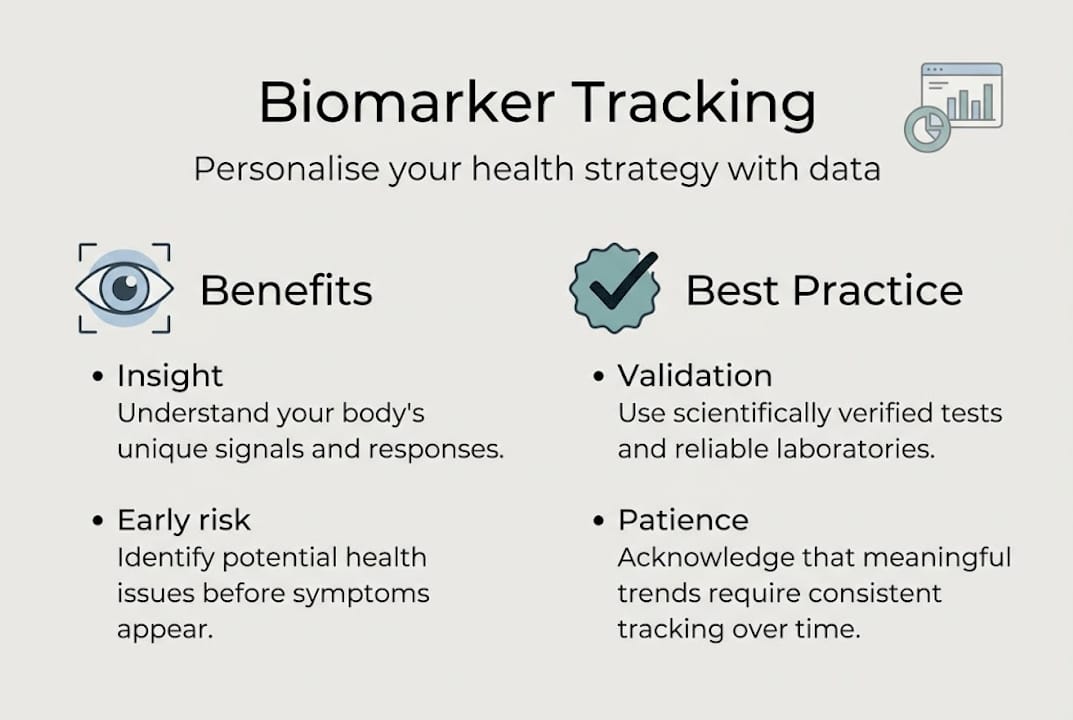
Tracking biomarkers shifts your health strategy from reactive to proactive — you identify risk before symptoms appear and measure whether your interventions are actually working.
However, context always matters. As research confirms, biomarkers are not always disease-specific and can be affected by sample timing, hydration status, or stress at the point of collection. A single result tells you far less than a trend measured consistently over time. Exploring biomarkers for peak performance helps you identify which signals are most relevant to your specific goals, rather than chasing every available test.
The benefits of tracking your biomarkers
The clearest benefit of biomarker tracking is early detection. Rising fasting glucose or a creeping HbA1c rarely produces noticeable symptoms in the short term, yet the trend reveals a metabolic trajectory that, left unchecked, develops into type 2 diabetes. Catching this early means a targeted dietary and lifestyle adjustment — not medication.
Using data to personalise your approach is where biomarker tracking becomes genuinely powerful. Here is a practical framework:
- Establish a baseline. Get a full panel measured before making significant lifestyle changes, so you have a clear starting point.
- Identify your priority areas. Focus on the markers that align with your goals — metabolic health, cardiovascular risk, hormonal balance, or recovery.
- Introduce one intervention at a time. Changing sleep, diet, and training simultaneously makes it impossible to attribute changes to a specific action.
- Remeasure at consistent intervals. Three to six months between panels gives most markers enough time to shift meaningfully.
- Adjust based on trends, not single data points. One elevated result may be noise; a consistent direction is a signal.
The contrast between generic and data-driven decisions is stark:
| Generic health advice | Biomarker-driven decision |
|---|---|
| “Eat less saturated fat” | ApoB is elevated — reduce processed fat and retest in 12 weeks |
| “Exercise more for energy” | Low ferritin explains fatigue — address iron before increasing training load |
| “Take a vitamin D supplement” | Confirmed deficiency at 28 nmol/L — prescribed dose with retest at 3 months |
| “Manage your stress” | Elevated morning cortisol — introduce targeted recovery and sleep protocol |
Pro Tip: Resist the urge to react to a single abnormal reading. The real value in biomarker analysis strategies comes from understanding the direction of change across multiple measurements over time.

For those working towards long-term performance or longevity goals, optimisation protocols for longevity use biomarker trends to confirm that interventions are working — or to pivot when they are not. As evidence indicates, prevention and optimisation remain the key advantages, provided the data is validated and actionable rather than speculative.
Risks, limitations, and common misconceptions
Biomarker tracking has real limitations, and ignoring them undermines everything else. The risks are not theoretical — they affect real people who start testing enthusiastically and end up more anxious and confused than when they began.
The main risks include:
- Overdiagnosis: Borderline results for markers without clinical validation can lead to unnecessary interventions
- False positives: Single aberrant results, especially from consumer-grade tests, may reflect collection or processing errors
- Anxiety spiral: Receiving multiple results with no professional context can generate disproportionate concern
- Financial cost: Unguided, frequent testing of low-value markers wastes money that could fund meaningful interventions
- Analysis paralysis: Too many data points without a framework makes it harder, not easier, to decide what to do
Research confirms these concerns are grounded: overdiagnosis and anxiety arise from unvalidated biomarker use, and poor reproducibility from small studies is a persistent problem in this field. Reproducibility issues mean a finding that looks meaningful in one study may not hold up in the next, making it critical to rely only on well-established markers with robust evidence behind them.
Pro Tip: Before adding a new biomarker to your panel, ask two questions. Is this marker validated in large, independent populations? And does a result in either direction lead to a clear, actionable response? If the answer to either is no, it does not belong in your protocol yet.
Understanding the scope of advanced diagnostics explained helps you distinguish established markers from emerging ones that are still being studied. Similarly, continuous monitoring for wellness works best when anchored to a small number of high-quality signals rather than a broad sweep of unvalidated data.
If you receive an unexpected result, do not self-diagnose. Book a review with a professional, provide full context about recent illness, sleep, or lifestyle changes, and always confirm with a repeat measurement before changing your protocol.
How to use biomarker tracking for tailored health optimisation
Approaching this well requires structure. Without it, even good data produces poor outcomes. Here is a practical approach:
- Define your goal first. Are you targeting metabolic health, cardiovascular risk, hormonal balance, or recovery and performance? Your goal determines your panel.
- Set a baseline. Measure before changing anything. This gives you a true reference point.
- Track at regular intervals. Most panels work well at three to six month intervals. Some markers, like glucose or HRV, can be tracked more frequently.
- Look for trends, not thresholds. A result moving consistently in the wrong direction matters more than whether it has crossed a clinical cut-off.
- Take targeted action. Use each result to inform one or two specific changes, then measure again to confirm effect.
For most people starting out, a practical core panel includes:
- Fasting glucose and HbA1c
- Full lipid panel including ApoB
- hsCRP (high-sensitivity CRP)
- Thyroid function (TSH, free T3, free T4)
- Vitamin D (25-OH)
- Ferritin and full blood count
- Testosterone and SHBG (particularly relevant for men over 35)
As research consistently confirms, reliable actionable results require large validation cohorts and contextual application — which is why working with a qualified practitioner matters enormously. Reviewing precision health strategies helps you understand how to layer biomarker data into a coherent personal health plan. If metabolic function is a priority, measuring metabolic health is a logical starting point for your first panel.
Our take: What most guides get wrong about biomarker tracking
Most mainstream content on biomarker tracking promises quick, dramatic results. Test everything, optimise everything, feel the difference in weeks. That framing sets people up to fail.
The individuals who get the most from biomarker tracking share one quality: patience with the process. They are not chasing a perfect score on any single marker. They are building a picture of how their body responds to specific interventions over months and years. That is where the real signal lives.
A common mistake is beginning with twenty or thirty markers and attempting to address them all at once. It produces noise, not clarity. Start narrow, act on what you find, then expand. The second mistake is reacting emotionally to individual results without professional context. A mildly elevated CRP after a poor night’s sleep means almost nothing in isolation.
True value from personalised preventative health comes from tracking with intention: knowing what you are measuring, why it matters to your specific goals, and what you will do differently based on the result. Without that, you are collecting numbers, not building insight.
Next steps: Personalised biomarker tracking with AI Healthician
You now have the framework. The next step is applying it to your own biology with expert support behind every result.

AI Healthician combines advanced functional testing with data-led interpretation to build personalised protocols that reflect how your body actually works, not how the average person’s does. Whether you are starting with DNA health testing solutions to understand your genetic baseline, booking a Longevity Blueprint consultation to map your long-term health trajectory, or using an Active metabolic test to optimise your energy systems precisely, every service is anchored in validated data and actionable strategy. Stop guessing. Start measuring what matters.
Frequently asked questions
What are the most important biomarkers to track?
Common biomarkers include blood glucose, ApoB cholesterol, hsCRP, vitamin D, and ferritin, but the best panel for you depends entirely on your personal health goals and existing risk factors.
Can tracking biomarkers reduce the risk of disease?
Tracking validated biomarkers helps identify risks before symptoms emerge, but only when results are interpreted with professional context — unvalidated use risks overdiagnosis and unnecessary intervention.
What are the risks of tracking too many biomarkers?
Focusing on unvalidated markers leads to anxiety, overdiagnosis, and wasted resource, as unvalidated biomarker use produces context-independent results that are difficult to act on meaningfully.
How often should biomarkers be measured for best results?
For most markers, measuring every three to six months allows enough time for genuine physiological change — decisions should be driven by trends across multiple measurements, not individual data points.
Recommended
- How to analyse biomarkers for personalised health: a guide – Aihealthician
- Top biomarkers to monitor for peak performance: 2026 guide – Aihealthician
- 7 Steps to a Personalised Metabolic Health Improvement Checklist – Aihealthician
- Metabolic Health Improvement Workflow for Peak Performance – Aihealthician


