


 matt@aihealthician.co.uk


TL;DR:
- Metabolic flexibility is the body’s ability to switch efficiently between burning fats and carbohydrates.
- Loss of flexibility is linked to insulin resistance, obesity, and increased disease risk.
- Personalized testing and lifestyle strategies can improve metabolic health at any age.
Most people assume fatigue, stubborn weight, and energy crashes are just facts of life. They are not. The hidden driver behind all three is often metabolic flexibility, which is the body’s capacity to switch between burning carbohydrates and fats depending on what the situation demands. When this system works well, you feel energised, recover quickly, and maintain a healthy body composition. When it breaks down, everything from your afternoon energy slump to your long-term disease risk is affected. This guide explains what metabolic flexibility is, how it is measured, what goes wrong when it fails, and how to sharpen it using personalised, evidence-informed strategies.
Table of Contents
- Defining metabolic flexibility: the science behind fuel-switching
- How metabolic flexibility is measured: tools, trends and real-life application
- Why metabolic inflexibility matters: risks, consequences and early warning signs
- Diet, exercise and genetics: personalised strategies to enhance metabolic flexibility
- The hidden complexity of metabolic flexibility: what most advice gets wrong
- How AI Healthician can help you optimise metabolic flexibility
- Frequently asked questions
Key Takeaways
| Point | Details |
|---|---|
| Flexible fuel switching | Being able to seamlessly shift between carbs and fats is crucial for energy and resilience. |
| Personal measurement matters | Measuring metabolic flexibility with context reveals your unique needs and progress. |
| Prevention beats cure | Spotting and improving inflexibility early helps stave off serious health problems. |
| Diet and exercise can rewire metabolism | Nutrition quality and intelligently programmed activity can transform your metabolic adaptability. |
Defining metabolic flexibility: the science behind fuel-switching
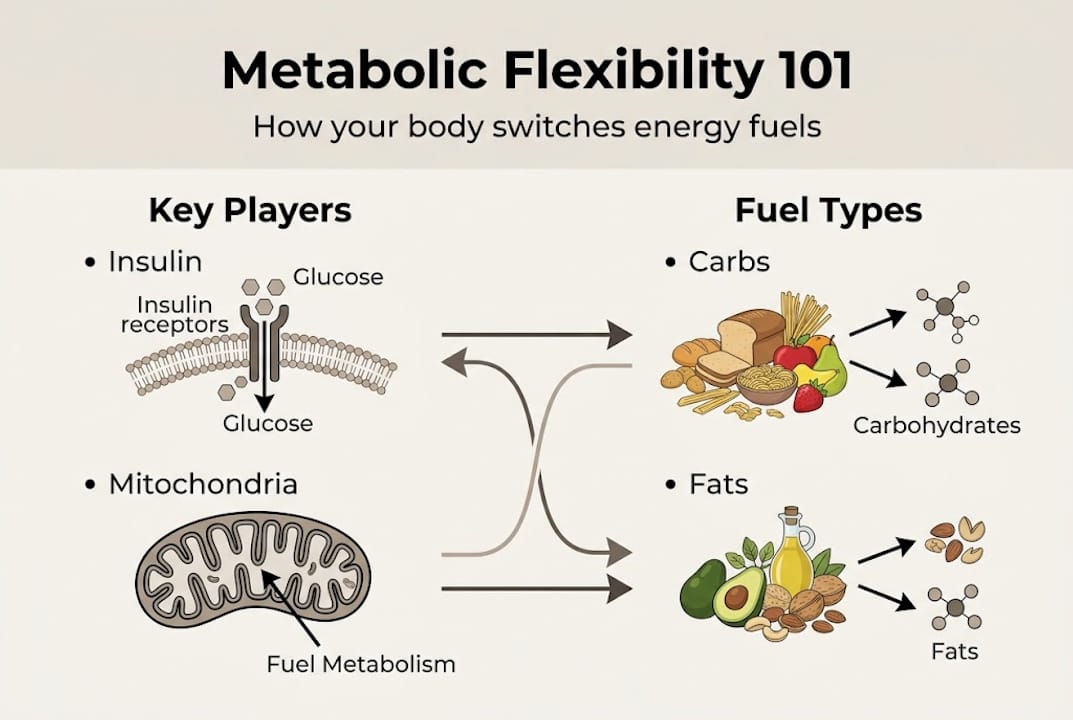
At its core, metabolic flexibility is the ability to shift between carbohydrate and fat oxidation depending on the body’s physiological needs. During a fasted state or low-intensity activity, a healthy metabolism draws predominantly on fat. After a carbohydrate-rich meal or during high-intensity exercise, it switches efficiently to glucose. The problem is that millions of people have lost this switching ability without knowing it.
The cellular machinery behind this process is intricate. Insulin signalling, the PDH complex, and mitochondrial function all coordinate to determine which fuel gets burned and when. When insulin sensitivity is impaired or mitochondrial health declines, the system becomes rigid, defaulting to glucose even when fat burning would be more appropriate and efficient.
One useful way to track fuel use is the Respiratory Exchange Ratio (RER). An RER of approximately 0.7 indicates near-complete fat oxidation, while an RER close to 1.0 signals that carbohydrates are the dominant fuel. A flexible metabolism moves fluidly across this range. An inflexible one stays stubbornly close to 1.0, even at rest.
| RER value | Dominant fuel source | Metabolic state |
|---|---|---|
| ~0.70 | Fat | Fasted or low-intensity |
| ~0.85 | Mixed | Moderate activity |
| ~1.00 | Carbohydrate | High-intensity or postprandial |
Understanding why measure metabolic health in the first place becomes obvious when you see how much this ratio tells you. Key factors that influence metabolic flexibility include:
- Mitochondrial density and function: More mitochondria means greater fat-burning capacity.
- Insulin sensitivity: Poor sensitivity locks you into glucose dependence.
- Dietary composition: Chronic high-fat or high-carb intake can shift baseline oxidation patterns.
- Training status: Endurance-trained individuals typically show superior fat oxidation at matched intensities.
For a broader data-driven metabolic health guide, these mechanisms form the foundation of every personalised intervention.
How metabolic flexibility is measured: tools, trends and real-life application
To understand your own metabolic flexibility, you need to know how it is measured and what the numbers mean. The gold standard remains indirect calorimetry, which analyses the ratio of oxygen consumed to carbon dioxide produced to calculate RER in real time. Measurement via indirect calorimetry, monitoring changes in RER and RQ, is well established but comes with recognised protocol inconsistencies that matter when interpreting results.
Practical measurement approaches include:
- Fasting RER: Measured after an overnight fast to assess baseline fat oxidation capacity.
- Postprandial RER shift: How quickly and completely RER rises after a standardised meal reflects insulin-mediated fuel switching.
- Fatmax protocol: Exercise intensity is progressively increased to identify the point of maximal fat oxidation (MFO), expressed in grams per minute.
- Graded exercise test: RER is tracked across intensities to map the full oxidative flexibility curve.
| Measurement approach | Setting | Key output |
|---|---|---|
| Fasting indirect calorimetry | Lab or clinic | Baseline fat oxidation |
| Fatmax protocol | Lab | MFO and crossover point |
| Continuous glucose monitor | Home or clinical | Postprandial glucose response |
| Wearable metabolic sensors | Field | Estimated RER trends |
A resting metabolic test provides the fasting baseline, while an active metabolic analysis maps how your metabolism responds to increasing workloads. Wearables and continuous glucose monitors offer useful proxies but cannot replace direct calorimetry for precision.
Pro Tip: Avoid caffeine, intense exercise, and large meals for at least 12 hours before any metabolic flexibility test. Even minor deviations can shift your RER by 0.05 to 0.10 units, which is enough to misclassify your metabolic state. For a broader overview of testing metabolism, context and preparation matter as much as the test itself.
Why metabolic inflexibility matters: risks, consequences and early warning signs
Accurate measurement reveals if you are at risk, so it is essential to recognise what happens when metabolic flexibility breaks down. Metabolic inflexibility is linked to insulin resistance, obesity, type 2 diabetes, and cardiovascular disease. What makes this particularly important is that dysfunction often precedes overt diagnosis by years, sometimes decades.
Early warning signs include:
- Persistent energy crashes after meals, especially carbohydrate-heavy ones.
- Difficulty losing body fat despite caloric restriction or increased exercise.
- Poor recovery from training sessions, with prolonged muscle soreness.
- Elevated fasting glucose or insulin on routine blood panels.
- Brain fog and concentration difficulties, particularly in the late morning or afternoon.
“Metabolic inflexibility is not just a consequence of disease. In many cases, it is a precursor that can be detected and corrected before clinical thresholds are crossed.”
Research examining children with obesity found impaired carbohydrate oxidation during exercise, suggesting that inflexibility develops early and is not confined to middle-aged or older populations. This has significant implications for health optimisation protocols aimed at prevention rather than treatment.
From a performance standpoint, athletes with poor metabolic flexibility hit the wall earlier, recover more slowly, and rely excessively on carbohydrate fuelling strategies that are unsustainable across longer events. HIIT has been shown to be more effective than moderate-intensity continuous training for improving flexibility, particularly in individuals with obesity. For a structured approach to addressing these issues, an improving metabolic health workflow provides a logical starting point, and a metabolic improvement checklist can help you track progress systematically.

Diet, exercise and genetics: personalised strategies to enhance metabolic flexibility
With the risks in mind, here is how you can actively boost your own metabolic flexibility through food, movement, and tailored protocols. There is no single intervention that works for everyone, but certain principles apply broadly.
Dietary strategies:
- Prioritise slowly digestible carbohydrates such as legumes, oats, and root vegetables over refined grains and sugars.
- Traditional high-quality carbohydrate diets, such as those typical in Kenyan populations, are associated with better metabolic flexibility than Western dietary patterns.
- Reduce ultra-processed food intake, which chronically elevates insulin and blunts fat oxidation capacity.
- Time carbohydrate intake around exercise to support performance without suppressing fat metabolism at rest.
Exercise interventions:
- Incorporate HIIT two to three times per week. HIIT is more effective than MICT (moderate-intensity continuous training) for improving metabolic flexibility in individuals with obesity.
- Add low-intensity fasted movement such as morning walks to reinforce fat oxidation pathways.
- Use resistance training to increase muscle mass, which directly expands mitochondrial capacity and glucose disposal.
- Apply Fatmax protocols periodically to train specifically at the intensity that maximises fat burning.
Pro Tip: Genetics shape how quickly you respond to these interventions. Variants in genes governing mitochondrial biogenesis and insulin signalling can mean that two people following identical protocols see very different results. DNA-level data can personalise your approach significantly, removing the guesswork from strategy selection.
For a structured path forward, the workflows for metabolic improvement and personalised improvement checklist translate these principles into actionable steps you can implement progressively.
The hidden complexity of metabolic flexibility: what most advice gets wrong
Most content on metabolic flexibility reduces it to a single number, your MFO value or your fasting RER, and tells you to improve it. That framing misses the point entirely. No standardised protocol exists for measuring MFO, and the curve dynamics that reveal true flexibility are routinely ignored in simplified guides.
Sex differences, dietary history, time of day, and even recent sleep quality all shift your RER readings meaningfully. A single test snapshot tells you far less than a pattern of assessments over time. We have seen clients with impressive MFO values who still struggle with energy and recovery because their flexibility curve is narrow, meaning they are only efficient across a small range of intensities.
True metabolic flexibility is not a fixed trait you either have or lack. It is a dynamic, context-dependent capacity that requires ongoing measurement and recalibration. Chasing one metric without understanding the full picture is how people spend months on protocols that produce no meaningful change. For a grounded view of what real-world metabolism test examples actually reveal, the nuance becomes clear quickly. Personalisation and repeated assessment are not optional extras. They are the entire point.
How AI Healthician can help you optimise metabolic flexibility
For those ready to turn knowledge into results, AI Healthician offers bespoke tools and expert support built around exactly this kind of precision.

Our active metabolic test maps your full oxidative flexibility curve across exercise intensities, identifying your Fatmax, crossover point, and fuel-switching capacity with clinical accuracy. DNA health testing reveals the genetic factors shaping your individual response to diet and exercise, so your protocol is built around your biology rather than population averages. For those seeking a complete roadmap, the longevity blueprint consultation integrates all of this data into a structured, long-term strategy. If metabolic flexibility is the engine of your health, we help you tune it precisely.
Frequently asked questions
Can metabolic flexibility be improved at any age?
Metabolic flexibility declines with age but remains responsive to targeted diet, exercise, and lifestyle interventions at any stage of adulthood. Consistent effort produces measurable improvements regardless of starting point.
Which test best assesses metabolic flexibility?
Indirect calorimetry measuring RER during fasting and exercise is considered the most accurate method, though results should always be interpreted within the context of your individual health history and protocol conditions.
How can diet make a difference to metabolic flexibility?
Consuming slowly digestible carbohydrates and minimising processed foods enhances fat oxidation capacity. Diet quality in traditional carb-rich diets consistently outperforms Western dietary patterns on measures of metabolic flexibility.
What are early signs of metabolic inflexibility?
Persistent fatigue, difficulty losing weight, poor exercise recovery, and fluctuating blood sugar are common early indicators. Performance and metabolic impairments often precede clinical diagnosis by years, making early detection genuinely valuable.


