


 matt@aihealthician.co.uk


TL;DR:
- Integrative health combines evidence-based conventional treatments with personalized complementary approaches focusing on the whole person. Clinical trials indicate it can improve pain, mental health, and quality of life, especially in chronic conditions. However, successful outcomes depend on data-driven, patient-centered implementation and expert guidance, not shortcuts or generic strategies.
Most people assume health care sits neatly in two camps: the conventional medicine their GP provides, or the “alternative” therapies found outside mainstream practice. Integrative health occupies neither category cleanly, and that ambiguity creates genuine confusion. Yet 14 clinical trials published in high-impact journals found consistent improvements in mental health, pain, and quality of life for people with non-communicable diseases under integrative care. The opportunity is real. The question is how to navigate it intelligently, without falling for oversimplification or unfounded enthusiasm.
Table of Contents
- Defining integrative health: Principles and real-world application
- The science: Evidence and outcomes of integrative health
- Integrative vs conventional medicine: Key differences and challenges
- What to expect: Integrative health in practice and the patient journey
- Our take: Why integrative health’s promise and pitfalls matter now
- Take your first step: Personalised integrative health solutions
- Frequently asked questions
Key Takeaways
| Point | Details |
|---|---|
| Patient-centred approach | Integrative health combines mainstream and complementary therapies based on your individual needs. |
| Supported by research | Clinical trials show benefits for chronic pain, fatigue, and quality of life with integrative strategies. |
| Real trade-offs exist | Integrative care may demand more time, variable evidence, and is not always covered by insurance. |
| Personalisation is key | Success depends on tailored plans—DNA and metabolic tests help guide evidence-based choices. |
| Assess readiness | Know what to expect and ask the right questions for the best outcomes on your health journey. |
Defining integrative health: Principles and real-world application
Integrative health is not a rejection of conventional medicine, nor is it a wholesale embrace of unproven therapies. At its core, it is a model of care that intentionally combines evidence-backed conventional treatments with complementary approaches, all coordinated around the individual patient’s biology, context, and goals.
The guiding principles are distinct:
- Patient-centred: Decisions are shaped by the individual’s full health picture, not just a single symptom or diagnosis
- Holistic: Physical, mental, social, and environmental factors are all considered as interconnected contributors to health
- Preventive: The aim is to reduce disease risk and optimise function, not simply manage illness once it appears
- Science-guided but personalised: Therapies are selected based on evidence, then adapted to the individual rather than applied uniformly
Common therapies included under the integrative umbrella range from nutrition therapy, mind-body practices (such as mindfulness and breathwork), acupuncture, and physical therapies, to targeted supplementation and behavioural medicine. These are not used instead of clinical care but alongside it.
The critical distinction with “alternative” medicine is this: integrative health does not abandon conventional medicine’s rigour. It extends the lens. Understanding functional health principles can help clarify where integrative and functional approaches overlap and diverge, since both emphasise personalisation but differ in methodology.
As conventional medicine excels in acute care settings but can fall short in chronic condition management, integrative health fills a meaningful gap, though it brings its own challenges around insurance coverage, practitioner availability, and evidence consistency.
Pro Tip: If a practitioner describes their approach as “integrative” but dismisses all conventional diagnostics, that is a red flag. Genuine integrative care uses conventional biomarkers and testing as its starting point, then builds a personalised layer on top.
The science: Evidence and outcomes of integrative health
Setting the context is useful, but what the research actually shows is what separates credible integrative health from wellness marketing. The evidence base has grown significantly over the past decade, with particular strength in specific conditions.
“Fourteen clinical trials published in high-impact journals found consistent improvements in mental health, pain, and quality of life for individuals with non-communicable diseases receiving integrative care. Fatigue reduction was a particularly robust finding across multiple intervention types.”
The data on back pain is striking. In specialist back pain clinics, 70% of patients received guideline-concordant non-pharmacological treatments, with modest but meaningful reductions in pain interference at 12 months (mean difference of minus 1.98). This is not a dramatic overnight transformation, but for individuals living with chronic pain, a sustained, measurable reduction achieved without escalating medication is clinically significant.
| Condition | Strongest evidence therapies | Key outcomes measured |
|---|---|---|
| Chronic back pain | Acupuncture, mindfulness, physical therapy | Pain interference, function |
| Cancer-related symptoms | Mind-body, acupuncture, nutrition | Fatigue, nausea, quality of life |
| Mental health and anxiety | Mindfulness, yoga, therapy integration | Depression scores, resilience |
| Fatigue (general/chronic) | Lifestyle medicine, pacing, nutrition | Energy, sleep quality |
| Metabolic conditions | Nutritional therapy, exercise medicine | Glycaemic control, inflammation |
Core research-supported benefits, listed by strength of evidence:
- Reduced pain intensity and interference in chronic musculoskeletal conditions
- Lower fatigue scores in cancer patients and those with chronic illness
- Improved mental health outcomes, particularly anxiety and depression
- Better quality of life ratings across multiple non-communicable disease groups
- Enhanced patient engagement and self-management capability
For those focused on optimising outcomes for chronic pain or using personalised wellness strategies to address fatigue and resilience, the evidence is increasingly difficult to dismiss. The caveat is that evidence strength varies considerably depending on the condition and the specific therapy combination used.
Integrative vs conventional medicine: Key differences and challenges

Understanding effectiveness is only the first step. The decision to pursue integrative care requires weighing its genuine strengths against real-world limitations, not just philosophical preferences.
| Feature | Integrative health | Conventional medicine |
|---|---|---|
| Primary focus | Whole person, root causes, prevention | Diagnosis and treatment of disease |
| Approach to chronic conditions | Individualised, lifestyle-centred | Pharmacological, protocol-driven |
| Evidence base | Growing but variable by therapy | Extensive, standardised |
| Insurance and access | Often limited coverage | Broadly covered |
| Patient engagement | High, co-produced care plans | Variable |
| Time investment | Substantial | Typically efficient |
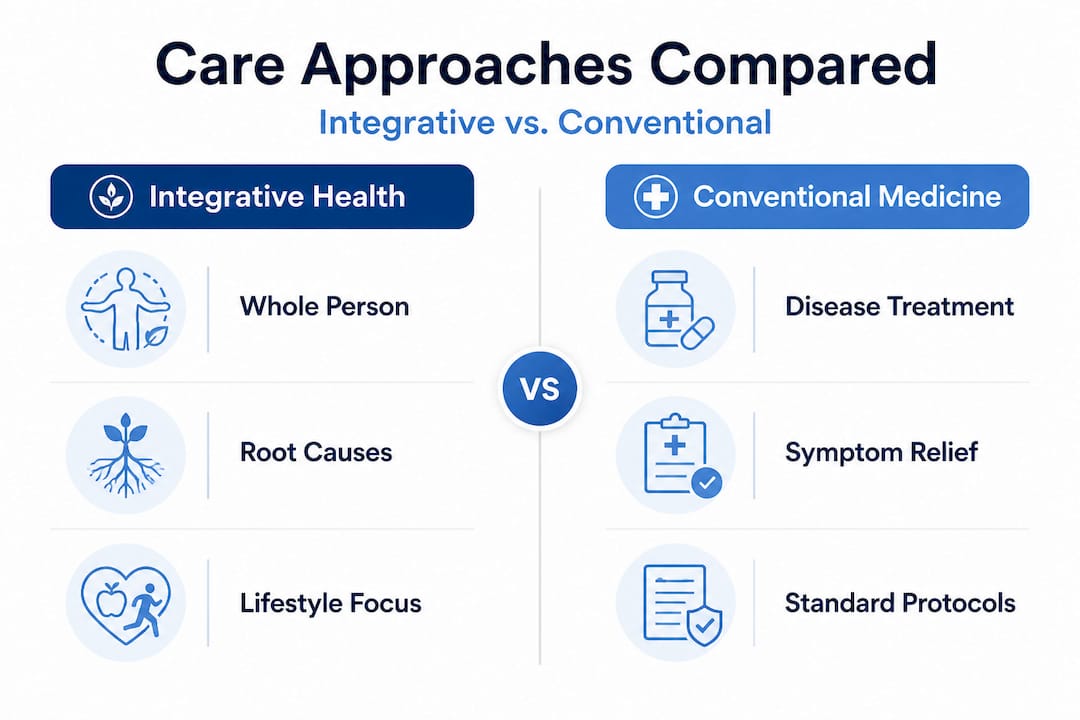
The strengths of integrative care are most visible in chronic, complex conditions where conventional medicine struggles to provide lasting resolution. This is precisely where precision health approaches become valuable, because individual variation in response to therapy is high and requires data-informed personalisation.
Where integrative care can fall short:
- Acute emergencies: Conventional medicine is irreplaceable for trauma, infection, cardiac events, and surgical needs
- Standardisation: Quality and training vary widely between integrative practitioners
- Time and cost: Meaningful integrative programmes require significant personal investment
- Insurance barriers: Most complementary therapies remain out-of-pocket expenses in the UK and many other countries
- Evidence inconsistency: Some therapies have compelling data; others are based primarily on tradition or limited studies
Surveys do reflect strong patient satisfaction. 80% of patients report better outcomes and 93% report improved patient experience when integrative care is part of their health journey. However, these are patient-reported measures and should be interpreted alongside clinical trial data rather than in isolation.
Despite this, physician scepticism persists, largely due to concerns about standardisation issues and inconsistent training pathways across the integrative space. This is a legitimate concern worth taking seriously.
Pro Tip: Before choosing an integrative practitioner, ask how they integrate with your existing medical team, what testing they use to inform recommendations, and how they measure and track your outcomes. If the answers are vague, look elsewhere.
What to expect: Integrative health in practice and the patient journey
Abstract principles only go so far. What matters is what actually happens when you enter an integrative health programme. The patient journey typically follows a structured but adaptive process.
- Initial assessment: A thorough intake that goes well beyond symptom review. This includes functional testing, metabolic markers, lifestyle history, sleep data, stress indicators, and often genetic or microbiome analysis where relevant
- Goal definition: Collaborative setting of health priorities. Whether that is reducing fatigue, improving metabolic health, or reducing disease risk, the goals shape the protocol
- Personalised protocol design: A multi-modal plan is constructed, integrating nutrition, physical activity, targeted supplementation, mind-body strategies, and any relevant conventional medical interventions
- Interdisciplinary team involvement: Depending on complexity, this may include a GP or specialist, a registered nutritionist, a physiotherapist, a psychologist, and a health coach working in a coordinated framework
- Monitoring and iteration: Regular follow-up appointments and retesting allow the protocol to evolve as your biology responds and your goals shift
- Long-term prevention focus: Unlike most conventional pathways that discharge once acute symptoms resolve, integrative care continues to build resilience and reduce future risk
Understanding comprehensive health assessment steps and aligning them with optimisation protocols for longevity are key structural elements of a credible integrative programme.
The WHO’s frameworks for integrating traditional and complementary medicine into health systems provide useful reference points, particularly regarding safety standards. Notably, acupuncture has positive evidence across 10 conditions and shows potential in over 80 more, making it one of the better-studied complementary modalities. Safety and evidence screening are non-negotiable features of any reputable integrative pathway.
Pro Tip: Before committing to an integrative programme, ask the following questions: What testing will be used to establish my baseline? How is progress measured objectively? Who oversees the programme and what are their credentials? Does the team communicate with my existing medical providers?
Our take: Why integrative health’s promise and pitfalls matter now
Having mapped the landscape, here is where honest reflection becomes important, particularly for high-performance individuals who approach their health with the same rigour they apply to professional performance.
The evidence base for integrative health is genuinely encouraging. Chronic pain responses, fatigue improvements, and quality of life gains are not marginal effects in well-designed trials. These are meaningful results for people whose lives are measurably constrained by symptoms that conventional medicine has not resolved. That matters and should not be minimised.
But the inconvenient reality is that outcome data does not automatically translate into clear individual protocols. Research identifying benefits at a population level still requires expert interpretation and personalisation at the individual level. Driven individuals often make the mistake of adopting integrative strategies wholesale, from comprehensive supplement stacks to intensive lifestyle interventions, without objective biological data guiding those choices. The result is wasted effort at best and physiological disruption at worst.
Evidence gaps are also real and worth naming directly. Certain comorbidities, such as diabetes combined with active cancer treatment, show less consistent benefit from integrative approaches, and the field still needs stronger randomised controlled trials in several key areas. Acknowledging this is not pessimism; it is how you avoid over-investing in areas where the evidence does not yet support the expectation.
The deeper issue for performance-focused individuals is this: integrative health is not a shortcut or an upgrade you apply once. It is a systematic, data-informed process that requires patience, objective measurement, and willingness to revise your approach based on results. The individuals who extract the most value from it treat it the same way they treat training or business performance, with metrics, feedback loops, and expert guidance.
“Combining biological data, professional clinical oversight, and self-awareness creates the conditions where integrative health strategies actually deliver. Without all three, the approach remains aspirational rather than transformative.”
There is also an underappreciated dimension around workplace wellness enhancements: integrative health strategies can profoundly affect cognitive performance, stress resilience, and energy management, outcomes that matter deeply to professionals who need sustained high performance across long working days. This intersection is still under-discussed in most integrative health literature.
Take your first step: Personalised integrative health solutions
The evidence is clear, but evidence without action is just information. If integrative health is going to improve your performance, longevity, or resilience, the starting point is always objective data about your own biology.
At AI Healthician, our health diagnostics and optimisation service takes the integrative framework seriously. We use advanced functional testing, metabolic analysis, and data-driven protocol design to identify where your biology needs support and build precise, personalised strategies around that insight. From DNA and metabolic testing through to full health optimisation assessments, our approach gives you the objective foundation that integrative health requires to work properly. You will know exactly where to focus, what interventions are justified by your data, and how to measure progress. That is the difference between a genuine integrative strategy and wellness guesswork.
Frequently asked questions
How does integrative health differ from functional medicine?
Integrative health focuses on combining conventional and complementary therapies for overall well-being, while functional medicine, as these approaches compare, places greater emphasis on root-cause diagnosis and individual biochemical analysis.
Is integrative health supported by scientific evidence?
Yes. Consistent improvements in chronic pain, fatigue, mental health, and cancer symptoms have been documented across multiple clinical trials, though evidence strength varies significantly by condition and therapy type.
What conditions benefit most from integrative health?
Chronic conditions including back pain, persistent fatigue, anxiety, depression, and cancer-related symptoms show the strongest evidence gains from well-designed integrative care programmes.
What are some limitations of integrative health?
It is less consistently effective in certain complex comorbidities, requires stronger randomised trials in several areas, and practical barriers such as cost, time commitment, and inconsistent practitioner training remain real challenges for many individuals.


