


 matt@aihealthician.co.uk


TL;DR:
- Proactive disease risk tracking uses genetics, biomarkers, and lifestyle data for early prevention.
- Combining polygenic risk scores with clinical data enhances accuracy and can save lives.
- Continuous, integrated health monitoring shifts focus from reactive treatment to personalized prevention.
Why track disease risk: personalise your health in 2026
Most people assume that screening and health checks are for those who are already unwell. That assumption is quietly dangerous. The biology of chronic disease tells a different story: conditions like cardiovascular disease, type 2 diabetes, and colorectal cancer develop silently over years, giving no warning until significant damage is done. Precision prevention shifts that dynamic by turning your genetic makeup, biomarkers, and lifestyle data into a personalised risk map long before illness takes hold. This article unpacks what disease risk tracking actually involves, what the science currently supports, and how you can use it to make genuinely informed decisions about your health.
Table of Contents
- What does it mean to track disease risk?
- How personalised risk tools are changing healthcare
- What the latest evidence teaches us (and the grey areas)
- How to put disease risk tracking into practice
- Our perspective: what most people miss about tracking disease risk
- Take the next step: discover your personalised health risk profile
- Frequently asked questions
Key Takeaways
| Point | Details |
|---|---|
| Precision prevention | Proactive risk tracking lets you personalise prevention—even years before symptoms develop. |
| Powerful new tools | Combining genetic analysis with health records improves early diagnosis and tailored screening. |
| Integrated action matters | Real benefit comes from understanding and acting with all available data, not just one test. |
| Practical health gains | Tracking risk leads to earlier interventions, better outcomes, and long-term peace of mind. |
What does it mean to track disease risk?
Disease risk tracking is not the same as getting a standard blood test at your GP once a year. It is a structured, ongoing process that combines multiple data sources to build a dynamic picture of your individual risk for specific conditions. The three core pillars are genomics (your inherited genetic variants), biomarkers (measurable biological signals in blood, urine, or tissue), and lifestyle and environmental data (sleep, activity, diet, stress exposure).
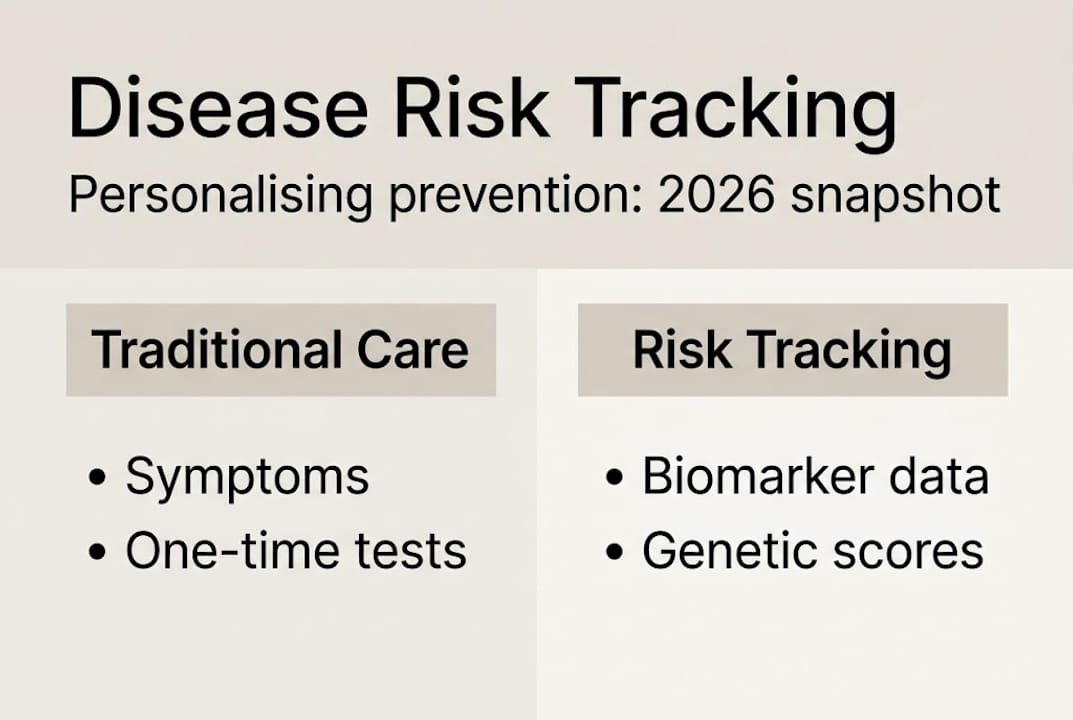
Traditional healthcare operates reactively. You feel unwell, you book an appointment, a clinician interprets your symptoms and responds. That model works for acute illness. It fails badly for chronic disease, where the damage accumulates quietly for a decade or more before a symptom appears. The benefits of health data tracking become most visible precisely in this gap: the years between biological change and clinical presentation.
Proactive tracking works differently. It uses your biological data to establish a baseline, then monitors deviation from that baseline over time. Rather than waiting for your LDL cholesterol to spike before addressing cardiovascular risk, proactive tracking identifies the trajectory early, when dietary and lifestyle interventions are most effective and least costly.
The key elements of a robust disease risk tracking programme include:
- Genomic profiling: identifying inherited variants that elevate risk for specific diseases
- Routine and advanced biomarker panels: including inflammatory markers, metabolic indicators, and hormonal data
- Continuous monitoring: wearable data capturing heart rate variability, glucose fluctuations, and sleep architecture
- Personalised health plans: integrating all data into actionable protocols tailored to your biology
Simply tracking lifestyle habits or relying on how you feel leaves enormous gaps. Many people with elevated cardiovascular risk feel completely fine. Many with early metabolic dysfunction have normal energy levels. Subjective experience is a poor proxy for physiological reality, which is precisely why preventative health strategies grounded in objective data matter so much.
| Approach | Data used | When it acts | Outcome focus |
|---|---|---|---|
| Reactive care | Symptoms | After illness appears | Treatment |
| Standard screening | Age and risk factors | Scheduled intervals | Early detection |
| Proactive risk tracking | Genetics, biomarkers, lifestyle | Continuously | Prevention and optimisation |
Pro Tip: If you start tracking your biological risk markers in your thirties or forties, you create a 10 to 20 year window to intervene before most chronic diseases become clinically significant. That window is where the real leverage sits.
How personalised risk tools are changing healthcare
Polygenic risk scores, commonly referred to as PRS, represent one of the most significant advances in personalised medicine in the past decade. A PRS aggregates the effect of thousands of small genetic variants across your genome, each individually modest in impact but collectively capable of identifying individuals at substantially elevated risk for conditions like coronary artery disease, breast cancer, or type 2 diabetes. Unlike many biomarkers, a PRS is stable across your lifetime. You measure it once, and it provides a permanent reference point for inherited susceptibility.
The power of PRS becomes most apparent when combined with clinical data. Health risk profiling that integrates PRS with family history, primary care records, and current biomarker status produces a dramatically more accurate risk picture than any single data source alone. Research involving more than 23,000 individuals confirmed that PRS with clinical factors improved risk stratification across 11 chronic diseases simultaneously, demonstrating both the breadth and the practical utility of this approach.
Here is how a PRS-guided screening programme typically works in practice:
- Genetic testing: A saliva or blood sample is processed to generate your polygenic risk score for one or more target conditions.
- Clinical integration: Your PRS is combined with primary care records, family history, current biomarkers, and lifestyle data.
- Risk stratification: You are placed into a low, intermediate, or high-risk category, each with a different recommended screening pathway.
- Tailored screening schedule: High-risk individuals begin screening earlier and more frequently; low-risk individuals may safely extend intervals.
- Intervention trigger: Findings at any point prompt clinical or lifestyle interventions, with outcomes continuously re-evaluated.
The outcomes data here is striking. PRS-guided screening can reduce premature deaths by 23.3% and initiates screening up to 10.8 years earlier for high-risk individuals compared to standard age-based programmes. Think about what that number means in practical terms: nearly a decade of additional lead time to detect, monitor, and address a condition before it becomes life-threatening.
| Metric | Standard screening | PRS-guided screening |
|---|---|---|
| Age screening begins | Fixed by population average | Individually calibrated |
| Deaths prevented | Baseline | Up to 23.3% reduction |
| High-risk lead time | Standard | Up to 10.8 years earlier |
| Resource allocation | Uniform | Risk-stratified |
When you combine analysing biomarkers with a validated genetic risk score, the result is a genuinely personalised clinical roadmap. That is a meaningful departure from the one-size-fits-all model most people are still navigating.

What the latest evidence teaches us (and the grey areas)
The research case for personalised risk tracking is strong, but it is not without nuance. Understanding what the evidence actually says, including its limits, makes you a more informed participant in your own health management.
What most influences the accuracy of a risk prediction? The data hierarchy is clearer than many people expect:
- Primary care and medical records: Short-term risk prediction relies heavily on clinical records, accounting for 41 to 43% of predictive power in colorectal cancer risk modelling
- Genomic data (PRS): Adds substantial independent value, particularly for long-term risk and complex, multifactorial diseases
- Lifestyle factors: Contribute meaningfully but are often underweighted in static models because they require consistent, longitudinal tracking to register accurately
- Dynamic machine learning models: EHR-based dynamic models outperform static risk calculators by continuously updating as new data becomes available
This hierarchy matters because it challenges a popular misconception: that a single genetic test tells you everything you need to know. It does not. Genetics provides a fixed prior probability. Your clinical history, biomarker trends, and lifestyle choices are what shift that probability up or down over time.
There are genuine equity issues in the current PRS landscape worth acknowledging. Most polygenic risk score research has been conducted in populations of European ancestry, which limits transferability across diverse ethnic groups. Validation studies in South Asian, African, and East Asian populations are improving, but the field is not yet at parity. If you come from a population underrepresented in genomic research, interpret PRS results with that context in mind.
In prostate cancer, PRS improved detection rates by over 70% compared to standard pathways, demonstrating that genetic risk stratification can transform outcomes even in well-established screening programmes.
Overdiagnosis is another legitimate concern. Risk stratification tools, if poorly implemented, can trigger unnecessary investigations, procedures, and anxiety. The solution is not to avoid tracking but to use integrated data and experienced clinical interpretation rather than acting on a single metric in isolation.
Proactive health management works best when risk information feeds into a structured, clinically supervised plan rather than prompting reactive panic based on a single reading. Context transforms data into insight.
Pro Tip: Never act on a single biomarker or genetic finding in isolation. Meaningful risk assessment comes from integrating multiple data streams over time, not from one-off snapshots. The pattern matters more than any single data point.
How to put disease risk tracking into practice
Knowing the science is useful. Knowing what to actually do with it is where most people need the most support. Here is a practical framework for getting started with disease risk tracking and turning insights into lasting health improvements.
Step 1: Establish your genetic baseline Begin with a validated genomic test that includes polygenic risk scores for the conditions most relevant to you, such as cardiovascular disease, type 2 diabetes, and relevant cancers. This gives you a fixed reference point for inherited susceptibility that you will build on with dynamic data.
Step 2: Run a comprehensive biomarker panel Baseline biomarker tracking should cover inflammation markers (hs-CRP, IL-6), metabolic indicators (fasting insulin, HbA1c, lipid fractions), hormonal markers, and nutrient status. This panel tells you where your physiology actually sits today, independent of how you feel.
Step 3: Integrate lifestyle and monitoring data Add continuous or regular tracking of sleep quality, physical activity, and if relevant, continuous glucose monitoring. Wearable data adds a real-world layer that laboratory tests alone cannot capture.
Step 4: Build your personalised health plan This is where the data becomes actionable. A precision prevention framework incorporates personalised lifestyle interventions, targeted nutritional strategies, and care pathways calibrated to your specific risk profile rather than population averages.
Step 5: Schedule regular re-evaluation Risk is not static. Your biomarkers shift with age, lifestyle changes, and environmental exposures. Revisit your full risk profile at least annually, more frequently if you are managing active risk factors or implementing significant interventions. Tracking trends over time is far more informative than any single measurement.
The key benefits of acting early, before symptoms or diagnosis, include:
- Reversibility: Many metabolic and inflammatory risk factors respond dramatically to early intervention before structural damage occurs
- Cost efficiency: Preventing a condition is substantially less expensive than treating it, both financially and in terms of quality of life
- Psychological clarity: Understanding your actual risk profile reduces health anxiety caused by uncertainty far more effectively than avoidance does
- Optimisation window: Early tracking allows you to target metabolic health improvement during the years when intervention produces the greatest long-term return
Pro Tip: Pair your risk data with professional coaching or clinical oversight. Data without interpretation is just numbers. Working with a practitioner who understands functional and preventive medicine transforms risk tracking from an intellectual exercise into a genuinely life-changing protocol.
Our perspective: what most people miss about tracking disease risk
Here is something worth saying plainly: more data does not automatically produce better health outcomes. We see this pattern regularly. Someone runs a comprehensive genetic panel, gets back a detailed risk report, and either dismisses it entirely or becomes overwhelmed by it. Neither response is useful.
The real value of disease risk tracking lies not in the data itself but in what you do with it. A polygenic risk score for cardiovascular disease means very little without a structured plan that addresses the modifiable factors sitting alongside that inherited predisposition. Data analysis for health performance is where the leverage actually lives, not in the testing alone.
There is also a dangerous tendency to treat risk tracking as a one-time event. You do the tests, you get the results, you feel informed, and then life continues as before. But biology is dynamic. Your risk profile at 38 is not your risk profile at 45. What the evidence supports is not a snapshot but a living, evolving health strategy that updates as your data updates. That is a fundamentally different mindset from the annual check-up model, and it requires ongoing engagement rather than periodic attention.
Take the next step: discover your personalised health risk profile
Understanding the science of disease risk tracking is a powerful starting point. But the real transformation comes from applying it to your own biology with the right tools and expert support behind you.
At AI Healthician, we combine validated DNA health testing with functional biomarker analysis and expert-guided interpretation to build a genuinely personalised risk and optimisation protocol for you. Whether you want to understand your inherited disease risk, baseline your metabolic health, or build a long-term prevention strategy, our metabolic testing packages provide the physiological depth your decisions deserve. The best time to understand your health trajectory is well before a symptom ever appears. Start with the data that actually matters.
Frequently asked questions
What is the main benefit of tracking disease risk?
The main benefit is earlier, personalised prevention. Proactive risk tracking enables you to act on biological signals years before illness becomes clinically apparent, when interventions are most effective.
How accurate are polygenic risk scores for disease prediction?
Polygenic risk scores are a validated tool for identifying high-risk individuals, and PRS-guided screening can reduce premature deaths by 23.3%, though accuracy varies by disease type and the population in which the score was developed.
Is tracking disease risk useful for everyone?
Yes, though the magnitude of benefit varies. Those with a strong family history or known risk factors gain the most, but primary care data and PRS combined add independent predictive value for most individuals regardless of baseline risk.
What information is most important for disease risk prediction?
Medical records and genetic data are the strongest drivers of accurate risk prediction. Clinical records alone account for 41 to 43% of short-term risk prediction power, with PRS adding the most value for long-term and complex disease trajectories.


