


 matt@aihealthician.co.uk


TL;DR:
- Most wearables rely on PPG sensors to passively monitor heart rate and blood oxygen, but their data accuracy can be affected by motion and interference.
- Clinically valid insights require understanding these sensors’ limitations, as most consumer metrics serve as trend indicators rather than diagnoses.
- Interpreting wearable data effectively depends on long-term context, personal baselines, and awareness that proprietary algorithms are approximations, not definitive medical assessments.
Your wearable device generates more physiological data in a single night than a GP appointment covers in a year. Yet most users glance at a sleep score or a heart rate variability number and either dismiss it or, worse, treat it as a diagnosis. Explaining wearable health data properly is not about simplifying the numbers; it is about giving you the right framework to interpret them. This article covers sensor technology, clinical validity, key metrics, and how to build a practical approach to using your data for genuine wellness and performance gains.
Table of Contents
- How do wearable devices measure your health data?
- Clinical validity: what your wearable data really means for your health
- Interpreting key metrics: heart rate, heart rate variability, and sleep data
- Making sense of trends: why context and longitudinal data matter most
- Using wearable data wisely: practical tips for wellness, performance, and prevention
- Why mastering wearable data interpretation is the key to empowered health decisions
- Explore AI Healthician’s services to complement your wearable health journey
- Frequently asked questions
Key Takeaways
| Point | Details |
|---|---|
| Sensor differences matter | Wearable devices use different sensors like ECG or PPG which affect data accuracy and interpretation. |
| Data is mostly wellness trends | Most wearable metrics indicate behavioural patterns, not clinical diagnoses. |
| Focus on long-term trends | Interpreting data over time and versus personal baselines leads to clearer health insights. |
| Symptoms outweigh devices | How you feel is more important than any single wearable alert for health decisions. |
| Combine data with expert testing | Use professional assessments alongside wearable data for personalised health optimisation. |
How do wearable devices measure your health data?
Understanding what your device is actually doing when it measures your heart rate or tracks your sleep is the foundation of everything else. Without this, you are reading outputs without knowing what went into them.
Most wearables rely on one of two core sensor types:
- ECG (electrocardiogram) sensors detect the electrical activity of the heart directly. They are clinically meaningful in specific scenarios, such as detecting atrial fibrillation, but require the user to actively initiate a reading by touching electrodes.
- PPG (photoplethysmography) sensors shine light into the skin and measure how blood volume changes with each heartbeat. This is the standard method for continuous, passive monitoring. It is convenient, but it is also susceptible to motion artefacts, skin tone variation, and poor fit.
The distinction matters because most of the data you see daily, including resting heart rate, blood oxygen saturation, and continuous HRV, comes from PPG. As cardiologists at the University of Colorado note, ECG can be useful in limited situations, PPG sensors can be inaccurate due to motion and interference, and many derived metrics rely on proprietary algorithms without strong clinical support.
Beyond raw sensor readings, devices compute derived metrics. Your sleep score, readiness score, or stress index are not direct measurements. They are algorithmic outputs built on combinations of heart rate, movement, skin temperature, and other signals. The algorithm is proprietary. You cannot audit it. This is not a reason to distrust your device entirely, but it is a reason to understand that data-driven wellness and precision health require more than accepting a single number at face value.

Pro Tip: Wear your device consistently on the same wrist, with a snug but not tight fit, and avoid checking it during exercise when PPG accuracy drops sharply. Consistency in how you wear it dramatically improves the reliability of longitudinal data.
For those interested in continuous health monitoring, understanding sensor type is the first step to knowing which readings to trust and which to treat as approximate.
Clinical validity: what your wearable data really means for your health
Having understood how wearables gather data, it is essential to evaluate their clinical relevance before trusting the numbers for health decisions.
There is a critical difference between a device that measures accurately and one whose measurements are clinically meaningful. Regulatory and research frameworks break this down into three distinct steps:
- Verification confirms the device measures what it claims, for example, that the heart rate reading matches a reference standard.
- Validation confirms the measurement has meaningful clinical use for a specific condition or decision, such as whether a low HRV score reliably predicts cardiovascular risk.
- Usability ensures users can reliably obtain accurate data in their real-world environment, not just in a controlled lab.
As Sakara Digital’s clinical evidence framework explains, verification, validation, and usability are distinct steps required to ensure wearable data is accurate, clinically meaningful, and reliable for intended users and settings. Most consumer wearables pass verification to varying degrees. Very few are validated for clinical decision-making.
Wellness wearables must avoid disease-related claims and should be interpreted primarily as behavioural and trend indicators unless explicitly clinically validated. FDA general wellness policy
This is not a technicality. It shapes how you should use your data. A high resting heart rate on your device is a prompt to investigate further, not a diagnosis of cardiac dysfunction. A low blood oxygen reading during sleep is a reason to speak to a doctor, not confirmation of sleep apnoea.
The real benefits of health data tracking come from using these outputs as behavioural signals and trend indicators, not as clinical verdicts. Recognising this distinction is what separates informed users from anxious ones.
Interpreting key metrics: heart rate, heart rate variability, and sleep data
With clinical context understood, we now focus on the most frequently viewed metrics and how to use their data responsibly.
Key wearable metrics at a glance
| Metric | Sensor used | What it measures | Clinical grade? | Best used for |
|---|---|---|---|---|
| Resting heart rate | PPG | Beats per minute at rest | Approximate | Trend tracking over weeks |
| HRV | PPG (pulse intervals) | Variability between beats | Surrogate only | Recovery and stress patterns |
| Sleep stages | Accelerometer + PPG | Movement and heart rate patterns | Limited | Sleep/wake detection |
| SpO2 | PPG (red/infrared) | Blood oxygen saturation | Approximate | Flagging potential concerns |
| Skin temperature | Thermistor | Surface skin temp deviation | Trend only | Illness or cycle tracking |
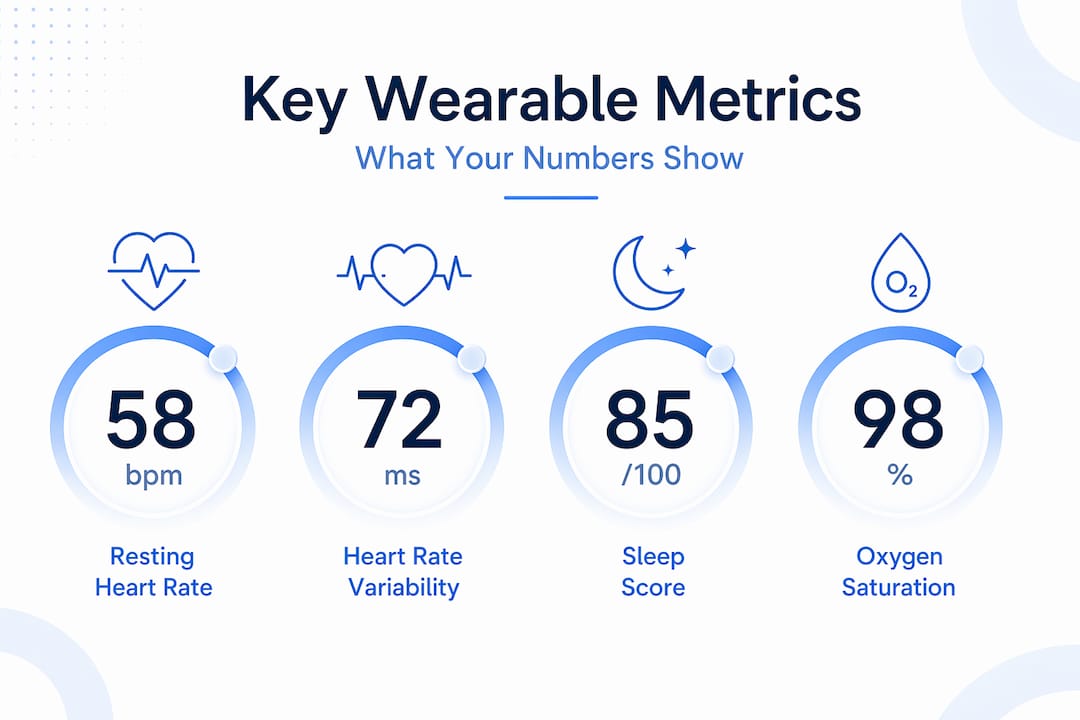
Heart rate is the most straightforward metric, but even here, PPG limitations apply. Motion during exercise can cause the sensor to misread cadence as heart rate, a well-documented artefact. For resting measurements taken after several minutes of stillness, accuracy is generally reasonable.
HRV is where misinterpretation is most common. As research published in Electronics confirms, wearable HRV metrics are computed from pulse-to-pulse intervals derived from PPG, which differ from the ECG R-R intervals used in clinical settings. Your device’s HRV number is a surrogate. It correlates with the clinical measure but is not identical to it. Use it to track your own patterns over time, not to benchmark against clinical reference ranges.
Sleep tracking is perhaps the most useful consumer application, with important caveats. Research on wearable sleep monitoring confirms that consumer devices detect sleep versus wakefulness with high sensitivity but do not yet match clinical polysomnography for precise sleep stage classification. Your device is reliable for telling you roughly how long you slept and whether you woke frequently. It is not reliable for telling you exactly how much deep sleep you achieved.
- Focus on weekly averages, not nightly scores
- Compare your data to your own baseline, not population averages
- Note external factors: alcohol, travel, illness, and stress all shift readings significantly
Pro Tip: If your HRV drops notably for three or more consecutive mornings without an obvious cause such as poor sleep or intense training, that pattern is worth paying attention to. A single low reading is almost always noise.
Pairing this understanding with insights from lifestyle data and performance gives you a richer picture of what your numbers are actually reflecting.
Making sense of trends: why context and longitudinal data matter most
Having clarified metric meanings, the next step is understanding how to use this data in daily health and wellness decisions.
The single most common mistake wearable users make is treating one day’s data as meaningful in isolation. It almost never is. Your resting heart rate on a Monday morning after a weekend of disrupted sleep and a long flight tells you very little about your cardiovascular health. It tells you a great deal about last weekend.
Large-scale population research from the All of Us Research Program shows systematic seasonal and longitudinal variations in activity and sleep data, emphasising the need to interpret data within personal and temporal context. Step counts drop in winter. Sleep duration shifts with daylight. These are population-wide patterns, not individual health events.
When to act on data vs when to wait
| Scenario | What it likely means | Recommended response |
|---|---|---|
| Single night of poor sleep score | Normal variability | Note it, continue as normal |
| Five consecutive nights of disrupted sleep | Meaningful pattern | Review sleep hygiene, consider stress factors |
| Resting HR elevated by 10+ bpm for three days | Possible illness or overtraining | Rest, monitor, seek advice if symptoms appear |
| HRV consistently lower than your baseline for a week | Recovery deficit | Reduce training load, prioritise sleep |
| SpO2 regularly below 94% during sleep | Worth investigating | Consult a healthcare professional |
The best practice, as the same research confirms, is within-person baseline comparisons and aggregation over time, preventing misinterpretation of single-day anomalies.
How to build a useful trend-reading habit:
- Establish your personal baseline over four to six weeks of consistent wearing
- Record external factors in a simple log: training load, alcohol, travel, illness, stress
- Review weekly averages rather than daily scores
- Flag patterns that persist for three or more days without an obvious external cause
- Bring meaningful trends, not individual readings, to any clinical conversation
The benefits of continuous health monitoring only materialise when you treat your wearable as a longitudinal tool, not a daily verdict machine.
Using wearable data wisely: practical tips for wellness, performance, and prevention
Finally, after learning how to interpret and contextualise data, let us consider what this means for health-conscious wearable users in practice.
Your wearable is a tool. Like any tool, its value depends entirely on how you use it. The most important principle is this: how you feel takes precedence over what your device says. As cardiologists advising on wearable use emphasise, symptoms guide decisions more than device readings. Do not assume good data means good health, or vice versa.
Practical guidelines for responsible wearable use:
- Symptoms override data. If you feel unwell, seek professional advice regardless of what your device shows.
- Use data to support behaviour change. Wearables are most powerful when they motivate better sleep, more movement, or stress reduction, not when they trigger medical anxiety.
- Avoid fixating on single scores. Proprietary wellness scores are useful for motivation, not for clinical inference.
- Set personal thresholds. Decide in advance what combination of symptoms and data trends would prompt you to consult a professional.
- Share trends with your healthcare provider. A week of exported data is far more useful in a clinical conversation than a screenshot of one bad night.
As clinical evidence frameworks make clear, wearables complement but do not replace professional medical evaluation. Use them to support, not determine, your health choices.
Pro Tip: Before your next GP or specialist appointment, export two to four weeks of your wearable data and bring a summary of any patterns you have noticed. This gives a clinician genuinely useful context and makes the conversation far more productive.
A comprehensive health assessment that integrates wearable trends with functional testing gives you a level of insight that neither approach achieves alone. Your device sees the surface. Deeper testing reveals what is driving it.
Why mastering wearable data interpretation is the key to empowered health decisions
Here is an uncomfortable truth about the wearable industry: the devices are designed to be engaging, and engagement is not always the same as accuracy. Proprietary scores, colour-coded readiness ratings, and sleep stage breakdowns are compelling. They are also, in many cases, algorithmically generated approximations dressed up as precision.
The consequence is that a significant number of users interpret these outputs as medical diagnoses. A poor readiness score becomes a source of genuine anxiety. A flagged irregular heart rhythm triggers a spiral of worry that a single ECG in a clinic could resolve in minutes. Research is unambiguous that misinterpretation of wearable data causes anxiety and unnecessary healthcare usage, and that clinical collaboration and critical data literacy are essential to mitigate this.
The solution is not to distrust your device. It is to develop what we would call wearable data literacy: understanding what each sensor actually measures, where the algorithmic layer begins, and what the clinical limits of the technology genuinely are. A user who understands that their HRV score is a PPG-derived surrogate, not an ECG measurement, will interpret a low score very differently from someone who assumes it is clinically equivalent.
The greatest value wearables offer is not diagnosis. It is pattern recognition over time and the behavioural nudges that follow. Users who use their devices to track whether lifestyle changes are working, whether sleep quality improves after reducing alcohol, or whether resting heart rate drops after a month of consistent training, are extracting real value. Those who use them to self-diagnose are setting themselves up for either false reassurance or unnecessary worry.
Explore the real benefits of health data tracking when it is approached with the right framework. The technology is genuinely powerful. The interpretation is what makes or breaks it.
Explore AI Healthician’s services to complement your wearable health journey
Your wearable gives you a continuous stream of surface-level physiological signals. What it cannot tell you is why those signals look the way they do. That requires deeper investigation.

AI Healthician’s testing services are designed to answer the questions your wearable raises but cannot resolve. DNA health testing can identify genetic predispositions that explain patterns in your physiological data, such as why your recovery consistently lags or why your metabolic response to training differs from the norm. Resting and active metabolic testing with 3D body scanning provides precise data on energy expenditure and body composition that no wrist-worn sensor can approximate. Whether you need active metabolic analysis to calibrate your training zones accurately or a resting metabolic assessment to understand your baseline energy needs, combining these results with your wearable trends creates a genuinely powerful health optimisation toolkit.
Frequently asked questions
Can wearable health devices replace professional medical diagnosis?
No. Wearables are designed for wellness tracking and trend monitoring, and they cannot substitute a professional medical diagnosis. The FDA general wellness policy is explicit that wellness devices must not output clinically mimicking values unless validated, meaning their outputs should inform behaviour, not clinical decisions.
Why do my wearable’s heart rate and HRV metrics differ from clinical measurements?
Wearable heart rate and HRV are derived from PPG signals and proprietary algorithms, which differ fundamentally from the ECG-based measurements used clinically. As confirmed by published HRV sensor research, wearable HRV is computed from pulse-to-pulse intervals rather than ECG R-R intervals, so variations between your device and a clinical reading are normal and expected.
How should I interpret sudden changes in my wearable’s sleep or activity data?
Sudden changes most often reflect normal variability, seasonal trends, or external factors such as travel, stress, or illness. Population-scale wearables research shows systematic seasonal and longitudinal variation in both sleep and activity data, so interpreting any change against your personal baseline and long-term patterns is always more meaningful than reacting to a single reading.
When should I seek medical advice based on wearable alerts?
Seek medical advice when you experience symptoms, or when a device alert coincides with a plausible clinical concern and persists over several days. As cardiologists advising on wearable use state clearly, if you do not feel well, consult a healthcare provider regardless of what your device readings show.


