


 matt@aihealthician.co.uk


TL;DR:
- Building a personalized daily health habits workflow based on timing and consistency enhances biological benefits and reduces health risks. Regular review, data tracking, and system flexibility are essential to maintaining progress amid life’s variability. Tailoring strategies through genetic and metabolic insights delivers more effective, sustainable health improvements.
Most people trying to improve their health focus on what to do rather than when and how consistently to do it. That gap explains why even well-informed, motivated individuals end up with fragmented routines that erode under pressure. A structured daily health habits workflow solves this at the systems level, not the willpower level. Consistent sleep timing alone correlates with a 38% lower risk of depression and 33% lower risk of anxiety, which tells you the schedule itself is doing biological work. This guide walks you through building, executing, and refining a workflow that actually holds.
Table of Contents
- Preparing your daily health habits workflow
- Executing your core daily habits: sleep, nutrition, and movement
- Troubleshooting common challenges in maintaining your workflow
- Verifying and optimising your daily health habits workflow over time
- Rethinking daily health habits for high performers: beyond checklists
- How AI Healthician supports your daily health habits workflow
- Frequently asked questions
Key Takeaways
| Point | Details |
|---|---|
| Consistent timing | Keeping regular sleep and wake times is crucial for better mental health and overall well-being. |
| Prioritise core habits | Daily nutrition and physical activity form the backbone of an effective health workflow. |
| Personalise your routine | Tailoring habits based on your data and lifestyle improves sustainability and results. |
| Review regularly | Frequent assessments and adjustments help maintain healthy behaviours long term. |
| Focus on timing | Habit timing and 24-hour balance matter more than checking off isolated behaviours. |
Preparing your daily health habits workflow
Before you schedule a single habit, you need a foundation. The most common mistake is treating healthy daily routines as a to-do list rather than a 24-hour time allocation problem. Every hour you spend doing one thing is an hour not spent doing another. Sleep competes with screen time. Movement competes with commuting. Once you frame the day as a fixed resource with competing demands, prioritisation becomes far more purposeful.
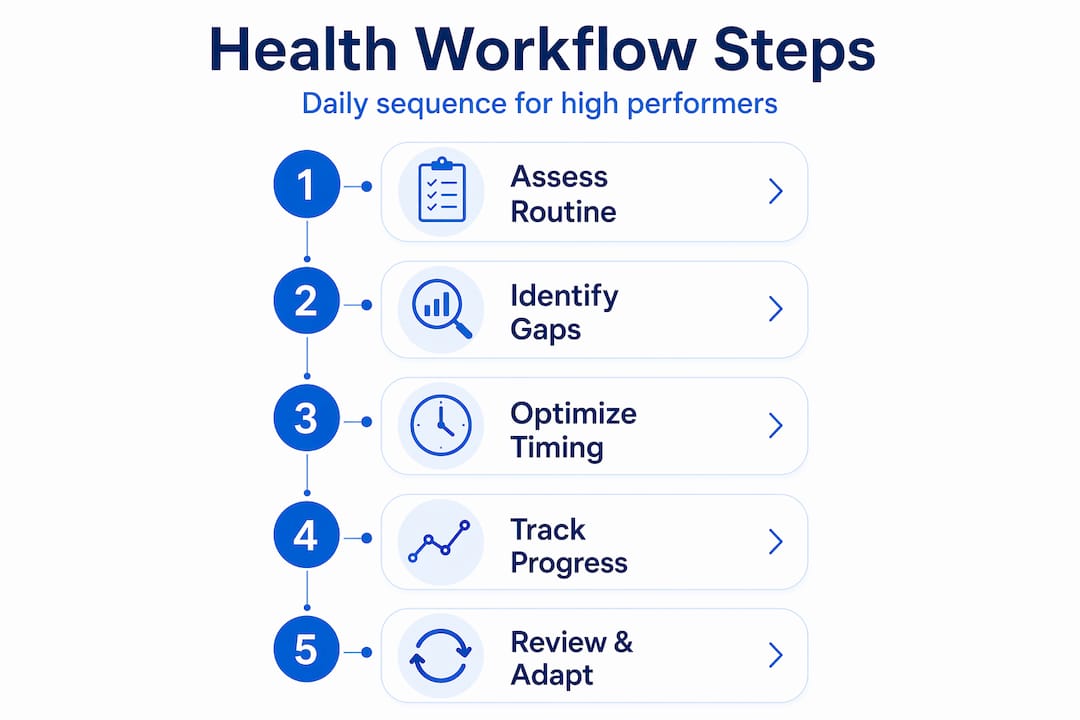
Start with a brief self-assessment across four domains: sleep quality and timing, daily movement patterns, meal timing and quality, and stress exposure. You do not need clinical-grade data at this stage. A one-week self-log using a wearable or even a paper diary reveals patterns most people genuinely do not notice until they see them written down.
Tools worth having before you begin:
- A sleep tracker (wearable or app-based) that records both duration and timing
- A food log, even a rough one, noting meal times rather than just content
- A basic activity monitor for step counts and active minutes
- A weekly calendar review slot of 15 to 20 minutes for workflow check-ins
The evidence is clear that a personalised 24-hour approach to balancing physical activity, sedentary behaviour, and sleep outperforms generic recommendations for every individual. One-size-fits-all morning health habits work for some and undermine others depending on chronotype, work structure, and baseline health.
| Self-assessment area | What to track | Why it matters |
|---|---|---|
| Sleep timing | Bedtime and wake time consistency | Circadian rhythm regulation |
| Movement | Daily steps, active minutes | Metabolic and mental health |
| Nutrition | Meal timing, skipped meals | Energy stability and mood |
| Stress load | Work hours, recovery time | Cortisol rhythm and resilience |
Pro Tip: Before adding any new habit, identify your single biggest timing gap. For most high performers, it is either irregular sleep timing or going five-plus hours without food during a demanding workday. Fix that first.
Exploring personalised health strategies before finalising your self-assessment can also highlight metabolic factors that standard habit guides overlook entirely.
Executing your core daily habits: sleep, nutrition, and movement
Now that you have your baseline and your tools in place, execution comes down to sequencing. Do not attempt to build every habit simultaneously. Anchor the three physiological pillars first: sleep, nutrition, and movement. Everything else, including stress management, social connection, and cognitive training, layers on top once the foundations are stable.
Step-by-step framework for core habit anchoring:
- Fix your wake time first. Choose a consistent wake time you can maintain seven days a week and hold it regardless of the previous night’s sleep quality. This is the single most powerful circadian reset tool available without a prescription.
- Assign meal windows, not just meal quality. Eating within a consistent 10 to 12 hour window each day supports metabolic health and prevents the mid-afternoon energy crashes that push most people towards caffeine and poor food decisions.
- Schedule movement as a non-negotiable appointment. Even 20 minutes of brisk walking, done at a consistent time daily, delivers measurable mental and physical benefits. The sustained benefits of diet and activity on both stress and sleep are well documented, reinforcing these as the primary levers to pull.
- Set a wind-down alarm, not just a bedtime. A 45-minute pre-sleep routine reduces sleep latency and, crucially, protects the consistency of your bedtime across high-stress periods.
- Audit and stabilise before adding. Spend two to four weeks confirming the three core habits are running reliably before introducing secondary habits.
The depression and anxiety risk reduction seen in individuals with consistent sleep timing holds regardless of total sleep duration. That finding reframes the goal entirely. It is not about getting eight hours every single night. It is about getting up and going to bed at the same time reliably.
Comparing movement types for different schedules:
| Exercise type | Time required | Primary benefit | Best suited to |
|---|---|---|---|
| Brisk walking | 20 to 30 min | Mental health, cardiovascular | All schedules |
| Resistance training | 40 to 50 min | Metabolic health, longevity | Structured days |
| Zone 2 cardio | 45 to 60 min | Fat oxidation, aerobic base | Flexible schedules |
| HIIT | 15 to 25 min | Time-efficient conditioning | Time-constrained days |

A solid nutrition personalisation guide can tell you far more about meal timing relative to your biology than any generic advice. Similarly, the broader health optimisation steps provide a structural map for layering additional habits once your core workflow is stable.
Pro Tip: Stack your movement habit with an existing anchor. If you always make coffee at 7am, put your training kit out next to the kettle the night before. The associative cue removes the decision point entirely.
The benefits of health data tracking become especially clear at this stage. Seeing your actual sleep timing variance, step counts, and meal windows over 30 days is consistently more motivating than any abstract health goal.
Troubleshooting common challenges in maintaining your workflow
Core habits in place does not mean challenges disappear. Every high performer encounters periods where travel, deadlines, illness, or life events disrupt their effective health routine. The workflows that survive these periods are not the most ambitious ones. They are the ones built with deliberate downgrade options.
The most common points of failure and how to address them:
- Timing drift: You start going to bed 30 minutes later each night until the consistency benefit has disappeared. Set a bedtime alarm rather than relying on fatigue as your cue.
- All-or-nothing collapse: Missing one day triggers abandonment of the full workflow. Plan a minimum viable version of each habit in advance. A 10-minute walk and a consistent wake time counts as a functional day.
- Meal timing erosion: Back-to-back meetings push lunch to 3pm, which then compresses dinner and disrupts sleep. Block a 20-minute meal slot in your calendar as you would any other commitment.
- Metric overload: Tracking too many variables creates cognitive burden that paradoxically reduces adherence. Track timing consistency first, quantity second, and quality third.
“Consistency often fails first at the timing layer, not the duration layer. Most people hit their sleep targets in terms of hours over a week, but their bedtimes vary by two or more hours night to night, which negates much of the benefit.” Adapted from UCLA Health research on routine and mental health.
Periodic workflow reviews matter more than most people realise. Research published in JAMA Network Open shows that maintaining a healthy lifestyle score over time directly correlates with reduced cardiometabolic risk, and that score tends to decline without deliberate review.
Building backup plans is not a sign of weakness in your workflow design. It is the mark of a system that will actually run for years rather than weeks. A full workout becomes a 15-minute bodyweight circuit. A balanced meal becomes a protein-first option from a known source. A regular bedtime during travel becomes a fixed wake time regardless of time zone. You protect the most critical variable and allow the rest to flex.
For broader context on building this kind of resilience into your approach, effective lifestyle changes grounded in data offer a more sustainable framework than motivational habit systems.
Verifying and optimising your daily health habits workflow over time
A workflow without verification is just intention. Sustained health improvement requires you to treat your daily habits with the same rigour you would apply to any other measurable goal: baseline, track, review, adjust.
Structured optimisation process:
- Set a quarterly review date. Mark it in your calendar as a fixed appointment. Review sleep timing variance, average daily movement, meal window consistency, and any biomarker data you have available.
- Score your lifestyle adherence. Assign a simple score from one to five across each pillar. Trends over time matter far more than any single week’s performance.
- Identify the lagging pillar. One habit category almost always underperforms the others. Address that specifically rather than overhauling the entire workflow.
- Update for context. A workflow built for a relatively low-stress quarter will need recalibration before a demanding work period. Anticipatory adjustment prevents reactive collapse.
- Confirm gains before adding complexity. Only introduce new habits when existing ones have been stable for at least six to eight weeks.
Sample progress tracking table:
| Review period | Sleep timing consistency | Daily movement | Meal window | Lifestyle score |
|---|---|---|---|---|
| Q1 baseline | Poor (2hr variance) | 4 days/week | Variable | 2/5 |
| Q2 | Fair (1hr variance) | 5 days/week | 10hr window | 3/5 |
| Q3 | Good (30min variance) | 6 days/week | 10hr window | 4/5 |
| Q4 | Consistent | Daily | Consistent | 5/5 |
Research confirms that increases in healthy lifestyle score correlate with substantially lower cardiometabolic disease risk, even when starting from a poor baseline. The trajectory matters. Progress compounds.
Key metrics to track in every review:
- Bedtime and wake time variance across the preceding quarter
- Average daily steps and active minutes per week
- Number of days within your target meal window
- Subjective energy and mood ratings (weekly average)
- Any available biomarker data: HRV, resting heart rate, blood glucose trends
The evidence also shows that personalised time-use interventions outperform generic protocols for cognitive health outcomes. This is why the review process must include recalibrating how you distribute activity, rest, and sedentary time across the day, not just whether you hit targets.
The health data tracking insights available through proper testing can accelerate this optimisation cycle significantly. And for those wanting a structured starting point, a personalised metabolic checklist provides an evidence-based framework to work from.
Rethinking daily health habits for high performers: beyond checklists
The habit industry has a checklist problem. Tick ten boxes by midday and feel productive. But for high performers, the checklist model creates a particular kind of false security: you complete the actions and assume the biology follows. It often does not.
What the research repeatedly shows is that timing and sequencing of habits carry as much physiological weight as the habits themselves. You can exercise daily and eat well, but if your sleep timing shifts by two hours each night, your cortisol rhythm, insulin sensitivity, and mood regulation are all compromised. The checklist says you succeeded. Your biology disagrees.
High performers also operate in dynamic environments. Fixed habits designed for a stable week disintegrate the moment a project deadline, travel schedule, or family demand disrupts the routine. Workflows built on rigid streaks break at the first disruption. What you actually need is a system oriented around trajectory, not perfection. Did your average sleep timing improve this quarter? Is your movement frequency trending upward over six months? Those questions are more useful than whether you hit every habit today.
There is also the issue of circadian sequencing. Morning health habits like exercise, light exposure, and protein-rich meals are not interchangeable with evening versions of the same activities. Exercising at 6am and eating breakfast reinforces your circadian anchor. The same exercise at 9pm with a late meal does the opposite. Most habit guides ignore this entirely.
The honest truth is that how to create health habits is not a knowledge problem for most high performers. You know what you should be doing. The gap is architectural: your workflow has not been designed to accommodate real-world variability while protecting what matters most biologically. That means prioritising timing consistency over habit quantity, building explicit downgrade options, and reviewing your system as a whole rather than individual behaviours in isolation.
Targeted health strategies grounded in individual data consistently outperform generalised advice for this reason. The more precisely your workflow reflects your physiology, schedule, and goals, the less it depends on motivation to function.
How AI Healthician supports your daily health habits workflow
Building an effective daily health habits workflow is far easier when you have precise biological data to work from rather than averages and assumptions.

AI Healthician’s DNA health testing identifies individual genetic predispositions that directly affect how your body responds to sleep timing, exercise type, and nutritional strategy. Rather than following population-level guidelines, you get a protocol shaped by your actual biology. For those wanting to refine their metabolic habits further, the resting and active metabolic test with 3D body scan provides precise data on how your body burns fuel at rest and under load. The active metabolic test specifically identifies your optimal training zones, removing the guesswork from your movement habits and ensuring your efforts translate into measurable physiological progress.
Frequently asked questions
What is the most important habit to prioritise in a daily health workflow?
Consistent sleep timing is the single highest-impact habit, with regular bedtimes correlating with a 38% lower risk of depression. Fixing your wake time and protecting your bedtime window should come before any other habit addition.
How often should I review and adjust my daily health habits workflow?
Every three months is a practical minimum, with a more thorough annual review recommended. Periodic lifestyle score reviews help maintain and improve the markers associated with lower cardiometabolic risk over time.
Can focusing on diet and physical activity improve my sleep and stress?
Yes, directly. Structured diet and activity interventions produce measurable improvements in both stress and sleep quality, even when those outcomes are not the primary target of the intervention.
Why is personalising my daily habits workflow important?
Because population-level advice averages out individual variation that significantly affects outcomes. Personalised 24-hour time-use optimisation consistently outperforms generic recommendations for cognitive and overall health, particularly when activity, rest, and sedentary time are balanced according to individual data.


