


 matt@aihealthician.co.uk


TL;DR:
- Prioritizing longevity involves focusing on healthspan, not just extending lifespan, by maintaining physical and mental function.
- A holistic approach includes metabolic health, regular physical activity, social connection, and psychological well-being to reduce long-term risks.
Most people assume longevity means simply living longer. That assumption is where the confusion starts. Understanding why prioritise longevity matters requires separating lifespan from quality of life, recognising that metabolic health, social connection, and consistent behaviour all shape whether extra years are worth having. The real goal is not accumulating birthdays. It is maintaining the physical function, mental sharpness, and independence that make a long life genuinely worthwhile. This guide uses current evidence and data-driven framing to show you what prioritising longevity actually looks like in practice.
Table of Contents
- Why prioritise longevity: beyond just adding years
- The vital role of metabolic health and physical activity in longevity
- The overlooked influence of social connection and mental health on longevity
- Integrating longevity strategies: data-driven and holistic approaches
- Why focusing solely on lifespan misses the point: a holistic longevity view
- Explore personalised longevity testing and consultations
- Frequently asked questions
Why prioritise longevity: beyond just adding years
There is a persistent misconception that medical progress and healthy habits guarantee a better old age. In reality, life expectancy gains have largely come from surviving disease, not from slowing biological ageing itself. People are living longer, but many of those additional years are spent managing chronic conditions, losing independence, or experiencing significant cognitive decline.
This is where the distinction between lifespan and healthspan becomes critical. Healthspan refers to the period of life you spend in genuine good health, functional capacity, and independence. Lifespan is simply the total. The importance of longevity planning lies in widening that gap in your favour, extending the years you are genuinely well rather than just technically alive.
The metrics worth tracking shift when you adopt this view:
- Frailty index: A composite measure of physical and cognitive decline that predicts mortality and hospitalisation more accurately than age alone.
- Multimorbidity burden: The accumulation of two or more chronic conditions, which dramatically reduces quality of life and functional independence.
- Grip strength and gait speed: Simple physical performance markers that reliably predict future health trajectories.
- Biological age versus chronological age: Determined through biomarker panels and epigenetic testing, this gap tells you whether your body is ageing faster or slower than your birth certificate suggests.
Modern medicine is exceptionally good at keeping people alive. It is less reliably good at ensuring those people remain capable and independent. Reviewing health longevity insights reveals how the field is increasingly focused on closing this gap between survival and vitality. Prioritising a long life must mean prioritising a functional one.
The vital role of metabolic health and physical activity in longevity
Once you accept that the goal is healthy years rather than mere years, two factors become non-negotiable levers: metabolic health and physical activity. Both are modifiable, measurable, and backed by large-scale evidence.
Physical activity has a dose-response relationship with mortality risk. That means more movement, up to a point, consistently correlates with lower all-cause mortality. Critically, 75 minutes per week of moderate physical activity provides significant survival benefits compared with inactivity. You do not need an elite training programme to start changing your trajectory. A brisk 15-minute walk five days a week already moves the needle.
Key metabolic and activity factors worth monitoring include:
- Fasting glucose and insulin sensitivity: Impaired glucose regulation accelerates biological ageing and increases cardiovascular and cognitive risk.
- Triglyceride-to-HDL ratio: A practical proxy for insulin resistance and cardiovascular risk, often more informative than LDL alone.
- VO2 max (maximal oxygen uptake): The single strongest cardiorespiratory fitness marker predicting long-term health outcomes.
- Resting metabolic rate: Understanding how efficiently your body uses energy at rest guides nutrition and activity planning.
- Body composition, not just weight: Muscle mass preservation is as important as fat reduction in reducing frailty risk.
Building a sustainable physical activity and metabolic health routine involves clear sequencing:
- Establish a baseline through metabolic testing, including fasting bloods and body composition assessment.
- Set a minimum viable weekly movement target, starting at 75 minutes moderate activity and building from there.
- Introduce resistance training at least twice weekly to preserve and build muscle mass.
- Review metabolic markers every three to six months to track directional change.
- Adjust nutrition based on personal metabolic data, not generic dietary guidelines.
Exploring improving metabolic health strategies alongside a structured metabolic health improvement workflow makes this process far more targeted than guesswork allows.
Pro Tip: VO2 max is one of the most powerful predictors of longevity available. A structured zone 2 cardio programme, sustained low-intensity aerobic work at roughly 60 to 70 percent of maximum heart rate, is currently the most evidence-supported method for improving it without excessive recovery burden.
The overlooked influence of social connection and mental health on longevity
Here is where most longevity plans have a blind spot. You can have excellent metabolic markers and a consistent exercise habit and still carry a significant, measurable mortality risk if you are chronically lonely or socially isolated.

Loneliness and social isolation have been linked to increased risks across more than 80 health conditions, spanning psychiatric disorders, respiratory conditions, neurological decline, and musculoskeletal disease. That is not a soft finding. It reflects the biological reality that human physiology is wired for social engagement, and its absence triggers stress responses that degrade multiple bodily systems over time.
The mechanisms are not mysterious:
- Chronic cortisol elevation: Social isolation activates the same threat-response pathways as physical danger, sustaining inflammatory states that accelerate ageing.
- Immune suppression: Lonely individuals show measurably weaker immune responses to pathogens and slower wound healing.
- Behavioural cascade: Isolation significantly increases rates of alcohol use, tobacco use, physical inactivity, and poor sleep, compounding the direct physiological effect.
- Cognitive load and mental health: Persistent loneliness is associated with earlier cognitive decline and substantially elevated depression and anxiety risk.
Social connection is not a lifestyle bonus for people who happen to have it. It is a measurable physiological input with direct effects on immune function, hormonal balance, and long-term disease risk. Treat it accordingly.
This is why reviewing biomarker analysis importance must go hand in hand with reviewing social and psychological health. The data picture is incomplete without both.
Pro Tip: Schedule social engagement the same way you schedule exercise. Frequency matters more than intensity. Brief, regular contact with trusted people produces stronger health effects than infrequent but elaborate social events.
Integrating longevity strategies: data-driven and holistic approaches
Understanding individual factors is useful. Integrating them is where the real long-term health advantages emerge. A longevity plan that addresses metabolic health but ignores social connection will eventually plateau. One that improves social wellbeing but ignores cardiovascular fitness misses half the picture.
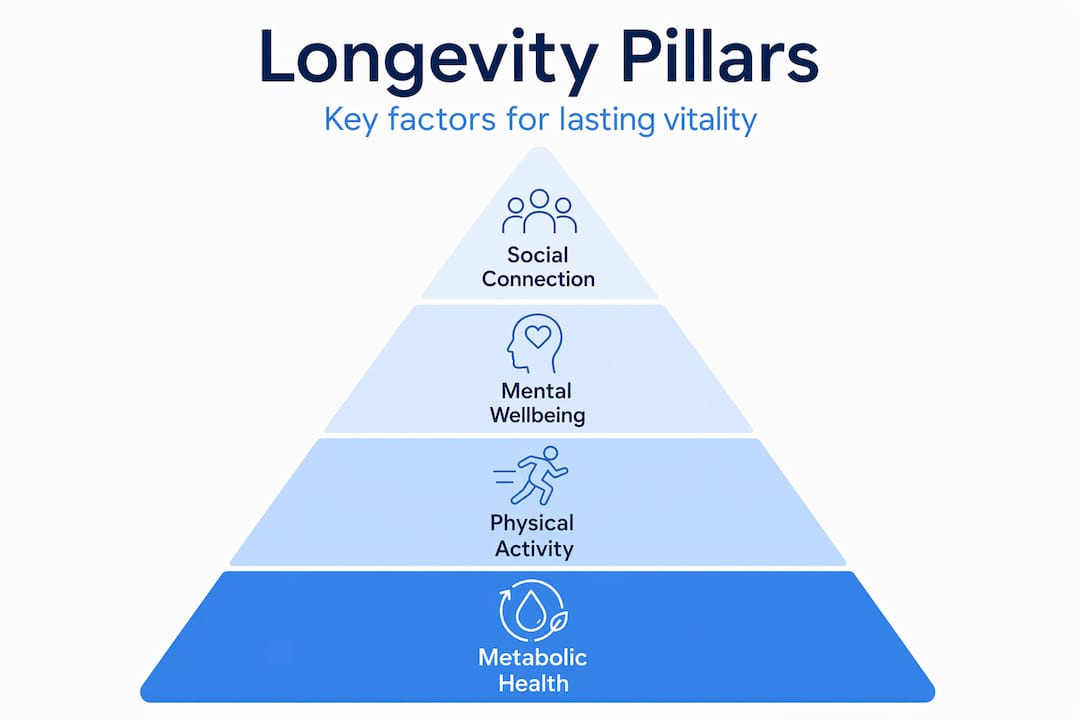
The core challenge is consistency. Longevity is a systems problem that requires consistent inputs over years. Sporadic interventions can move biomarker numbers temporarily without producing lasting change in biological risk. This is the most common and costly mistake in longevity planning.
A genuinely integrated approach follows this logic:
- Baseline everything. Metabolic bloods, body composition, VO2 max, psychological wellbeing markers, and a self-assessed social engagement audit.
- Identify your highest-leverage gaps. If your VO2 max is strong but your fasting insulin is elevated, metabolic work comes first.
- Build habits in layers, not in parallel. Adding three major behaviour changes simultaneously produces poor adherence. Sequence them.
- Review progress on a six-month cycle. Not just biomarkers but functional measures, mood, energy, and social quality too.
- Adjust based on direction of travel, not individual data points. One elevated fasting glucose reading means less than a consistently rising trend.
| Factor | Short-term impact | Long-term impact | Key metric |
|---|---|---|---|
| Physical activity | Mood, energy, sleep | Mortality risk, VO2 max | Minutes per week, VO2 max |
| Metabolic health | Blood sugar stability | Cardiovascular and cognitive risk | Fasting insulin, triglyceride/HDL |
| Social connection | Wellbeing, stress reduction | Immune function, cognitive decline | Frequency of meaningful contact |
| Sleep quality | Recovery, cognition | Hormonal balance, inflammation | Sleep duration, continuity |
| Psychological health | Resilience, motivation | Mental disorder risk, longevity | Validated wellbeing scores |
Using a structured metabolic health checklist alongside biological data for longevity provides the framework to move from knowing what matters to actually measuring and improving it.
Pro Tip: The difference between people who succeed long-term with longevity strategies and those who plateau is rarely knowledge. It is measurement cadence. If you are not reviewing the right markers at regular intervals, you will not know whether your habits are producing meaningful change.
Why focusing solely on lifespan misses the point: a holistic longevity view
The mainstream conversation about longevity still skews heavily towards survival metrics. How long will you live. What is your all-cause mortality risk. But this framing is limiting and, in practice, counterproductive for the people most motivated to do something about their health.
In our view, the most important shift is accepting that healthspan and lifespan are not in competition. Expanding the years you spend with full function, cognitive vitality, and genuine independence is the actual mission. Lifespan may extend as a consequence, but it is not the target.
What frustrates us about much longevity content is how relentlessly reductive it becomes. Track your sleep score. Lower your biological age. Supplement your way to a better HRV reading. These are tools, not goals. When the tools become the focus, the actual experience of living well gets lost.
The value of living longer is only realised when those years contain something worth experiencing. Strong relationships, maintained physical capability, purposeful engagement, and freedom from debilitating disease. Social and mental health are not optional modules you add once your metabolic work is done. They are foundational, and evidence increasingly confirms they affect the same biological pathways as diet and exercise.
What this means practically is that a genuinely useful longevity plan must hold complexity. It must account for the fact that an isolated person with perfect blood panels carries real health risk. It must recognise that joy, belonging, and purposeful activity produce measurable physiological benefit. Reviewing health longevity insights with this lens produces a far richer and more honest picture of what the field is actually telling us.
The questions about longevity worth asking are not just biochemical. They are about how you are living, who with, and whether your daily experience is worth extending.
Explore personalised longevity testing and consultations
Knowing which factors drive longevity is one thing. Knowing which ones are most relevant to your specific physiology is another entirely. AI Healthician’s advanced diagnostics translate the evidence above into personalised, measurable protocols built around your biological data.
The longevity blueprint consultation integrates metabolic assessment, lifestyle analysis, and personalised strategy into a single coherent plan. For a genetically informed perspective, DNA health testing identifies inherited predispositions that shape your individual risk profile. Combining these with a resting and active metabolic test gives you the precise physiological baseline that turns general longevity principles into targeted, trackable action.
Frequently asked questions
What is the difference between lifespan and healthspan?
Lifespan is the total years you live, while healthspan is the period you spend in good health and full physical function. The goal of longevity science is healthy life extension, expanding function and resilience alongside lifespan rather than simply prolonging survival.
How much physical activity is needed to reduce mortality risk?
As little as 75 minutes of moderate physical activity per week significantly lowers all-cause mortality risk compared with inactivity, with benefits continuing to increase at higher activity levels.
Why is social connection important for longevity?
Loneliness and social isolation are linked to increased risks across more than 80 health conditions, affecting immune function, hormonal balance, and cognitive health, making social engagement as important as physical and metabolic health in any longevity plan.
Can data-driven longevity strategies ignore social factors?
No. Metabolic data alone does not capture the risks associated with chronic loneliness, which affects multi-system health outcomes through distinct biological pathways that no biomarker panel fully reflects without social and behavioural context.
What common pitfalls should I avoid in longevity planning?
Avoid treating longevity as a short-term intervention or chasing isolated biomarkers. Longevity is a systems problem requiring consistent inputs across years, and sporadic changes in behaviour can shift lab numbers temporarily without reducing actual biological risk.


