


 matt@aihealthician.co.uk


TL;DR:
- Early risk detection identifies biological threats before symptoms develop, allowing for preventive interventions. Advances in predictive models, AI, and personalized testing improve early identification, but benefits depend on individual age and health context. Informed, personalized screening and proactive health strategies maximize the potential for better health outcomes.
Early risk detection is the proactive identification of biological threats before symptoms appear, giving you the best possible chance of preventing disease rather than simply treating it. The difference between catching a condition at stage one versus stage four is not marginal. It is often the difference between a straightforward intervention and a life-altering one. Established screening programmes for breast, cervical, colorectal, lung, and prostate cancer exist precisely because the evidence for mortality reduction is strong. Add to that the rise of predictive models using electronic health records (EHRs), AI-driven surveillance platforms, and personalised metabolic and DNA testing, and the case for why early risk detection belongs at the centre of any serious health strategy becomes undeniable.
Why early risk detection changes disease outcomes
Screening targets biological changes before clinical symptoms emerge, aiming to remove or treat precursors before they become life-threatening. That single principle underpins every major cancer screening programme in the world.

The five most evidence-backed programmes cover breast, cervical, colorectal, lung, and prostate cancer. Each works by catching pre-malignant states or early-stage disease when treatment is most likely to be curative. Breast screening via mammography, cervical screening via smear tests, and colorectal screening via faecal immunochemical testing (FIT) or colonoscopy all carry demonstrated mortality benefits in appropriate populations.
Beyond traditional screening, EHR-based predictive models now improve identification of high-risk individuals by 3 to 6 times compared to conventional risk factors alone. That figure matters because it means clinicians can target limited resources at the people who need them most, rather than applying blanket protocols to entire populations.
AI foundation models trained on longitudinal patient data are accelerating this further. A 2026 study using the All of Us dataset demonstrated improved prediction accuracy across 26 cancer types using these approaches. The implication is clear: the more data a predictive system has access to, the earlier it can flag genuine risk.
- Population screening catches disease at a pre-symptomatic stage across large groups
- Predictive EHR models identify individuals at elevated risk beyond age and family history
- AI foundation models extend detection capability across dozens of cancer types simultaneously
- Metabolic testing reveals physiological risk markers such as insulin resistance and inflammatory load before they manifest as diagnosable conditions
- DNA health testing identifies inherited predispositions, allowing targeted surveillance years before risk becomes reality
Pro Tip: If you have a family history of any cancer, ask your GP specifically about risk-stratified screening rather than waiting for standard age-based invitations. You may qualify for earlier or more frequent testing.
Does early detection always benefit everyone?
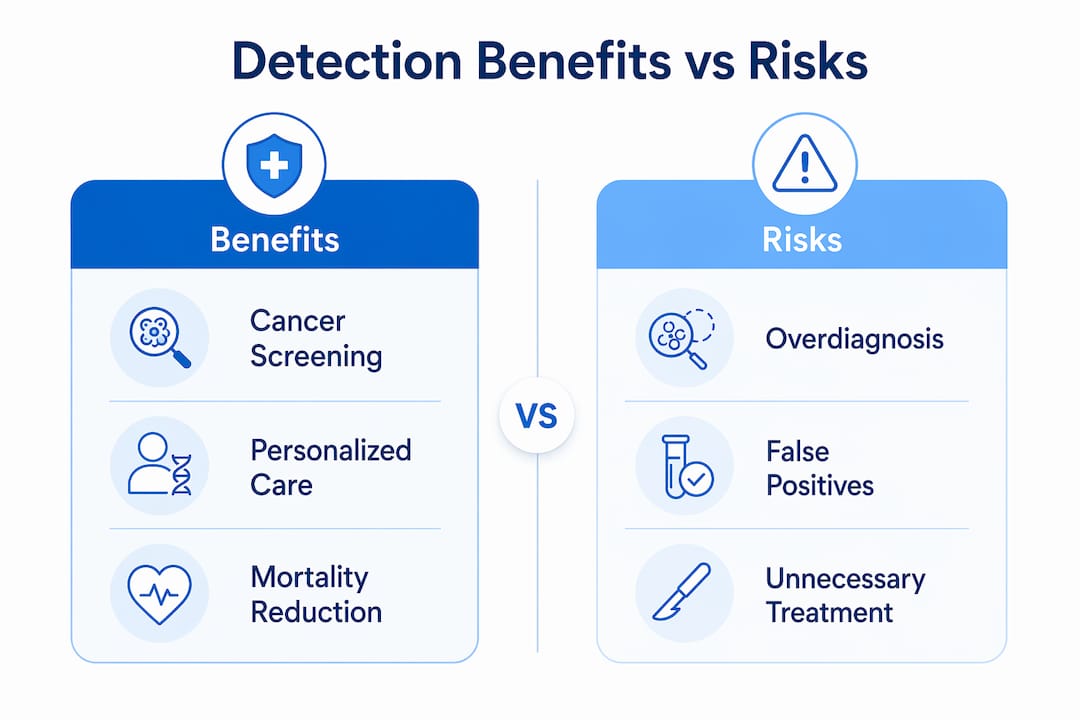
The short answer is no. The benefits of early detection vary significantly by age, life expectancy, and the specific characteristics of the test being used. A 2025 review in American Family Physician found that PSA screening reduces prostate cancer mortality in men aged 55–69 but produces no overall reduction in all-cause mortality. That distinction is critical. Detecting a slow-growing cancer in a man aged 80 with multiple comorbidities may cause more harm than good through unnecessary procedures and psychological distress.
Overdiagnosis is a genuine risk in any screening programme. Colorectal screening with FIT or colonoscopy detects more early-stage cancers, but the SCREESCO trial also recorded higher rates of short-term cardiovascular and gastrointestinal adverse events in the first year post-screening. Real-world programmes reveal that initial detection rates rise alongside short-term procedural risks. Ongoing follow-up is required to confirm net mortality benefit over time.
The table below summarises where early detection delivers clear value versus where caution is warranted.
| Scenario | Early Detection Value |
|---|---|
| Breast cancer screening, women aged 50–70 | High. Established mortality reduction with regular mammography. |
| PSA testing, men aged 55–69 | Moderate. Reduces prostate cancer mortality but not all-cause mortality. |
| Colorectal screening, adults aged 45–75 | High. FIT and colonoscopy both detect early-stage disease effectively. |
| Cancer screening in adults over 80 | Low to harmful. Overdiagnosis risk outweighs benefit in limited life expectancy. |
| Lung cancer screening, high-risk smokers | High. Low-dose CT in eligible individuals shows significant mortality benefit. |
Shared decision-making is the standard of care here, not optional. Personalised risk stratification using longitudinal data improves targeting of early detection benefits beyond what age or single-factor rules can achieve. You and your clinician should weigh your specific risk profile, your values, and the potential harms of any given test before proceeding.
Pro Tip: Before agreeing to any screening test, ask your clinician two questions: what happens if the result is positive, and what are the realistic risks of the follow-up procedure? Informed consent is not a formality.
How AI and predictive analytics are reshaping detection
Healthcare systems are shifting from reactive to proactive surveillance, using AI to identify risk patterns before a crisis develops. This is not a distant prospect. AI platforms are already analysing repeated consultation patterns within GP systems to trigger early alerts for patients who might otherwise wait months for a referral.
The mechanics of this shift follow a clear progression:
- Data aggregation. Longitudinal EHR data, including repeat prescriptions, consultation frequency, and test results, is compiled into a continuous patient profile rather than a series of isolated encounters.
- Pattern recognition. AI models identify combinations of signals that precede a diagnosis, often years before symptoms appear. These signals would be invisible to a clinician reviewing a single appointment.
- Risk stratification. Patients are ranked by predicted risk, allowing clinical teams to prioritise outreach and investigation for those most likely to benefit from early intervention.
- Intelligent triage. Screening pathways are calibrated to balance sensitivity against specificity. Balancing lead time against false positives is critical. Accepting some false alarms is necessary to catch genuine cases early, but the threshold must be set carefully to avoid overwhelming diagnostic services.
- Continuous refinement. As outcomes data feeds back into the model, prediction accuracy improves over time, making the system more precise with each cycle.
This approach does not replace clinical judgement. It amplifies it. A GP reviewing a flagged patient still applies their knowledge of that individual’s circumstances. The AI simply ensures that the flag is raised before the patient deteriorates rather than after.
How to identify risks early in your own health plan
Taking control of your own early detection strategy starts with understanding what your personal risk profile actually looks like. Generic advice to “eat well and exercise” does not constitute a risk management strategy.
- Commission a DNA health test. Genetic variants associated with cardiovascular disease, certain cancers, and metabolic conditions can be identified years before any clinical sign appears. This allows you to target surveillance and lifestyle interventions precisely where your biology demands it.
- Undergo metabolic testing. Markers such as fasting insulin, HbA1c, triglycerides, and VO2 max provide a functional picture of your metabolic health that a standard GP blood panel often misses. Metabolic dysfunction precedes type 2 diabetes and cardiovascular disease by a decade or more in many cases.
- Align check-ups with your risk profile. Standard NHS screening invitations are population-level tools. If your DNA or metabolic data indicates elevated risk, you need a more frequent or targeted schedule. Discuss proactive health management with a clinician who understands personalised risk stratification.
- Track disease risk markers over time. A single data point tells you where you are today. Serial measurements tell you which direction you are heading. Tracking disease risk markers over months and years is what separates genuine health management from annual box-ticking.
- Engage with shared decision-making. Bring your data to appointments. Ask about the specific tests relevant to your risk factors. A clinician who understands your full biological picture can make far better recommendations than one working from age and BMI alone.
Key takeaways
Early risk detection delivers its greatest value when it is personalised, data-driven, and paired with informed clinical decision-making rather than applied as a blanket protocol.
| Point | Details |
|---|---|
| Screening saves lives when targeted | Established programmes for breast, cervical, colorectal, lung, and prostate cancer reduce mortality in appropriate age groups. |
| EHR models multiply detection accuracy | Predictive models improve high-risk identification by 3 to 6 times compared to traditional risk factors alone. |
| Age and context determine benefit | PSA screening helps men aged 55–69 but offers no all-cause mortality benefit, illustrating why personalisation matters. |
| AI enables proactive surveillance | AI platforms identify repeated consultation patterns to flag risk before symptoms develop, reducing diagnostic delays. |
| Personal testing closes the gap | DNA and metabolic testing reveal individual risk years before standard screening criteria are triggered. |
The uncomfortable truth about waiting for symptoms
Most people I speak with through my work at Aihealthician arrive at health testing after something has already gone wrong. A worrying blood result, a family diagnosis, a bout of fatigue that will not resolve. That reactive pattern is deeply ingrained, and I understand why. Symptoms feel concrete. Risk feels abstract.
What I have come to believe, having worked with detailed biological data across hundreds of clients, is that the gap between “feeling fine” and “being fine” is far wider than most people assume. Metabolic dysfunction, for example, can be measurable and progressive for a decade before it produces a single symptom you would notice. By the time you feel it, the window for low-effort intervention has often closed.
The technology now available through precision health approaches means that waiting is genuinely a choice, not a necessity. DNA testing, metabolic analysis, and AI-assisted risk profiling give you a biological picture that is specific to you, not to a population average. That specificity is what makes the difference between a vague recommendation to “watch your diet” and a targeted protocol that addresses your actual risk.
My caution, and it is an important one, is that more data does not automatically mean better decisions. The value of early detection lies in acting on what you find, with clinical guidance, not in accumulating test results that sit uninterpreted. The goal is not to know your risk. The goal is to do something about it.
— Matthew
Take control of your health with Aihealthician
Understanding your risk is only the first step. Aihealthician’s DNA health testing service gives you a detailed genetic risk profile covering cardiovascular disease, metabolic conditions, and cancer predispositions, so you can build a prevention strategy grounded in your own biology rather than population averages.
For a complete physiological picture, the resting and active metabolic test with 3D body scan reveals how your body is actually functioning at a metabolic level, identifying risks that standard GP panels routinely miss. Both services are designed for individuals who want measurable, targeted interventions rather than generic wellness advice.
FAQ
What is early risk detection in health?
Early risk detection is the identification of biological markers, genetic variants, or physiological patterns that indicate elevated disease risk before symptoms appear. It includes screening programmes, predictive EHR models, and personalised testing such as DNA and metabolic analysis.
How does early detection reduce cancer mortality?
Screening targets pre-malignant states and early-stage disease when treatment is most likely to be curative, reducing both mortality and the severity of treatment required. Established programmes for breast, cervical, and colorectal cancer demonstrate this benefit clearly.
Is early detection always beneficial?
No. Benefits vary by age and life expectancy, and overscreening in older adults with limited life expectancy can cause more harm than good through unnecessary procedures and psychological distress. Personalised risk stratification is the standard approach.
How do AI and EHR models improve early detection?
EHR-based predictive models improve high-risk identification by 3 to 6 times compared to traditional risk factors alone, by analysing longitudinal data patterns that would be invisible in a single clinical encounter.
What personal tests support early risk detection?
DNA health testing identifies inherited predispositions, while metabolic testing reveals markers such as fasting insulin, HbA1c, and VO2 max that precede diagnosable conditions by years. Both are available through Aihealthician’s testing services and provide a personalised foundation for proactive health management.


