


 matt@aihealthician.co.uk


TL;DR:
- Personalised nutrition tailors dietary advice based on individual biology, lifestyle, and health goals, unlike generic population guidelines. Scientific evidence supports its benefits, especially when combined with professional interpretation and ongoing data analysis for better health outcomes. However, it remains an evolving field, requiring careful testing, behavioral commitment, and realistic expectations for long-term success.
Most dietary advice is built on averages. The food pyramid, calorie targets, macronutrient ratios — these guidelines were designed for populations, not people. If you have ever followed a diet perfectly and seen disappointing results, you have already experienced the core problem that personalised nutrition sets out to fix. Understanding what is personalised nutrition, how it works, and what the science actually supports can change how you approach your health entirely. This guide breaks down the foundations, the evidence, and the practical steps to get started.
Table of Contents
- Key takeaways
- Personalised nutrition: definition and scientific foundations
- The evidence: does personalised nutrition actually work?
- How personalised nutrition works in practice
- Putting personalised nutrition plans into practice
- Personalised plans versus generic diets
- My perspective on where personalised nutrition actually stands
- How Aihealthician supports your personalised nutrition journey
- FAQ
Key takeaways
| Point | Details |
|---|---|
| Not one-size-fits-all | Generic dietary advice is built for populations; your biology, genetics, and lifestyle require a tailored approach. |
| Science is evolving rapidly | The field is shifting from “personalised nutrition” toward “precision nutrition,” integrating genetics, metabolomics, and AI. |
| Evidence supports real benefits | Clinical trials show personalised plans outperform standard diets for weight, mood, sleep, and metabolic markers. |
| Data quality drives outcomes | Meaningful results depend on biomarker testing, metabolic analysis, and professional interpretation, not consumer apps alone. |
| Adherence remains the hard part | Biological complexity and behavioural consistency are the biggest barriers to making personalised nutrition work long-term. |
Personalised nutrition: definition and scientific foundations
At its most straightforward, personalised nutrition means tailoring dietary recommendations to an individual based on their unique biology, lifestyle, and health goals rather than applying population-level guidelines. The definition of personalised nutrition has broadened significantly over the past decade as the tools to measure individual differences have improved.
What separates this approach from conventional dietary advice comes down to the data underpinning it. Personalised nutrition draws on:
- Genetic data: single nucleotide polymorphisms (SNPs) that influence nutrient metabolism, food sensitivities, and appetite regulation
- Metabolomic profiles: the pattern of metabolites in blood or urine that reflects how your body processes what you eat
- Microbiome composition: the unique ecosystem of gut bacteria that affects energy extraction, inflammation, and nutrient absorption
- Lifestyle and environmental factors: sleep quality, physical activity, stress load, and socioeconomic context
It is worth noting that the scientific community is increasingly favouring the term precision nutrition over personalised nutrition. The National Research Council describes precision nutrition as a more evidence-based framing, one that integrates molecular diagnostics, metabolic profiles, and advanced algorithms to move decisively away from one-size-fits-all guidelines. The distinction matters because “personalised” can include relatively unsophisticated approaches such as filling in a questionnaire, whilst precision nutrition demands rigorous biological data.
Understanding why nutrient profiling matters for your specific physiology is a useful starting point before investing in any testing programme.
The evidence: does personalised nutrition actually work?
The clinical picture is genuinely encouraging, though not without caveats. A 2024 study of 347 participants found that those on personalised nutrition plans achieved greater weight loss and lower triglycerides compared to those receiving standard dietary advice. Participants on the 18-week programme were twice as likely to report improved mood and more than four times more likely to report better sleep and energy.
“Personalised nutrition led to significantly better outcomes across metabolic, psychological, and lifestyle markers compared to generic dietary advice.” — 2024 clinical study of 347 participants
These are not trivial gains. Triglyceride levels, mood, and sleep quality are deeply interconnected markers of metabolic health, and improving all three simultaneously through dietary change alone is clinically meaningful.
The market is responding to this evidence at pace. The global personalised nutrition market is projected to reach $37.3 billion by 2030, growing at approximately 11.5% annually. The largest segments are personalised supplements (38.7% of the market) and AI-driven recommendation engines (29.4%), which reflects where the technology is heading. AI and data-driven health tools are making it possible to deliver genuinely dynamic dietary guidance at scale, adjusting recommendations in real time as new biological data comes in.
That said, NIH researchers are direct about the limitations. Variables including age, sex, ethnicity, genetics, and social determinants interact in ways science has not yet fully mapped. More comprehensive research is needed before universal precision nutrition protocols can be confidently recommended across diverse populations. The promise is real. The field is still maturing.
How personalised nutrition works in practice
Understanding how personalised nutrition works means understanding the layers of data it relies on, and how those layers are integrated to produce recommendations that are actually specific to you.
The process typically follows a structured sequence:
- Baseline biological testing. This includes genetic analysis, blood biomarkers, resting metabolic rate, and, where possible, microbiome sequencing. Each of these provides a different window into how your body functions at rest and under dietary stress.
- Metabolic and lifestyle profiling. Resting metabolic rate tells you how many calories your body burns without exercise. Active metabolic testing and VO2max data reveal how your body responds to physical load and what fuel sources it prefers. Sleep patterns, stress exposure, and activity levels are factored in alongside the biology.
- Data integration and pattern recognition. Modern adaptive personalised nutrition systems combine biomedical, behavioural, and environmental data to personalise both what you should eat and how to change your dietary behaviour. These systems use AI to deliver guidance at key moments of decision-making rather than as a static plan.
- Ongoing monitoring and adjustment. A personalised plan is not a one-time document. Biomarkers shift as your diet changes, your training load varies, and your health improves or declines. Regular re-testing and plan revision are what separate genuine personalised nutrition from a glorified quiz result.
- Professional interpretation. The AMA and NSGC both advise that genetic test results for nutrition should only be acted upon under qualified professional guidance. Direct-to-consumer genetic nutrition tests frequently lack clinical validation, and misinterpretation of raw data carries real risks.
Pro Tip: Before purchasing any direct-to-consumer genetic nutrition test, confirm that your provider offers professional interpretation and that the test has clinical validation. Raw SNP data without expert context is rarely sufficient to guide meaningful dietary change.
The future of this field lies in what researchers call “data fusion.” By combining biomedical and behavioural data with environmental context and AI-driven pattern recognition, precision nutrition systems can optimise not just the diet itself but the conditions under which dietary behaviour change becomes sustainable.

Putting personalised nutrition plans into practice
Knowing the theory is one thing. Getting results from a personalised nutrition programme is another matter entirely.
The benefits of personalised nutrition plans are well-supported by clinical evidence. Beyond weight and metabolic improvements, you gain a clearer understanding of how your specific biology responds to dietary inputs, which makes future decisions faster and more confident. Learning how to personalise your health data for genuine wellness improvements is a skill that compounds over time.
However, the challenges are real and worth addressing honestly:
- Behavioural adherence is the most consistent barrier. A 2026 study found that only 36.1% of users improved vitamin biomarkers by their second test despite receiving platform-specific guidance. Biological complexity means that recommendations that look correct on paper do not always translate to measurable change without sustained behavioural consistency.
- Data privacy is a legitimate concern when sharing genetic and biomarker data with third-party platforms. Verify data governance policies before committing to any service.
- Realistic expectations matter enormously. Personalised nutrition is not a rapid fix. It is a process of progressive refinement based on how your body actually responds.
Self-experimentation accelerates progress substantially. A 12-week pilot study found participants who actively self-optimised their dietary choices lost an average of 8.66 kg compared to 4.76 kg in those following standard recommendations. Adjusting macronutrient ratios, meal timing, and food choices based on your own observed responses, tracked against objective biomarkers, is what turns a plan into a system.
Pro Tip: Track one dietary variable at a time for a minimum of two weeks before changing another. This makes it possible to attribute changes in energy, mood, or body composition to a specific input rather than guessing.
Personalised plans versus generic diets
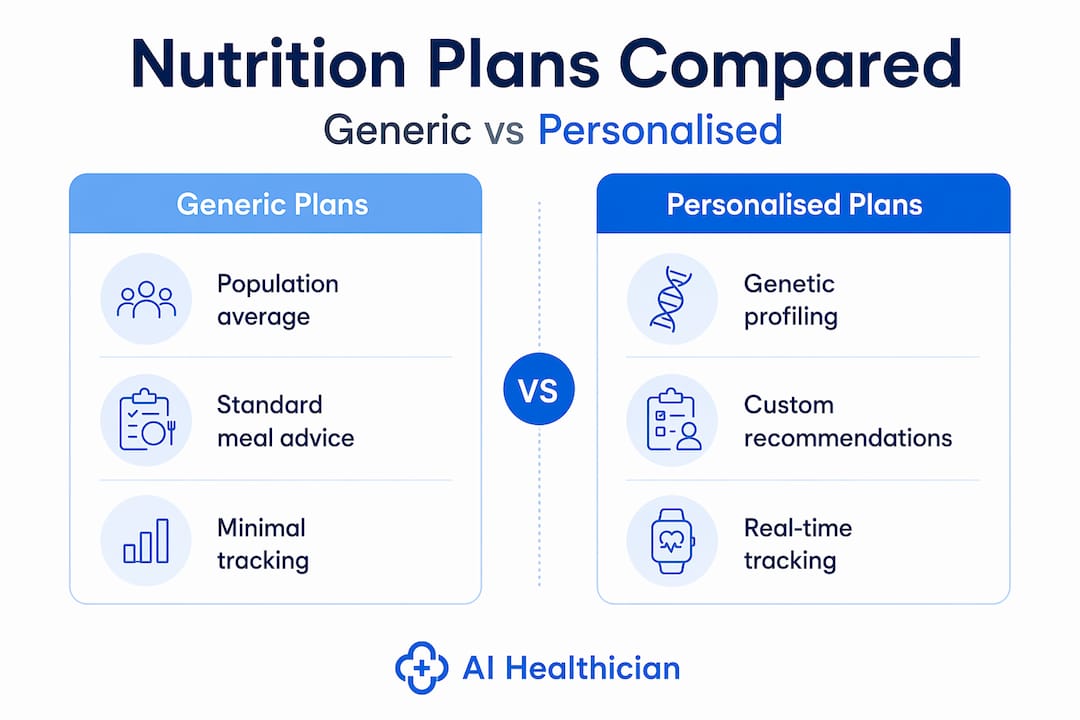
The comparison between personalised nutrition and conventional dietary approaches is not simply academic. Understanding the practical differences helps you decide where to invest your time and resources.
| Factor | Generic dietary advice | Personalised nutrition |
|---|---|---|
| Basis of recommendations | Population averages | Individual biology, genetics, and lifestyle |
| Flexibility | Fixed guidelines | Adaptive and continuously updated |
| Outcome specificity | Broad health goals | Targeted markers (triglycerides, energy, weight) |
| Professional involvement | Minimal | High, particularly for data interpretation |
| Cost | Low to zero | Moderate to high depending on testing depth |
| Accessibility | Universal | Currently limited by cost and expertise |
The NIH workshop report underscores that precision nutrition is not yet universally accessible, and the science for many specific populations is still being established. The direct-to-consumer testing market is ahead of its regulatory environment in many regions, which means buyer scrutiny is warranted. Most consumer genetic nutrition tests lack clinical approval, and platforms interpreting raw genomic data often operate without meaningful oversight.
The advantages of a well-structured personalised plan are real. The risks lie primarily in poorly validated tests and the absence of professional support.
My perspective on where personalised nutrition actually stands
I have spent considerable time reviewing the clinical literature on precision nutrition, and my honest assessment is this: the science is promising but it is genuinely early-stage for most applications. The studies showing improved mood, sleep, weight, and metabolic markers are compelling. They are also relatively short in duration, conducted on motivated participants, and not yet replicated at population scale.
What I find more interesting than the headline results is what the adherence data reveals. The fact that fewer than four in ten users improved biomarkers by their second test tells you something important. Biology is not straightforward, and a recommendation built on your genetics and baseline blood work is a starting hypothesis, not a prescription. The individuals who get the most from personalised nutrition plans are those who treat them that way.
I also think the field underweights behavioural and environmental factors. Genetics and metabolomics get the attention because they are measurable and marketable. But sleep quality, psychological stress, and social eating patterns have an outsized influence on whether any dietary strategy actually works. A plan that does not account for those realities will underperform regardless of how sophisticated the biological data behind it is.
My practical advice: pursue personalised nutrition with professional support, start with functional testing rather than consumer apps, and build in regular reassessment. The step-by-step personalisation approach matters more than the sophistication of your first test.
— Matthew
How Aihealthician supports your personalised nutrition journey
If you are ready to move beyond generic dietary advice and work from your actual biology, Aihealthician provides the functional testing foundation that makes personalised nutrition meaningful rather than speculative.
The DNA health testing service analyses genetic variants that directly influence how you metabolise nutrients, respond to dietary fat, and regulate appetite. Paired with the resting and active metabolic test with 3D body scan, you get a precise picture of your energy expenditure, fuel partitioning, and body composition in a single session. These assessments are not wellness extras. They are the biological data points that allow customised dietary plans to be built on evidence rather than assumption. Aihealthician’s team translates that data into protocols you can act on, monitor, and refine over time.
FAQ
What is personalised nutrition in simple terms?
Personalised nutrition means tailoring your diet to your individual biology, genetics, lifestyle, and health goals rather than following generalised population guidelines. It uses data such as blood biomarkers, genetic markers, and metabolic measurements to produce recommendations specific to you.
How does personalised nutrition differ from a standard diet plan?
A standard diet plan applies the same advice to everyone based on population averages. A personalised nutrition plan uses your specific biological data, including metabolic rate, genetic variants, and biomarker results, to create recommendations that reflect how your body actually functions.
What data is used in personalised nutrition plans?
Personalised nutrition plans draw on genetic data, blood and metabolic biomarkers, microbiome analysis, resting and active metabolic rates, and lifestyle factors including sleep, stress, and physical activity. Integrating multiple data types produces more accurate and useful recommendations than any single data source alone.
Is personalised nutrition backed by clinical evidence?
Yes, though the field is still developing. A 2024 clinical study found personalised nutrition produced greater weight loss and lower triglycerides than generic advice, with participants reporting significantly better mood, sleep, and energy over 18 weeks.
Do I need a professional to guide my personalised nutrition plan?
Professional guidance is strongly recommended, particularly when genetic or biomarker data is involved. Both the AMA and NSGC advise that genetic test results for nutrition should be interpreted by a qualified healthcare professional to avoid misinterpretation and ensure safe, effective application.


