


 matt@aihealthician.co.uk


TL;DR:
- Holistic health assessment considers the interconnected physical, psychological, social, and environmental factors affecting overall wellbeing. It relies on continuous, personalized evaluation and follow-up to drive sustained behavior change and long-term health improvements. Implementing structured tools like the LMWPHI enhances scalable, data-driven, whole-person care for better health outcomes.
Most people assume a health assessment means a blood panel, a BMI reading, and a quick chat about symptoms. That assumption is exactly why so many wellness plans fail. The role of holistic assessment is to capture something far more complex: the intersection of your physiology, psychology, lifestyle, environment, and personal goals. When you understand your health as an integrated system rather than a collection of isolated readings, the data becomes genuinely actionable. This article explains what holistic assessment actually involves, how it drives better outcomes, and how to use it as a continuous tool for performance and longevity.
Table of Contents
- What is holistic assessment and why does it matter
- How holistic assessment integrates with whole-person care
- Evidence for benefits of whole-person approaches
- Tools and frameworks for implementing holistic assessment
- Applying holistic assessment for personalised wellness and performance optimisation
- Why the true power of holistic assessment is often missed
- Discover personalised wellness solutions through holistic health assessment
- Frequently asked questions
Key Takeaways
| Point | Details |
|---|---|
| Holistic assessment definition | Holistic assessment evaluates physical, emotional, social, spiritual, and cultural health domains to see the whole person. |
| Foundation of whole-person care | It is the starting point for personalised health plans that consider all aspects of well-being. |
| Evidence of improved outcomes | Whole-person approaches increase treatment adherence and therapy completion rates. |
| Available tools | Tools like the LMWPHI help operationalise holistic assessment in clinical practice via EHR integration. |
| Continuous process | Effective wellness optimisation requires ongoing holistic assessment with repeated check-ins and goal adjustments. |
What is holistic assessment and why does it matter
Traditional clinical assessments are built around problems. You present a symptom, the clinician investigates that symptom, and a treatment is prescribed. This model is efficient for acute illness but almost useless for optimising long-term health in someone who is already functioning reasonably well and wants to perform at a higher level.
A proper understanding of what is holistic health assessment starts with scope. Holistic assessment covers physical, psychological, social, spiritual, and cultural domains to form a full health profile rather than a snapshot of a single complaint. That breadth is not philosophical posturing. It is a recognition that your sleep quality affects your cortisol, which affects your insulin sensitivity, which affects your energy, which affects your motivation to exercise. None of those variables exist in isolation.
The domains a well-structured holistic assessment covers include:
- Physical health: biomarkers, cardiovascular function, metabolic indicators, body composition
- Psychological wellbeing: stress levels, mood patterns, cognitive performance, resilience
- Social context: relationships, support systems, occupational demands
- Lifestyle behaviours: nutrition, sleep, movement, substance use
- Environmental factors: exposure to toxins, work environment, access to green space
- Personal values and goals: what the individual actually wants from their health
Understanding your comprehensive health assessment workflow before you begin makes the difference between gathering data and generating insight. The importance of holistic assessment lies precisely in that translation: from raw numbers to a coherent picture of who you are biologically and how you live.
How holistic assessment integrates with whole-person care
Understanding holistic assessment sets the stage to see how it operates within a whole-person care model. The assessment is not a destination. It is the starting point for an iterative process that builds over time.
Whole-person care visits explore needs and goals, formalise personal health plans, document findings, and support proactive follow-up to sustain long-term change. That cycle looks something like this in practice:
- Baseline assessment: Gather physiological data, lifestyle information, and patient-reported outcomes across all relevant domains.
- Goal identification: Work with the individual to establish what matters most to them, whether that is energy, longevity, body composition, or cognitive sharpness.
- Plan formalisation: Build a personalised protocol grounded in the assessment findings and aligned with stated goals.
- Documentation and communication: Record everything clearly so that progress can be tracked and adjustments justified with data.
- Follow-up and iteration: Schedule regular check-ins to review progress, update the assessment, and refine the plan.
The failure point in most wellness programmes is step five. Practitioners conduct an impressive initial assessment and then hand over a static report. Without follow-up, behaviour change rarely sticks.
Pro Tip: Treat holistic assessment as an ongoing conversation rather than a one-off data collection exercise. The trust built through repeated engagement is often what drives the behaviour change that single consultations cannot achieve.
Evidence for benefits of whole-person approaches
With the process understood, let us examine the compelling evidence supporting whole-person care benefits. The data is more striking than most people expect.
“Whole-health care use increased completion rates of evidence-based PTSD psychotherapy by 39% among veterans receiving care within the Veterans Health Administration.”
That figure is worth sitting with. The base completion rate of PTSD psychotherapy was 34.8%, already a difficult benchmark to move. Integrating whole-health services pushed that figure up by 39%. The mechanism is not mysterious. When people feel seen as whole individuals rather than diagnostic categories, they engage more consistently with their care.
The benefits of holistic evaluation extend well beyond mental health. Research consistently shows that addressing lifestyle factors alongside clinical treatment improves adherence, reduces hospitalisation rates, and lowers long-term disease risk. These are not soft outcomes. They translate directly into measurable physiological improvements that show up in your biomarkers.

For health-conscious individuals focused on performance, the implication is clear. Addressing lifestyle changes for disease prevention through a whole-person lens produces compounding returns that symptom-focused care simply cannot replicate.
Tools and frameworks for implementing holistic assessment
To put theory into practice, let us explore tools and frameworks that enable effective holistic assessment in real clinical and wellness settings.
The Lifestyle Medicine Whole Person Health Index (LMWPHI) is one of the most practically useful instruments available. The LMWPHI is a patient-reported assessment embedded in EHRs capturing lifestyle behaviours across six key pillars to support whole-person care at scale. It is currently integrated into Epic and eClinicalWorks, two of the most widely used electronic health record systems, which means it can be deployed without disrupting existing clinical workflows.
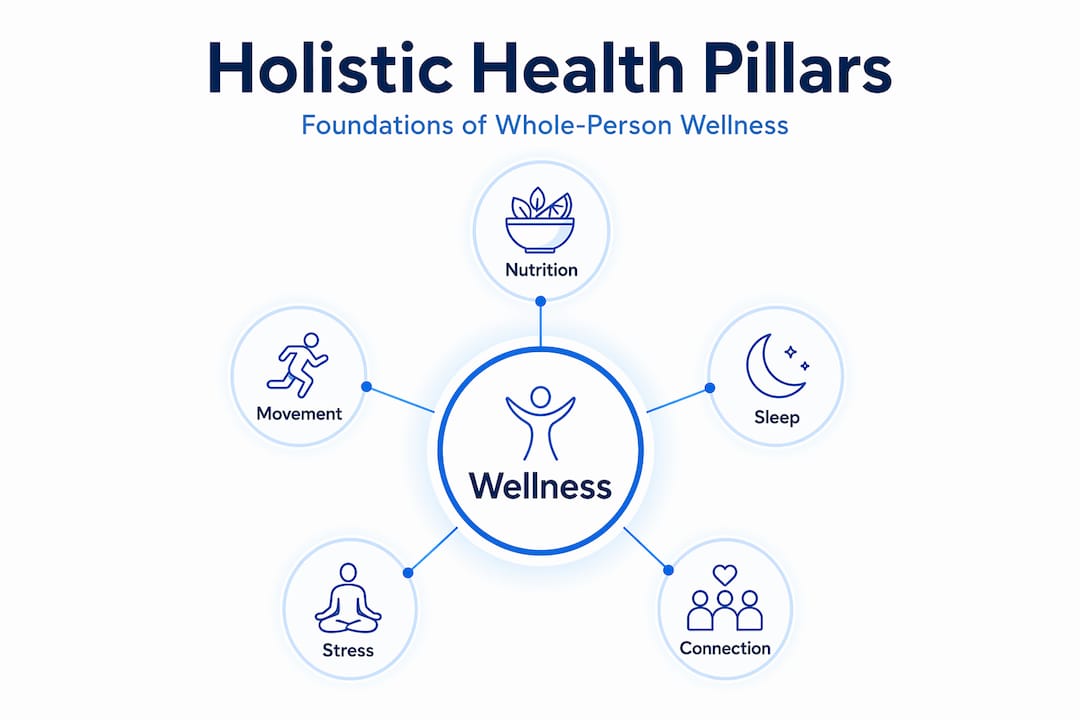
| Pillar | What it measures | Why it matters |
|---|---|---|
| Nutrition | Dietary patterns and food quality | Drives metabolic and inflammatory markers |
| Physical activity | Movement frequency and intensity | Affects cardiovascular and cognitive function |
| Sleep | Duration, quality, and consistency | Regulates hormones, recovery, and immunity |
| Stress management | Perceived stress and coping strategies | Influences cortisol, gut health, and resilience |
| Substance use | Alcohol, tobacco, and other substances | Direct risk modifier for chronic disease |
| Social connection | Relationship quality and social support | Predicts longevity independently of other factors |
The value of standardised holistic assessment methods like the LMWPHI is that they make personalisation scalable. Rather than relying on a clinician’s memory or a patient’s ability to self-report accurately in a brief appointment, the tool captures structured data that can be tracked over time and compared against the individual’s own baseline.
Key features to look for in any holistic assessment tool:
- EHR integration so data flows into existing records without duplication
- Patient-reported outcomes that capture subjective experience alongside objective measures
- Longitudinal tracking to show change over time rather than just a point-in-time snapshot
- Risk stratification capability to prioritise interventions based on where the need is greatest
Understanding how lifestyle data transforms your health and performance becomes far more concrete when you have a structured framework capturing it consistently.
Pro Tip: When evaluating a healthcare provider or wellness service, ask directly whether their assessment tools integrate with your health records and whether they track your data longitudinally. A single assessment with no follow-up architecture is a red flag.
Applying holistic assessment for personalised wellness and performance optimisation
Having seen how to measure things properly, here is how to apply it for continuous personal improvement. The distinction between people who see lasting results and those who plateau is almost always in how they use their data over time.
Using holistic assessment as an ongoing iterative loop with repeated check-ins builds trust and focuses on meaningful life outcomes, not arbitrary target scores. That framing matters. Chasing a specific HRV number or a particular VO2 max without contextualising it within your lifestyle, stress load, and goals is a fast route to frustration.
A practical cycle for applying holistic assessment looks like this:
- Establish your baseline: Capture physiological markers, lifestyle behaviours, and subjective wellbeing across all domains simultaneously.
- Set meaningful goals: Define outcomes in terms of how you want to function, not just what you want your numbers to say.
- Implement targeted interventions: Address the highest-leverage variables first, typically sleep, nutrition, and stress before more granular optimisation.
- Review at regular intervals: Monthly check-ins for subjective data, quarterly for full biomarker panels.
- Adjust based on response: What works for one person’s biology and lifestyle will not work for another’s. The data tells you what to change.
The most important variables to track in parallel include:
- Objective physiological data: blood biomarkers, body composition, cardiovascular metrics
- Subjective experience: energy levels, mood, cognitive clarity, sleep quality ratings
- Lifestyle adherence: how consistently you are actually implementing the plan
- Functional outcomes: performance in activities that matter to you personally
Learning how to personalise health data for better wellness is the skill that separates people who collect data from people who act on it effectively.
Why the true power of holistic assessment is often missed
Here is the uncomfortable reality. Most holistic assessments fail not because the science is wrong but because of how they are implemented. The tool is only as good as the relationship it sits within.
The most common failure mode is the checkbox assessment. A practitioner works through a long list of domains, records the answers, generates a score, and moves on. The patient leaves with a report and no meaningful dialogue about what it means for their specific life. Adequate time and focus on strengthening the patient-clinician relationship, not score chasing, are key to realising holistic assessment benefits. That is not a soft observation. It is a finding from peer-reviewed research that practitioners consistently underweight.
The second failure mode is comparative scoring. When practitioners frame holistic assessment results in terms of how a patient compares to population averages, they inadvertently shift focus away from the individual’s own trajectory. Someone who scores poorly on a social connection metric relative to the population average needs a conversation about their specific circumstances, not a percentile ranking.
The third failure mode is treating the comprehensive health assessment workflow as a one-time event. Biology changes. Life circumstances change. A holistic assessment conducted 18 months ago is not a reliable guide to what you need today. The role of comprehensive assessment is to evolve alongside you, not to produce a fixed document that collects digital dust.
What actually works is simpler than most people expect. Consistent engagement, genuine curiosity about the individual’s experience, and a willingness to adjust the plan when the data or the person’s goals shift. The practitioners who achieve the best outcomes are not the ones with the most sophisticated tools. They are the ones who use those tools within a relationship built on trust and continuity.
Discover personalised wellness solutions through holistic health assessment
You now have a clear picture of what holistic assessment is, why it works, and how to apply it. The next question is where to access it at the level of depth and rigour that actually moves the needle.
AI Healthician builds personalised health protocols grounded in exactly this kind of whole-person assessment. Through a personalised health consultation, you gain access to functional testing, detailed data analysis, and evidence-informed strategy that goes far beyond what standard GP appointments can offer. For those who want to go deeper into their biological individuality, DNA health testing adds another layer of precision, revealing how your genetics interact with your lifestyle choices to shape your long-term health trajectory. This is holistic assessment done properly: iterative, data-driven, and built around who you are.
Frequently asked questions
What exactly is holistic assessment in healthcare?
Holistic assessment covers physical, psychological, social, spiritual, and cultural domains to provide a complete health picture, going well beyond symptom-focused clinical evaluations.
How does holistic assessment improve wellness outcomes?
By addressing root causes across all life domains, holistic assessment supports personalised plans that improve adherence. Whole-person care increases treatment completion rates and sustains durable behaviour change over time.
What tools exist to help with holistic health assessment?
The Lifestyle Medicine Whole Person Health Index (LMWPHI) is one of the most practical options available. The LMWPHI is a patient-reported, EHR-embedded tool covering six lifestyle medicine pillars to support structured, whole-person care.
How often should I undergo holistic health assessments for best results?
Regular assessment is far more valuable than a single evaluation. Ongoing whole-person care with proactive follow-up and iterative adjustment turns assessment into sustained optimisation rather than a one-off report.
Can holistic assessment help with mental health conditions like PTSD?
Yes. Integrating whole-health services alongside psychotherapy significantly improves outcomes. Whole-health care use was linked to higher completion rates of evidence-based PTSD psychotherapy among veterans, demonstrating measurable real-world impact.


