


 matt@aihealthician.co.uk


TL;DR:
- Most workplace wellness programs fail because they focus on perks rather than systemic organizational changes. Effective strategies address all five wellbeing domains through systemic policies, leadership engagement, and targeted interventions. Long-term measurement over 3 to 5 years is essential to assess true ROI and cultural impact.
Most workplace wellness programmes are built on good intentions but poor foundations. Leaders invest in gym subsidies, meditation apps, and free fruit bowls, then wonder why absenteeism and burnout rates barely shift. The uncomfortable reality is that many wellness programmes fail because they treat symptoms rather than causes. This guide cuts through the noise. It gives you a clear, evidence-based framework for designing, launching, and measuring a workplace wellness strategy that produces genuine, lasting improvements in employee performance, resilience, and health outcomes.
Table of Contents
- Defining an effective workplace wellness strategy
- Preparation: assess needs and set measurable goals
- Execution: implement multidimensional, system-focused interventions
- Verification: measure, adapt, and sustain results
- Our perspective: why most workplace wellness advice misses the mark
- Take the next step: personalised wellness solutions
- Frequently asked questions
Key Takeaways
| Point | Details |
|---|---|
| Address root causes | Sustainable wellness depends on systemic changes, not just perks or one-off events. |
| Assess and measure | Start with thorough needs assessment and track KPIs over 3–5 years for meaningful ROI. |
| Prioritise holistic approaches | The best results come from supporting mental, social, financial, and physical wellbeing together. |
| Iterate for success | Continually adapt strategies based on real data, employee feedback, and changing workplace dynamics. |
Defining an effective workplace wellness strategy
The word “wellness” gets used loosely, and that vagueness is part of the problem. For most organisations, wellness means perks: discounted gym memberships, lunchtime yoga, or an employee assistance programme that nobody uses. These are not strategies. They are gestures.
A genuinely effective strategy addresses the full range of factors that influence how people feel and perform at work. Gallup’s research identifies five interconnected elements of wellbeing: career, social, financial, physical, and community. Organisations that address all five see up to 5x greater engagement and significant reductions in healthcare costs. Focusing on just one or two, such as physical health alone, leaves the others to quietly erode everything you have built.
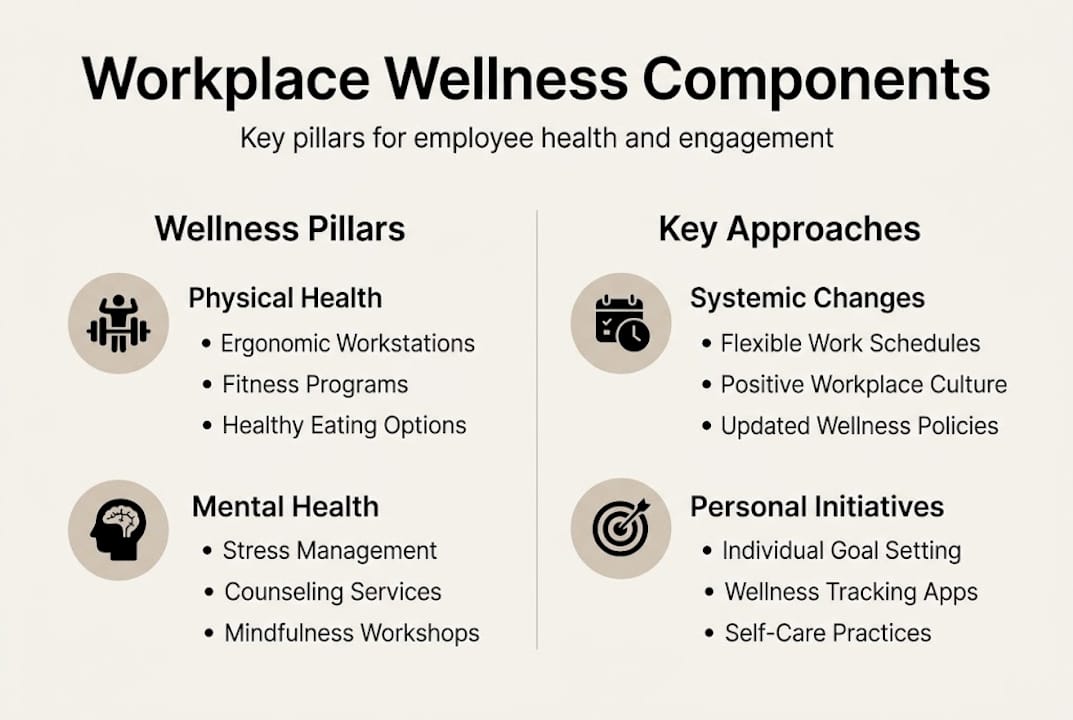
The critical distinction is between individual-focused and systemic approaches. Individual models place responsibility on the employee: use the app, attend the class, manage your stress. Systemic models place responsibility on the organisation: review workloads, adjust policies, train managers, redesign the environment. Neither works in isolation, but the evidence consistently favours systemic change as the foundation.
| Approach | Focus | Typical tools | Limitation |
|---|---|---|---|
| Individual-focused | Employee behaviour | Apps, classes, coaching | Ignores root causes |
| Systemic/organisational | Culture and policy | Workload review, flexible working, leadership training | Requires sustained commitment |
| Holistic (combined) | Both layers | Data-led protocols, policy reform, individual support | Most effective; hardest to sustain |
A robust strategy built on WHO organisational guidelines typically includes the following core components:
- A formal needs assessment conducted before any intervention is designed
- Clear, measurable goals tied to business outcomes
- Leadership accountability and visible senior buy-in
- Policy changes that reduce structural stressors
- Individual supports that complement, not replace, systemic action
- Regular review cycles with defined KPIs
Use a workplace wellness checklist to audit where your current programme sits across these dimensions before moving forward.
Preparation: assess needs and set measurable goals
With a clear model in mind, the next step is a thorough assessment phase. Skipping this is the single most common reason wellness initiatives fail to gain traction. Without baseline data, you are guessing at what your people actually need.

SHRM’s guidance on effective wellness design stresses the importance of baseline surveys and structured data collection before setting any goals. Importantly, a landmark Illinois workplace study found no measurable impact from wellness interventions when the wrong metrics and timeframes were used, confirming that measurement design matters as much as the intervention itself.
Here is a structured approach to conducting your needs analysis:
- Survey your workforce using validated tools covering stress, energy, job satisfaction, and physical health
- Review existing data including sick day trends, turnover rates, and any available engagement scores
- Conduct focus groups with a cross-section of roles and seniority levels to surface qualitative insights
- Identify priority areas by mapping where the greatest gaps and the highest potential impact intersect
- Set SMART goals with specific targets, timelines, and named owners for each objective
Once you have your baseline, choose KPIs that reflect the full picture. Participation rates alone tell you almost nothing.
| KPI | What it measures | Why it matters |
|---|---|---|
| Employee engagement score | Motivation and connection to work | Predicts retention and productivity |
| Absenteeism rate | Sick days per employee per year | Direct cost and health indicator |
| Burnout index | Exhaustion, cynicism, efficacy | Early warning for attrition risk |
| Life evaluation score | Thriving vs. struggling self-report | Gallup-validated wellbeing marker |
| Presenteeism rate | Working while unwell | Often greater cost than absenteeism |
Pro Tip: Involve both senior leadership and frontline staff in the goal-setting process. When people at every level see their input reflected in the programme, uptake improves significantly.
Use baseline testing for wellness to establish objective physiological benchmarks alongside survey data. Then apply a clear framework for setting precise health goals so your targets are grounded in real evidence rather than aspiration. Tracking wellbeing metrics consistently from the outset gives you a defensible foundation for every decision that follows.
Execution: implement multidimensional, system-focused interventions
Now that objectives and metrics are set, it is time to bring the plan to life through focused, evidence-led interventions. The temptation at this stage is to launch everything at once. Resist it.
WHO evidence consistently advocates for system-wide policy actions as the primary lever for improving mental health and wellbeing at work. Individual-focused tools such as standalone apps or one-off training sessions tend to underperform when root causes like excessive workload remain unaddressed.
A practical implementation sequence looks like this:
- Start with policy review: Audit workload distribution, meeting culture, and flexibility arrangements before adding any new programmes
- Equip your managers: Train line managers to recognise burnout signals and have supportive conversations; they are the most influential lever you have
- Redesign the environment: Consider lighting, noise, rest spaces, and access to healthy food as part of the physical wellness offer
- Layer in individual supports: Once structural issues are addressed, introduce targeted individual resources that complement the systemic changes
- Communicate clearly and consistently: Employees need to understand what is available, why it exists, and that using it carries no stigma
Across the five wellbeing domains, effective interventions include:
- Mental health: Structured mental health days, access to counselling, psychological safety training for managers
- Physical health: Subsidised functional health assessments, active travel incentives, ergonomic workspace reviews
- Financial wellbeing: Financial education workshops, salary advance schemes, transparent pay progression frameworks
- Social connection: Cross-team projects, mentoring programmes, deliberate inclusion initiatives
- Community: Volunteering time, local partnership schemes, purpose-driven team goals
Apply health optimisation protocols to the physical health pillar specifically, and use targeted health strategies rather than blanket offerings to address the distinct needs of different employee groups.
Pro Tip: Pick two or three high-visibility quick wins in the first 90 days. Early results build trust and create momentum for the harder, slower systemic changes that follow.
Verification: measure, adapt, and sustain results
After launching new wellness interventions, the true test lies in the rigour and adaptability of ongoing measurement. Most programmes lose momentum here, not because the interventions were wrong, but because nobody was watching closely enough.
“Organisations that commit to multiyear, evidence-based wellbeing approaches can save over £1 million per 5,000 employees through reduced burnout and improved retention.” Gallup
SHRM recommends allowing 3 to 5 years before expecting full ROI, using sick day reductions, biometric screening results, and digital tracking tools as primary evidence. This timeline surprises many leaders, but it reflects the reality of behaviour change and cultural shift.
A critical caution: uptake rates for workplace wellness programmes frequently sit below 20 to 50%, and celebrated ROI figures are often inflated by selection bias, where healthier employees self-select into programmes. Build this scepticism into your evaluation design from the start.
Here is a structured approach to ongoing measurement:
- Collect data quarterly across all agreed KPIs using consistent tools and survey instruments
- Review against baseline at the six-month and twelve-month marks to identify early trends
- Segment your findings by team, role, and demographic to spot where the programme is working and where it is not
- Gather qualitative feedback through short pulse surveys and manager check-ins to understand the ‘why’ behind the numbers
- Revise and iterate based on evidence, not assumption; retire what is not working and scale what is
Common obstacles include low uptake driven by stigma or poor communication, short-lived interest after initial novelty wears off, and leadership disengagement once the launch phase ends. Each has a specific remedy. Low uptake responds to normalisation and peer advocacy. Fading interest responds to evolving the programme content. Leadership disengagement responds to tying wellness outcomes to business metrics that leaders already care about.
Use analysing health data as a framework for interpreting the physiological data streams that sit beneath your engagement numbers.
Our perspective: why most workplace wellness advice misses the mark
Here is the uncomfortable truth that most wellness consultants will not tell you: even well-designed programmes regularly fail because the organisation was not ready for them. Budget constraints, a culture that quietly penalises vulnerability, and leaders who do not model the behaviours they are asking others to adopt will undermine any intervention, no matter how evidence-based.
The advice to “start with yoga at lunch” is not just ineffective. It can actively damage trust. Employees recognise a performance of wellness when they see one. They notice when the programme exists but the workload does not change. They notice when leadership skips the mental health day they just announced.
Real impact requires making uncomfortable decisions: redistributing workload, having honest conversations about culture, and accepting that change is slow. The compounding gains from targeted health strategies are real, but they require patience and consistency that most organisations underestimate. The leaders who get this right treat wellness as an operational discipline, not a communications exercise.
Take the next step: personalised wellness solutions
Building a workplace wellness strategy that actually works requires more than good intentions. It requires precise data, targeted interventions, and a clear line between biological insight and organisational action.
At AI Healthician, we provide the diagnostic foundation that makes this possible. From DNA health testing that reveals individual genetic predispositions to a resting and active metabolic test that quantifies energy and metabolic efficiency, our assessments give you and your team objective data to act on. Explore our full range of personalised health solutions and discover how evidence-based diagnostics can accelerate the results your wellness strategy is designed to achieve.
Frequently asked questions
What is the biggest mistake in workplace wellness programmes?
Focusing on perks or individual supports while ignoring root organisational causes like workload and leadership culture consistently leads to poor results. Individual-focused interventions fail when systemic issues remain unaddressed.
How long does it take to see ROI from wellness strategies?
Most organisations should expect 3 to 5 years before seeing measurable ROI in lower absenteeism, better engagement, and health savings. SHRM advises tracking sick day reductions and biometric data across that full window.
Which KPIs best indicate wellness programme success?
Monitor multiple KPIs including engagement scores, absenteeism rates, life evaluation indices, and burnout rates rather than participation numbers alone. Gallup’s framework defines success across several interconnected wellbeing domains.
Are individual or systemic interventions more effective?
Systemic interventions addressing culture, policy, and leadership consistently outperform perk-based programmes. WHO guidelines place organisational-level levers above individual supports as the primary driver of lasting change.
What is selection bias in wellness research?
Selection bias occurs when healthier, more motivated employees self-select into programmes, making results appear stronger than they are for the broader workforce. Wellness study findings are frequently overstated as a result.
Recommended
- Checklist for workplace wellness: enhance employee health – Aihealthician
- A.I. Healthician | Liverpool | Enhance Your Well-Being – Aihealthician
- Why targeted health strategies outperform generic advice – Aihealthician
- Role of Preventative Health – Personalised Strategies For Longevity – Aihealthician


