


 matt@aihealthician.co.uk


Your DNA is not your destiny. That idea, once radical, is now backed by decades of research showing that the chemical environment around your genes shapes how they behave just as much as the sequence itself. Epigenetic modifications regulate gene expression without altering your underlying DNA code, meaning your lifestyle choices leave measurable biological fingerprints. Epigenetic testing reads those fingerprints. This article explains how these tests work, what they genuinely reveal, and when investing in one makes real sense for your health.
Table of Contents
- Understanding epigenetics: more than just DNA
- How epigenetic testing works: methods and accuracy
- What results reveal: from biological age to disease risk
- Benefits and limitations: separating hope from hype
- When to consider epigenetic testing for your health
- Take your next step with personalised health testing
- Frequently asked questions
Key Takeaways
| Point | Details |
|---|---|
| Epigenetics modifies genes | Chemical markers on your DNA influence health outcomes without changing genetic code. |
| Tests must be clinically valid | Choose quality-assured tests for accurate results and actionable health insights. |
| Ideal for targeted use | Epigenetic testing is most helpful for disease risk, therapy monitoring, and professional wellness planning. |
| Understand test limits | Many consumer epigenetic tests have unproven utility for individual age or long-term health predictions. |
Understanding epigenetics: more than just DNA
Epigenetics refers to reversible chemical markers that sit on top of your DNA and control whether genes are switched on or off. The most studied of these is DNA methylation, where small chemical groups attach to specific points along the genome. According to the CDC overview of epigenetics, these modifications regulate gene expression without changing the DNA sequence itself. That distinction matters enormously.
Unlike a genetic mutation, an epigenetic change is not permanent. Diet, chronic stress, environmental toxins, sleep quality, and exercise all shift these markers over time. This makes your biology far more dynamic than a standard DNA test would suggest. It also means that the choices you make today are actively rewriting how your genes behave tomorrow.
The factors most consistently shown to alter epigenetic markers include:
- Nutritional intake, particularly folate, B vitamins, and polyphenols
- Chronic psychological stress, which accelerates methylation changes in stress-response genes
- Physical activity, which promotes favourable methylation patterns in metabolic pathways
- Toxin exposure, including cigarette smoke and certain industrial chemicals
- Sleep disruption, which alters circadian gene regulation
Epigenetics does not rewrite your genetic code. It changes the volume at which specific genes are expressed, and those volume settings are measurable, trackable, and in many cases reversible.
For anyone exploring DNA health testing as part of a broader wellness strategy, understanding this layer of biology is essential context before interpreting any results.
How epigenetic testing works: methods and accuracy
Several laboratory methods now exist to measure epigenetic markers, each with different strengths depending on whether you need a broad overview or targeted precision. Common methodologies include bisulfite sequencing, enzymatic methyl-seq, methylation arrays, and pyrosequencing for targeted analysis.
| Method | Best suited for | Resolution | Typical use |
|---|---|---|---|
| Whole genome bisulfite sequencing (WGBS) | Genome-wide screening | Highest | Research, comprehensive profiling |
| Reduced representation bisulfite sequencing (RRBS) | Cost-effective broad analysis | High | Clinical research |
| Illumina EPIC methylation array | Population-level studies | Moderate | Consumer and clinical tests |
| Pyrosequencing | Specific gene targets | Very high | Targeted clinical diagnostics |
For most health-conscious individuals, the Illumina EPIC array is the platform behind many consumer and clinical-grade tests. It measures methylation across hundreds of thousands of sites simultaneously. Pyrosequencing, by contrast, zooms in on a handful of specific genes with exceptional accuracy, making it the preferred tool when a clinician needs to confirm a targeted finding.
Accuracy depends heavily on sample quality, the laboratory’s processing standards, and how results are interpreted. A raw methylation score means very little without contextual analysis. You can explore DNA methylation test comparisons to understand how different platforms stack up before committing to a test.
Pro Tip: Always ask whether a test uses clinical-grade laboratory processing or a consumer-grade pipeline. The same biological sample can produce meaningfully different outputs depending on the analytical method applied.
For a practical sense of what interpreted data looks like in practice, biological data analysis examples show how raw epigenetic output translates into actionable health insights.
What results reveal: from biological age to disease risk
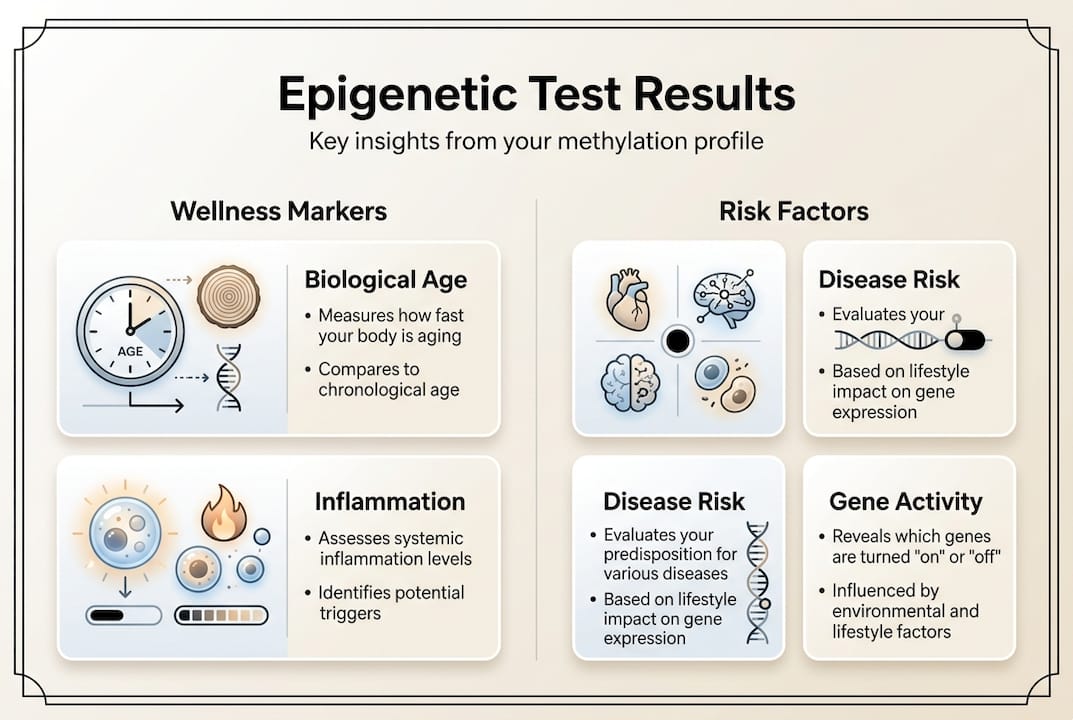
Epigenetic test results typically fall into a few categories, each with varying degrees of clinical utility.
Biological age estimation is the most widely marketed output. Epigenetic clocks, such as the Horvath or GrimAge models, calculate how old your cells appear to be based on methylation patterns. A biological age significantly higher than your chronological age signals accelerated cellular ageing. Reviewing epigenetic clocks and health longevity provides useful context on how these models are constructed and where they fall short.

Clinical diagnostic applications are where epigenetic testing shows its strongest evidence base. Clinical applications include cancer detection via liquid biopsies, diagnosis of neurodevelopmental disorders with a 30.6% diagnostic yield, and predicting macrovascular events in type 2 diabetes with an AUC of 0.81. These are not consumer wellness claims. They are validated clinical tools.
The main categories of results and their practical value:
- Biological age score: Useful as a broad indicator of cellular health, but not a precise individual diagnostic on its own
- Disease risk flags: Methylation patterns associated with cancer, cardiovascular disease, or metabolic dysfunction
- Intervention tracking: Measuring whether a dietary change, medication, or exercise protocol is shifting your epigenetic profile in the right direction
- Tissue-specific findings: Certain markers are only meaningful in specific tissues, which affects how blood-based tests should be interpreted
Pro Tip: A methylation report for disease risk is most valuable when reviewed alongside other biomarkers. Epigenetic data in isolation rarely tells the full story.
For those interested in how epigenetic findings integrate with broader health data, biomarker analysis and personalised health explains why combining data sources produces far sharper insights.
Benefits and limitations: separating hope from hype
Epigenetic testing offers genuine advantages for health-conscious individuals who approach it with realistic expectations. The ability to track biological change over time, rather than receiving a static genetic snapshot, is a meaningful shift in how we can monitor health. Prioritising validated clinical uses over consumer hype is essential to getting real value from these tests.
Key benefits:
- Personalising interventions based on your current biological state, not just your genetic predispositions
- Early warning signals for certain diseases before symptoms appear
- Dynamic tracking of how lifestyle changes are affecting your biology at a cellular level
- Informing clinical decisions around medication, nutrition, and recovery protocols
However, the limitations are equally important to understand. Epigenetic clocks are unreliable for individual-level decisions due to noise, tissue specificity, and the absence of clinical standards. A single data point from a consumer kit is not a diagnosis.
Direct-to-consumer epigenetic tests vary enormously in quality. Some are built on robust clinical platforms. Others are marketing products dressed in scientific language. The difference matters for every decision you make based on the results.
Ethical concerns also deserve attention. Data privacy, the potential for genetic discrimination, and the risk of overinterpreting ambiguous results are real issues. Understanding the role of precision health in responsible testing helps frame these decisions properly. For a deeper look at how advanced diagnostics should be applied, context and professional interpretation are non-negotiable.
When to consider epigenetic testing for your health
Not everyone needs an epigenetic test right now. But for certain individuals, the timing and context make it a genuinely high-value investment.
- You have a family history of cancer, cardiovascular disease, or metabolic conditions and want early biological signals beyond standard screening
- You are actively monitoring a health intervention, such as a new dietary protocol, medication, or structured exercise programme, and want objective data on whether it is working at a cellular level
- You are working with a clinician or health optimisation specialist who can contextualise results within your full health picture
- You want a baseline measurement before making significant lifestyle changes, so you can track progress meaningfully over time
Research shows that monitoring interventions via epigenetic markers can reveal meaningful biological shifts, including reductions in epigenetic age following targeted therapies. However, the same evidence highlights that ageing clocks still require more validation before they can guide individual clinical decisions with confidence.
Pro Tip: Before purchasing any epigenetic test, confirm whether the provider offers professional interpretation. Raw data without expert analysis is rarely actionable. Understanding the benefits of biomarker analysis in a guided context makes the difference between information and genuine insight.
Clinical-grade tests, interpreted by qualified practitioners, consistently outperform consumer kits for meaningful health decisions. If you are serious about using epigenetic data to guide your wellness strategy, the quality of the testing platform and the expertise behind the interpretation are the two factors that matter most.
Take your next step with personalised health testing
If this article has clarified what epigenetic testing can genuinely offer, the logical next step is ensuring you access the right quality of testing and interpretation. Consumer kits can be a starting point, but they rarely provide the clinical rigour or expert context needed to act confidently on results.
At AI Healthician, we offer clinical-grade DNA health testing built on validated platforms, paired with expert analysis that translates your biological data into precise, actionable protocols. Whether you are tracking disease risk, monitoring an intervention, or establishing a longevity baseline, our personalised health consultation ensures your results are interpreted within the full context of your health. This is not generic wellness advice. It is targeted, evidence-informed strategy built around your biology.
Frequently asked questions
What does epigenetic testing actually measure?
It measures chemical tags, primarily DNA methylation, that regulate how genes are expressed without altering the underlying DNA sequence. These patterns reflect the cumulative influence of your lifestyle, environment, and health history.
Are epigenetic tests useful for checking biological age?
They can estimate biological age using methylation-based clocks, but individual-level accuracy remains debated due to noise and the absence of standardised clinical benchmarks. Treat biological age scores as directional indicators rather than definitive measurements.
What are the main risks or limitations of home epigenetic tests?
Direct-to-consumer tests may lack clinical-grade accuracy, and DTC ethical concerns include data privacy risks, potential discrimination, and a tendency to overpromise on what results can tell you. Professional interpretation significantly reduces the risk of misreading your data.
When should I consider getting an epigenetic test?
It is most valuable when you are monitoring health interventions under professional guidance or have a personal or family history that warrants early biological surveillance. A clear clinical purpose makes the investment worthwhile.


