


 matt@aihealthician.co.uk


TL;DR:
- Personalized recovery checklists must address core pillars like nutrition, sleep, hydration, and stress management.
- Biological data such as HRV, CK, and genetics refine recovery decisions beyond generic guidelines.
- Effective recovery strategies depend on adapting protocols based on individual responses, injury status, and data trends.
Recovery is where performance is actually won or lost, yet most athletes still follow the same generic template their coach handed out years ago. The problem is not effort; it is that a fixed checklist cannot account for your current training load, your genetics, your stress hormones, or the specific modalities that your physiology actually responds to. Building a recovery checklist that reflects your individual biology, not just broad population averages, is the difference between consistently performing at your ceiling and perpetually grinding through accumulated fatigue. This article gives you the criteria, comparisons, and practical frameworks to do exactly that.
Table of Contents
- Core elements in the athlete recovery checklist
- How biological data refines your recovery decisions
- Comparing recovery modalities and methods
- Adapting your checklist: injury, transitions, and advanced cases
- Why ‘one size fits all’ recovery checklists fall short
- Personalise your recovery with advanced health insights
- Frequently asked questions
Key Takeaways
| Point | Details |
|---|---|
| Foundation first | Sleep, nutrition, and hydration form the bedrock of any athlete recovery checklist. |
| Data-driven decisions | Tracking biological and subjective metrics leads to more personalised recovery strategies. |
| Tailor methods | Choose recovery modalities based on your needs and the evidence, not trends. |
| Adapt through phases | Modify your checklist based on injury status, genetics, and transition periods. |
Core elements in the athlete recovery checklist
Every personalised approach must be built on a solid foundation. Before you start layering biometric data or advanced modalities on top, you need to confirm the basics are firmly in place. Think of these pillars as the non-negotiables that earn their position in any credible checklist, regardless of sport, training age, or recovery goal.
A recovery checklist for athletes should systematically address seven proven pillars: nutrition, hydration, sleep, active recovery, mobility and stretching, stress management, and ongoing monitoring with adjustment.
Here is what each pillar requires in practice:
- Nutrition: Target 1.6 to 2.2 grams of protein per kilogram of body weight daily to support muscle protein synthesis. Pair this with adequate carbohydrate intake post-workout to replenish glycogen, particularly within the two-hour window after high-intensity sessions. Nutrition’s role in healing extends beyond muscle repair; it directly influences inflammation regulation, immune function, and hormonal balance.
- Hydration: Even mild dehydration of around two percent of body weight impairs neuromuscular function and cognitive performance. Urine colour and body weight pre and post-session are practical daily markers.
- Sleep: The most powerful and underutilised recovery tool available. Seven to nine hours nightly supports growth hormone release, tissue repair, and memory consolidation for skill-based sports.
- Active recovery: Low-intensity movement such as walking, cycling at 50 percent of maximum heart rate, or swimming accelerates lactate clearance without adding mechanical stress.
- Mobility and stretching: Dynamic mobility work before sessions and targeted static stretching post-session maintain joint range of motion and reduce injury risk over time.
- Stress management: Psychological load is physiologically indistinguishable from training load. Chronic stress elevates cortisol, suppresses immune function, and impairs sleep quality.
- Monitoring and adjustment: No checklist is static. Weekly reviews of training load, subjective wellbeing scores, and performance metrics are essential for keeping the plan calibrated.
Statistic callout: Protein intake of 1.6 to 2.2 grams per kilogram of body weight is the evidence-based range for muscle repair and hypertrophy, while athlete wellness essentials consistently reinforce that seven to nine hours of sleep remains the single most impactful non-nutritional recovery intervention available.
The reason each of these elements earns its place is simple: remove any one of them and the entire system degrades. Excellent sleep without adequate protein means you lack the raw material for repair. Perfect nutrition with chronic stress leaves cortisol chronically elevated, blocking the anabolic signal entirely. The checklist works because the pillars interact, not in spite of it.
How biological data refines your recovery decisions
Understanding the pillars is step one. Step two is recognising that your response to those pillars is not identical to another athlete’s response, even if you train the same volume, eat the same diet, and sleep the same hours. This is where individual biological data becomes operationally valuable, not as a novelty, but as a genuine decision-making tool.
The key metrics for athlete recovery span biological, psychological, and social domains, with the most robust insight emerging from tracking trends and baselines rather than reacting to single absolute values.
The most useful biological markers to track include:
- Heart rate variability (HRV): A suppressed HRV reading compared to your personal seven-day rolling average is a more reliable indicator of under-recovery than any single threshold number. Wearables like WHOOP and Garmin now make this accessible daily.
- Creatine kinase (CK): Elevated CK signals significant muscle damage. Serial blood testing across a training block reveals how long your particular muscle recovery actually takes, which often differs substantially from textbook estimates.
- Inflammatory genetics (IL6 and CRP variants): Some athletes carry gene variants that produce a prolonged inflammatory response after tissue damage. If you carry these variants, your checklist needs longer recovery windows between high-intensity sessions, not because you are less fit, but because your biology is working differently.
- Subjective fatigue and soreness scores: Counterintuitively, athlete health data analysis consistently shows that subjective wellbeing measures, things like a simple 1 to 10 soreness rating, often predict performance decrements more accurately than laboratory biomarkers alone.
When you combine biological data examples with subjective reporting, you get a layered picture that neither source provides independently. An athlete who reports feeling fine but shows suppressed HRV and elevated CK warrants caution. One who feels fatigued but shows normal objective markers may simply need a session structure adjustment rather than a full rest day.
Pro Tip: Never make checklist decisions based on a single day’s data. Build a two to four week personal baseline first, then use deviations from that baseline as your signal. A single low HRV reading is noise. Five consecutive low readings are a pattern worth acting on.
Comparing recovery modalities and methods
With your checklist foundations set and your biological feedback loop established, the next question is which specific recovery modalities to use and when. The research here has matured considerably, and the evidence now gives us clear situational guidance rather than generic endorsements.
| Modality | Best for | SUCRA ranking | Limitation |
|---|---|---|---|
| Far infrared radiation (FIR) | Countermovement jump recovery | 98.3% for CMJ | Equipment access |
| Cold water immersion (CWI) | Muscle soreness, CK reduction | 98.9% for soreness | May blunt hypertrophy |
| Instrument-assisted percussion (INPT) | CK and lactate clearance | 91% for CK | Technique dependent |
| Massage | GABA, CK, perceived recovery | High for subjective | Time and cost |
| Active recovery | Lactate clearance, mobility | Moderate, context-dependent | Limited for soreness |
| Static stretching | Flexibility maintenance | Low for acute soreness | Minimal performance benefit |
The 2026 comparison of recovery methods using SUCRA (surface under the cumulative ranking curve) rankings provides a genuinely useful hierarchy. SUCRA scores rank interventions probabilistically across multiple outcomes, meaning a score of 98 percent does not mean the technique is perfect; it means it outperforms other listed options across that specific metric in most scenarios.
The 2025 recovery review adds important nuance. For instance, CWI clearly outperforms active and passive recovery for DOMS (delayed onset muscle soreness) and CK reduction, but it may attenuate hypertrophic adaptations if used immediately after resistance training. Massage outperforms most modalities for GABA elevation and subjective recovery, suggesting a role in managing the psychological dimension of recovery, not just the physical one.
“Static stretching provides minimal acute performance benefit and should not be prioritised over sleep or nutrition when recovery time is limited.” This matters practically because many athletes invest significant time in post-session stretching while neglecting the modalities with far stronger evidence behind them.
Key situational guidance from the evidence:
- Use FIR in the 24 to 48 hour window after explosive-dominant sessions such as sprint work or plyometrics, when jump performance recovery is the priority.
- Use CWI after endurance sessions or during congested fixture schedules where DOMS management outweighs hypertrophy goals.
- Use massage or percussion tools when CK reduction and subjective recovery are the targets, particularly mid-week between heavy training days.
- Integrate active recovery as your default low-load day strategy, since peak performance trends confirm it remains one of the most versatile and accessible tools for maintaining aerobic base while managing fatigue.
Adapting your checklist: injury, transitions, and advanced cases
A well-constructed checklist does not collapse under pressure. It adapts. The scenarios where athletes most need a structured framework are also the ones where generic advice fails most spectacularly: post-injury return, concussion management, seasonal transitions, and genetically influenced recovery timelines.
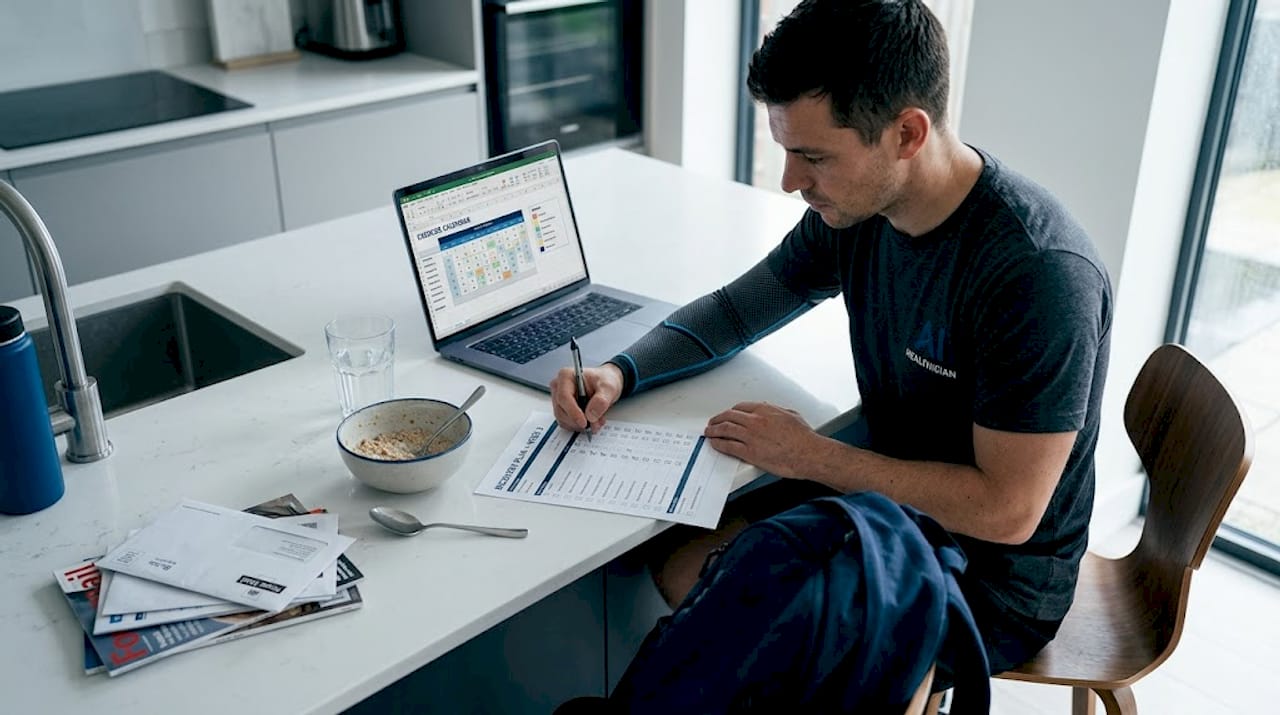
Volume reduction during transitions is one of the most consistently mismanaged elements of athlete recovery. The NSCA and CSCCa recommend a stepwise volume reduction rule during transition periods from high training load to reduced activity, cutting volume in stages of 50, 30, 20, and 10 percent over successive weeks rather than abruptly stopping. Abrupt deconditioning accelerates muscle loss and metabolic adaptation reversal far more than a gradual taper does.
For injury-specific adaptations, follow this structured approach:
- Acute phase (days 1 to 5): Replace all high-load sessions with active rest (gentle walking, aquatic therapy). Prioritise anti-inflammatory nutrition, particularly omega-3 fatty acids and adequate vitamin D. Maintain sleep targets rigorously since this is when tissue repair is most metabolically active.
- Sub-acute phase (days 5 to 21): Introduce progressive range of motion work and low-load resistance training for unaffected muscle groups. Begin monitoring HRV daily to track systemic recovery trajectory.
- Remodelling phase (weeks 3 to 12): Gradually reintroduce sport-specific movement. Use GPS tracking and CK monitoring to ensure load does not outpace tissue repair.
- Return to performance phase: Validate readiness with objective testing such as hop tests for ACL, not just symptom resolution. Research confirms post-ACL rehabilitation produces high return rates when GPS-informed loading and staged progression are followed, compared to symptom-led approaches alone.
For concussion management, the CDC’s six-step return-to-play progression is non-negotiable and must be applied in sequence without skipping stages. The types of functional health tests relevant to concussion clearance include neurocognitive assessment, vestibular function tests, and controlled exertion tolerance evaluations.
| Recovery phase | Volume target | Priority marker | Checklist adjustment |
|---|---|---|---|
| Transition week 1 | 50% of prior week | HRV baseline | Reduce intensity, maintain frequency |
| Transition week 2 | 30% of prior week | Subjective fatigue | Increase sleep target to 9 hours |
| Transition week 3 | 20% of prior week | CK normalisation | Introduce mobility emphasis |
| Transition week 4 | 10% of prior week | Full baseline HRV | Reintroduce progressive load |
Pro Tip: Adjust your checklist intensity weekly during injury rehab rather than monthly. Recovery trajectories after injury are non-linear, and weekly reviews allow you to capitalise on faster-than-expected progress rather than adhering to a fixed timeline.
Athletes with IL6 and CRP genetic variants should build an additional 20 to 30 percent buffer into their recovery windows during intense training blocks. This is not a weakness; it is simply working with your biology rather than against it.
Why ‘one size fits all’ recovery checklists fall short
Here is an uncomfortable truth: most published recovery checklists are designed for an average athlete who does not exist. They represent the mean response from a study population, which means they are optimised for no single individual within it.
The real problem is not that athletes lack information; it is that they use generic frameworks as if they were personalised prescriptions. The evidence is clear that sleep, nutrition, and hydration must be prioritised as the irreplaceable foundation before any performance technology or advanced modality delivers meaningful additional benefit. Yet the industry perpetually over-indexes on novel interventions and under-invests in mastering the basics.
What separates elite recovery management from average recovery management is not access to the best ice baths or the most sophisticated wearables. It is the discipline to treat health analytics for performance as a dynamic feedback loop rather than a one-time assessment. Your checklist should be a living model that evolves with each training block, each life stressor, and each new data point your biology produces.
The athletes who recover best are not the ones with the longest checklists. They are the ones who understand precisely which items on their checklist actually move their personal needle, and they have the data to prove it.
Personalise your recovery with advanced health insights
Knowing which recovery tools to use is one thing. Understanding exactly how your unique biology responds to them is another level entirely.
At AI Healthician, we combine functional testing and in-depth data analysis to build recovery protocols around your actual physiology, not population averages. Whether you are looking to understand your genetic recovery profile through DNA health testing, identify your true metabolic thresholds with a metabolic test and body scan, or calibrate your training zones precisely using active metabolic analysis, our protocols translate raw biological data into specific, measurable changes to your recovery checklist. Take the guesswork out of regeneration entirely.
Frequently asked questions
What is the ideal amount of sleep for athletic recovery?
Most athletes benefit from 7 to 9 hours of sleep nightly to support muscle repair, growth hormone release, and the next day’s performance output.
How much protein should athletes consume to maximise recovery?
Aim for 1.6 to 2.2 grams of protein per kilogram of body weight daily, distributed across meals, to support optimal muscle protein synthesis throughout the day.
Are data-driven approaches better than generic recovery advice?
Research confirms that subjective and objective data combined outperform generic plans because they capture individual variation in fatigue, inflammatory response, and recovery capacity that averages cannot account for.
What recovery method is best for muscle soreness?
Cold water immersion consistently shows the strongest evidence for reducing muscle soreness and CK and lactate levels compared with active and passive recovery methods.
How should a recovery checklist be adapted after injury?
Follow a phased volume reduction protocol and apply evidence-based rehab progressions; genetic factors and concussion protocols may significantly influence the duration and structure of each phase.


