


 matt@aihealthician.co.uk


Pushing your mental and physical limits often means you notice small changes others might overlook. When every decision and training session matters, relying on basic check-ups can leave vital questions unanswered. Advanced blood testing analyses a wide range of markers including proteins, hormones, and genetic factors, moving far beyond standard panels to reveal hidden imbalances or risk patterns. This approach empowers you to take control of your health trajectory with precision, offering targeted strategies rather than generic solutions.
Table of Contents
- Defining Advanced Blood Testing And Its Scope
- Types Of Advanced Blood Tests Explained
- How Advanced Blood Testing Powers Precision Health
- Costs, Risks, And Common Misconceptions
Key Takeaways
| Point | Details |
|---|---|
| Importance of Advanced Blood Testing | Advanced blood testing offers detailed insights into physiological states, identifying dysfunction patterns before diseases develop. |
| Diversity of Tests | A wide range of tests, including hormone assessments and genetic profiling, provide a comprehensive view of health and performance potential. |
| Proactive Strategy | Unlike standard tests that primarily diagnose existing diseases, advanced tests facilitate proactive health optimisation tailored to individual needs. |
| Investment vs. Value | The costs of advanced blood testing should be viewed as investments towards improved decision-making and performance enhancement, rather than mere expenses. |
Defining Advanced Blood Testing and Its Scope
Advanced blood testing extends far beyond the basic check-up your GP might order. It involves analysing multiple blood components including red and white blood cells, platelets, electrolytes, proteins, fats, sugars, and hormones to uncover detailed insights into your physiological state.
Think of standard blood work as a snapshot. Advanced testing is the detailed report with context, trends, and predictive markers.
For entrepreneurs and athletes, this distinction matters enormously. Your body’s chemical balance directly impacts decision-making clarity, energy capacity, recovery speed, and long-term disease risk. You cannot optimise what you cannot measure.
What Advanced Blood Testing Actually Covers
Advanced testing ranges across multiple analytical layers:
- Biomarker detection – identifying genetic markers, inflammatory proteins, and disease-specific compounds
- Organ function assessment – evaluating how your liver, kidneys, heart, and metabolic systems are truly performing
- Hormonal profiling – measuring testosterone, cortisol, thyroid hormones, and metabolic regulators
- Micronutrient analysis – uncovering deficiencies in minerals and vitamins that limit performance
- Metabolic markers – tracking glucose control, lipid profiles, and mitochondrial health indicators
Advanced blood testing reveals the biological mechanisms driving your performance and longevity, not just surface-level disease markers.
Why Scope Matters for Your Situation
The scope of advanced testing directly impacts what you can actually do with the results. Standard diagnostic testing focuses on diagnosing existing disease. Advanced testing identifies the dysfunction patterns before disease develops.
As an entrepreneur managing high cognitive demands, you need to know if your cortisol rhythm is destabilising your focus. As an athlete, you need to understand if your iron levels are limiting your VO2 max gains. These insights fall outside traditional diagnostic scope.
The depth of analysis varies significantly. Some advanced panels include 20 markers. Precision panels can assess 80+ biomarkers, revealing interconnected patterns that single tests cannot show.
The Practical Difference
Standard blood work answers: “Do you have disease X?”
Advanced testing answers: “What is your current physiological capacity? Where are your vulnerabilities? What interventions will move your metrics in the direction you need?”
This distinction changes everything about how you interpret results and build your health strategy. You shift from reactive management to proactive optimisation based on actual biological data rather than population averages.
Here is a comparison of standard and advanced blood testing to clarify their practical differences:
| Aspect | Standard Blood Test | Advanced Blood Test |
|---|---|---|
| Primary Purpose | Detect existing diseases | Reveal early dysfunction patterns |
| Number of Markers | Usually under 20 | Up to 80 or more |
| Use Case Examples | Diagnose anaemia, infection | Optimise performance, assess capacity |
| Data Interpretation | Population reference ranges | Individual baseline and trends |
| Strategic Role | Reactive diagnosis | Proactive health optimisation |
Pro tip: When ordering advanced blood testing, specify whether you need diagnostic confirmation (disease-focused) or performance optimisation (capacity-focused) – the panel selection differs significantly, and asking for the wrong scope wastes resources.
Types of Advanced Blood Tests Explained
Advanced blood tests fall into distinct categories, each revealing different layers of your physiological function. Understanding which test serves which purpose helps you ask smarter questions and interpret results with genuine insight rather than confusion.
The landscape spans from simple functional markers to complex molecular diagnostics. What you test depends entirely on what you need to know and why you need to know it.
Core Test Categories
Think of advanced testing in functional groups rather than isolated tests. Most comprehensive health assessments combine multiple test types to create a complete picture.
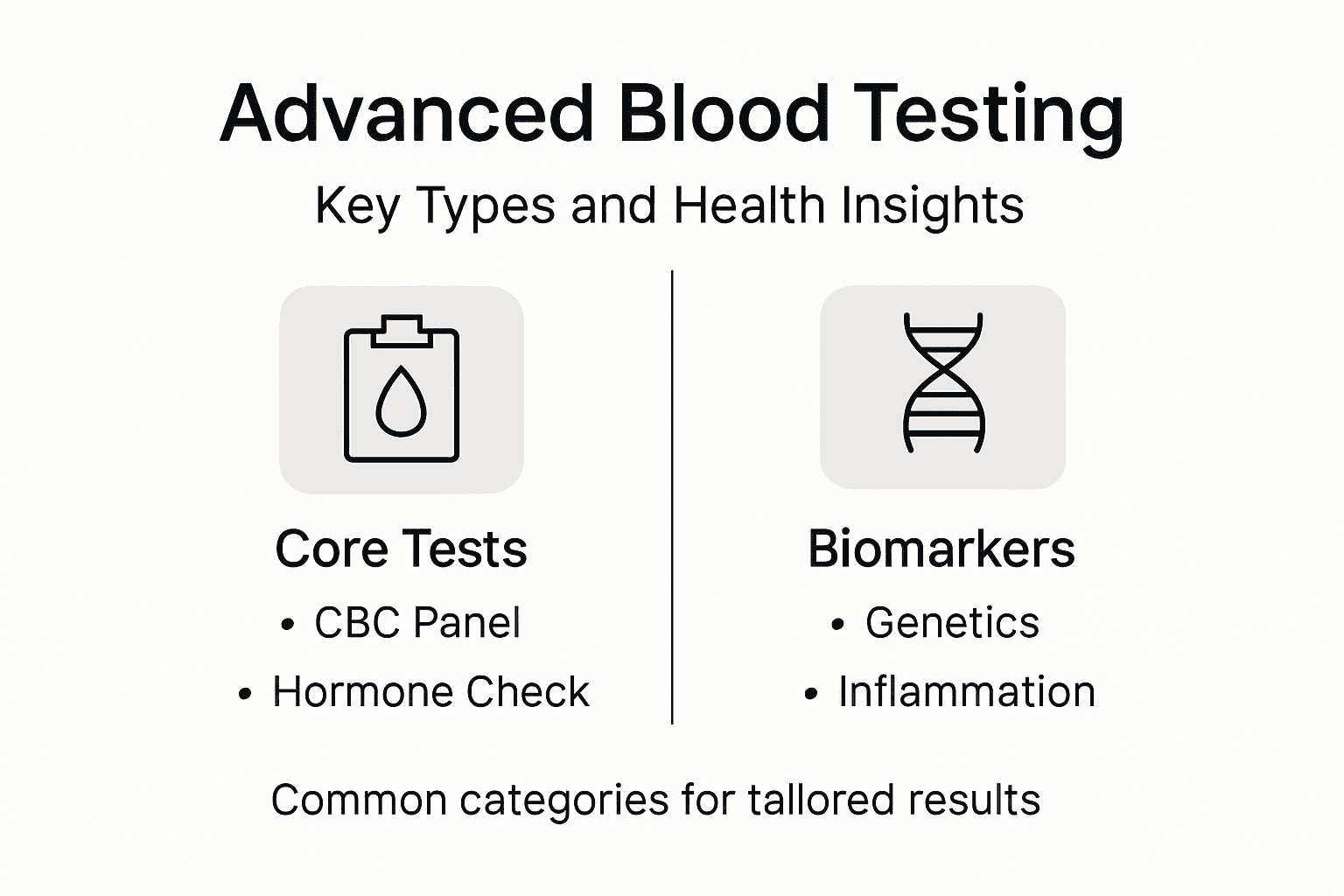
Complete Blood Count (CBC) and metabolic panels measure your baseline cellular and chemical status. These reveal energy production capacity, immune function, and organ stress signals.
Hormone assessments track thyroid function, cortisol patterns, sex hormones, and metabolic regulators that directly impact performance, recovery, and mental clarity.
Genetic and biomarker testing identifies disease risk variants and inflammatory proteins that signal dysfunction patterns before symptoms emerge.
For entrepreneurs, advanced hormone testing often reveals cortisol dysregulation driving fatigue and decision fatigue. For athletes, deep health testing evaluates cardiovascular efficiency markers and metabolic capacity in ways standard physicals cannot.
Below is a summary of core advanced blood test categories and what unique insight each category provides:
| Test Category | Main Focus Area | How it Adds Value |
|---|---|---|
| Hormone Assessment | Endocrine system balance | Identifies fatigue or stress causes |
| Genetic/Biomarker Testing | Disease risk, inflammation | Detects hidden vulnerabilities |
| Metabolic/Functional Panels | Organ and energy function | Pinpoints energy or nutrient limits |
| Specialised Immunological | Immune system efficiency | Reveals infection or autoimmunity |
Specialised Diagnostic Approaches
Advanced blood testing includes several targeted methodologies:
- Immunoassays – measuring antibodies and immune responses to infections or autoimmune patterns
- Biochemical panels – evaluating organ function through enzyme and protein analysis
- Molecular diagnostics – detecting genetic mutations and disease-specific markers at the DNA level
- Tumour marker testing – identifying cancer risk or progression indicators
- Serological testing – assessing your immune response history to infections
The right test answers the specific question you’re asking about your health, not just generic screening questions.
Why Test Selection Matters
Ordering advanced tests without clarity wastes money and generates noise. A high-performing entrepreneur tracking cognitive decline needs different markers than an endurance athlete optimising oxygen utilisation.
Your testing strategy should align with your actual goals. Are you preventing disease? Optimising performance? Monitoring existing conditions? Clarifying this determines which tests belong in your panel.
Basic testing shows presence or absence. Advanced testing reveals the biological mechanisms underneath, allowing precise intervention design based on your unique physiology rather than population averages.
Pro tip: Request testing panels designed for your specific situation—performance optimisation, disease prevention, or monitoring—rather than generic comprehensive panels that include irrelevant markers for your actual goals.
How Advanced Blood Testing Powers Precision Health
Precision health means tailoring interventions to your individual biology rather than applying population averages. Advanced blood testing provides the detailed data that makes this shift possible—turning generic recommendations into personalised protocols based on your actual physiological state.

Without detailed biomarker data, you’re essentially guessing. With it, you’re making decisions grounded in measurable reality.
From Population Averages to Personal Baselines
Traditional medicine uses standardised reference ranges developed from large populations. These ranges work as broad screening tools but miss critical individual variations that matter enormously for performance and longevity.
Personalised analysis of blood tests using individual-specific reference points enables earlier detection of conditions like diabetes and cardiovascular disease. More importantly, it reveals your unique metabolic patterns before dysfunction becomes clinically obvious.
Your baseline matters more than population averages. A cortisol level considered “normal” might be creating cognitive fog and recovery delays for you specifically. An iron level within range might still be limiting your aerobic capacity.
Precision health captures these individual nuances through comprehensive biomarker profiling.
How Data Becomes Strategy
Advanced blood testing provides pivotal data for predicting and preventing disease tailored to your unique biology and circumstances. This transforms the traditional healthcare model from reactive (treating disease) to proactive (preventing dysfunction).
Here’s the practical shift:
- Traditional approach – wait for symptoms, run tests, diagnose condition, treat disease
- Precision approach – measure biomarkers, identify dysfunction patterns, design preventative interventions, optimise function
For entrepreneurs managing cognitive demands, precision testing reveals whether fatigue stems from thyroid dysfunction, mitochondrial stress, or cortisol dysregulation. For athletes, it identifies which metabolic adaptations are occurring and which performance bottlenecks require specific intervention.
Precision health turns blood data from diagnostic snapshots into ongoing performance intelligence that guides measurable interventions.
Building Your Personal Protocol
The power emerges when you combine baseline testing, targeted interventions, and follow-up measurement. This closed-loop system creates accountability and demonstrates what actually works for your physiology.
Your advanced blood testing strategy should:
- Establish individual baselines across relevant biomarkers
- Identify dysfunction patterns specific to your goals
- Guide intervention selection based on biological reality
- Enable measurement of intervention effectiveness
- Inform protocol adjustments based on actual response
This approach requires more initial testing investment but generates far superior results because every intervention is targeted to your measurable reality rather than generic protocols.
Pro tip: Request baseline comprehensive testing first, then follow-up testing 8–12 weeks after implementing targeted interventions to measure actual biological response rather than assuming outcomes.
Costs, Risks, and Common Misconceptions
Advanced blood testing generates legitimate questions about expense, safety, and whether the investment actually delivers value. Understanding the real risks versus imagined ones helps you make confident decisions about your testing strategy.
The facts are straightforward once you separate marketing hype from actual physiology.
Understanding the Real Risks
Blood draws carry minimal risks such as brief discomfort, minor bruising at the puncture site, or rare infection if protocols are breached. Experienced phlebotomists following proper procedures reduce these risks substantially.
The misconception is that frequent blood testing causes significant harm. In reality, a single draw removes roughly 40 millilitres of blood—negligible compared to your total circulating volume of 5 litres. Even comprehensive testing drawing multiple vials poses minimal physiological stress.
Vulnerable populations require careful monitoring, but healthy adults undergoing quarterly or bi-annual testing face virtually no meaningful risk from the procedure itself.
The Cost Question
Advanced blood testing costs vary dramatically based on panel scope. Basic panels run £150–£300. Comprehensive metabolic profiling with biomarker analysis ranges from £500–£2,000 depending on marker selection.
The relevant question isn’t absolute cost. It’s return on investment through:
- Early identification of dysfunction patterns before clinical disease emerges
- Personalised intervention targeting that prevents expensive treatment down the line
- Performance optimisation that increases income or athletic results
- Reduced guesswork in protocol design
For entrepreneurs earning significant income, advanced testing costing £1,000 annually is trivial compared to improved decision-making clarity. For athletes pursuing performance gains, identifying metabolic bottlenecks through testing costs far less than ineffective training programmes.
The cost of testing is minimal compared to the cost of treating preventable disease or following ineffective protocols.
Debunking Common Misconceptions
Misconceptions often arise from misunderstanding test purposes and limitations. Here are the most common:
- “Advanced blood tests diagnose everything” – They reveal dysfunction patterns, not definitive diagnoses. They guide clinical assessment.
- “One test tells you everything you need” – No single test captures your complete physiological picture. Comprehensive assessment requires multiple markers.
- “Results are immediately actionable” – Interpretation requires expertise. Raw numbers without context create confusion.
- “More testing is always better” – Excessive testing generates noise. Strategic testing targeting specific questions delivers clarity.
- “Results apply forever” – Biomarkers change constantly. Baseline measurement matters less than tracking trends over time.
Making Smart Testing Decisions
Order testing strategically rather than comprehensively. Define your actual question first: Are you preventing disease? Optimising performance? Monitoring existing conditions?
Your question determines which markers matter. Understanding metabolic health measurement helps clarify which biomarkers align with your specific goals rather than ordering panels with irrelevant markers.
Work with practitioners who interpret results in context of your physiology, goals, and baseline rather than comparing you to population standards.
Pro tip: Request a detailed analysis of which specific markers matter for your goals before testing, then request only those markers—this reduces cost substantially whilst ensuring every result drives actionable insight.
Unlock Your Unique Health Blueprint with Advanced Blood Testing
Struggling to find clarity in your health journey because generic tests only show part of the picture You deserve more than surface-level diagnostics Understanding your individual physiological capacity and dysfunction patterns is the key to proactive optimisation and long-term resilience. At AI Healthician we specialise in advanced health diagnostics that transform detailed blood biomarker analysis into personalised strategies tailored to your unique biology and goals. Whether you want to optimise energy, sharpen mental clarity, or reduce disease risk our precision approach moves you beyond guesswork and broad population averages.

Explore how our DNA Health Testing and comprehensive functional testing deliver actionable insights that standard panels miss. With expert data interpretation and evidence-informed protocols you can track progress and measure real biological change. Do not wait for symptoms or ineffective advice take control today. Visit AI Healthician to start your journey towards a personalised health strategy that truly reflects your individual physiology.
Frequently Asked Questions
What is advanced blood testing?
Advanced blood testing involves a detailed analysis of various blood components to uncover insights into your physiological state, going beyond standard blood work.
How does advanced blood testing differ from standard blood tests?
While standard tests focus on diagnosing existing diseases, advanced blood testing reveals early dysfunction patterns and provides insight into performance, recovery, and overall health optimisation.
What types of biomarkers can advanced blood tests assess?
Advanced blood tests can assess biomarkers related to hormone levels, organ function, metabolic markers, micronutrient levels, and genetic indicators to provide a comprehensive picture of health.
Why is it important to choose the right advanced blood test?
Choosing the right advanced blood test ensures that the results align with your health goals, whether you are looking to optimise performance, monitor existing conditions, or prevent disease.


