


 matt@aihealthician.co.uk


Many believe VO2 max is a fixed genetic ceiling you’re stuck with for life. Yet research shows training can modify VO2 max by 10-30%, demonstrating its plasticity. Understanding VO2 max and how to improve it empowers you to unlock better fitness results and longevity strategies grounded in measurable physiology.
Table of Contents
- Understanding VO2 Max: Definition and Physiology
- How VO2 Max is Measured: Lab and Field Methods
- Why VO2 Max Matters: Health, Longevity, and Performance
- Common Misconceptions About VO2 Max
- VO2 Max Benchmarks by Age, Sex, and Fitness Level
- How to Improve Your VO2 Max: Training and Lifestyle Strategies
- Applying VO2 Max Data for Personalized Performance and Health Optimization
- Unlock Your Peak Performance with Aihealthician’s Advanced VO2 Max Testing
- What Is VO2 Max? Frequently Asked Questions
Key Takeaways
| Point | Details |
|---|---|
| VO2 max measures maximal oxygen uptake | It reflects your cardiovascular, respiratory, and muscular efficiency in transporting and using oxygen during intense exercise. |
| Accurate measurement requires validated tests | Lab graded exercise tests provide gold standard accuracy, while field tests and wearables offer practical alternatives with trade-offs. |
| VO2 max predicts endurance and longevity | Higher VO2 max correlates strongly with better performance and reduced mortality risk by up to 13% per 3.5 ml/kg/min increase. |
| Training and lifestyle modify VO2 max significantly | Targeted interval training, endurance work, nutrition, and recovery strategies can improve VO2 max by 10-30% over time. |
| Wearables aid monitoring but have limits | Devices track trends continuously but carry error margins up to 15% compared to lab tests. |
Understanding VO2 Max: Definition and Physiology
VO2 max is the maximal amount of oxygen your body can use during intense exercise, measured in milliliters per kilogram of body weight per minute (ml/kg/min). It reflects how efficiently your cardiovascular, respiratory, and muscular systems transport and utilize oxygen at peak exertion. Research confirms VO2 max directly measures cardiovascular and respiratory system efficiency in oxygen transport and utilization during peak exercise.
Typical VO2 max values vary widely based on fitness level, age, and sex. Sedentary individuals might register 25-35 ml/kg/min, recreational athletes 40-50 ml/kg/min, and elite endurance athletes often exceed 70 ml/kg/min. These numbers reveal your aerobic capacity and explain 30-60% of the variation in endurance performance among trained individuals.
Three physiological systems determine VO2 max:
- Cardiovascular system: Heart pumps oxygenated blood to working muscles efficiently.
- Respiratory system: Lungs exchange oxygen and carbon dioxide rapidly during exertion.
- Muscular system: Muscles extract and utilize oxygen from blood to generate energy aerobically.
When you perform Active Metabolic Analysis, you measure how well these systems coordinate under stress. Higher VO2 max means your body delivers and uses oxygen more effectively, powering longer and harder efforts. Understanding this metric gives you a baseline to track improvements and set realistic performance goals.
For those serious about optimization, knowing your VO2 max reveals where you stand and what’s possible. It’s not just a number. It’s a window into your body’s aerobic engine and a predictor of health outcomes beyond the gym.
How VO2 Max is Measured: Lab and Field Methods
Accurate VO2 max measurement requires the right method matched to your goals and resources. The gold standard is a lab graded exercise test using a metabolic cart, which directly measures oxygen consumption and carbon dioxide production breath by breath during progressively intense exercise. This method delivers accuracy within ±3-5%, making it ideal for athletes and individuals seeking precise data.
Field tests offer accessible alternatives when lab access isn’t practical. The Cooper 12 minute run test estimates VO2 max based on distance covered in 12 minutes at maximal effort. While convenient and low cost, field tests carry higher error margins, typically ±10-15%, because they rely on performance estimates rather than direct oxygen measurement.
Wearable devices like fitness watches estimate VO2 max continuously using heart rate data, activity patterns, and algorithms. They provide ongoing monitoring and trend tracking, but accuracy varies significantly by device and individual, with error margins reaching ±15% compared to lab tests. Wearables excel at longitudinal tracking but shouldn’t replace lab tests for baseline or critical decisions.
Comparison of VO2 Max Measurement Methods
| Method | Accuracy | Cost | Best For |
|---|---|---|---|
| Lab graded exercise test | ±3-5% | High | Precise baseline, athletes, clinical assessment |
| Field tests (Cooper run) | ±10-15% | Low | Quick estimates, fitness screening |
| Wearable devices | ±15% | Medium | Continuous monitoring, trend tracking |
Choosing the right method depends on your needs:
- Lab tests: When you need precise data for training zones, health optimization, or performance benchmarking.
- Field tests: For quick assessments or when lab access isn’t available.
- Wearables: To monitor changes over time and adjust training dynamically.
Pro Tip: Start with a lab test to establish your true baseline, then use wearables to track trends and verify improvements with periodic lab retests. This strategy balances accuracy with convenience and cost.
For comprehensive insights, consider pairing VO2 max testing with other functional health tests to build a complete physiological profile. Learn more about VO2 max measurement methods to understand technical details behind each approach.
Why VO2 Max Matters: Health, Longevity, and Performance
VO2 max isn’t just an athlete’s metric. It’s a powerful biomarker linked to endurance performance, metabolic health, and longevity. Studies demonstrate VO2 max explains up to 60% of endurance variability and associates with reduced cardiovascular disease and mortality.
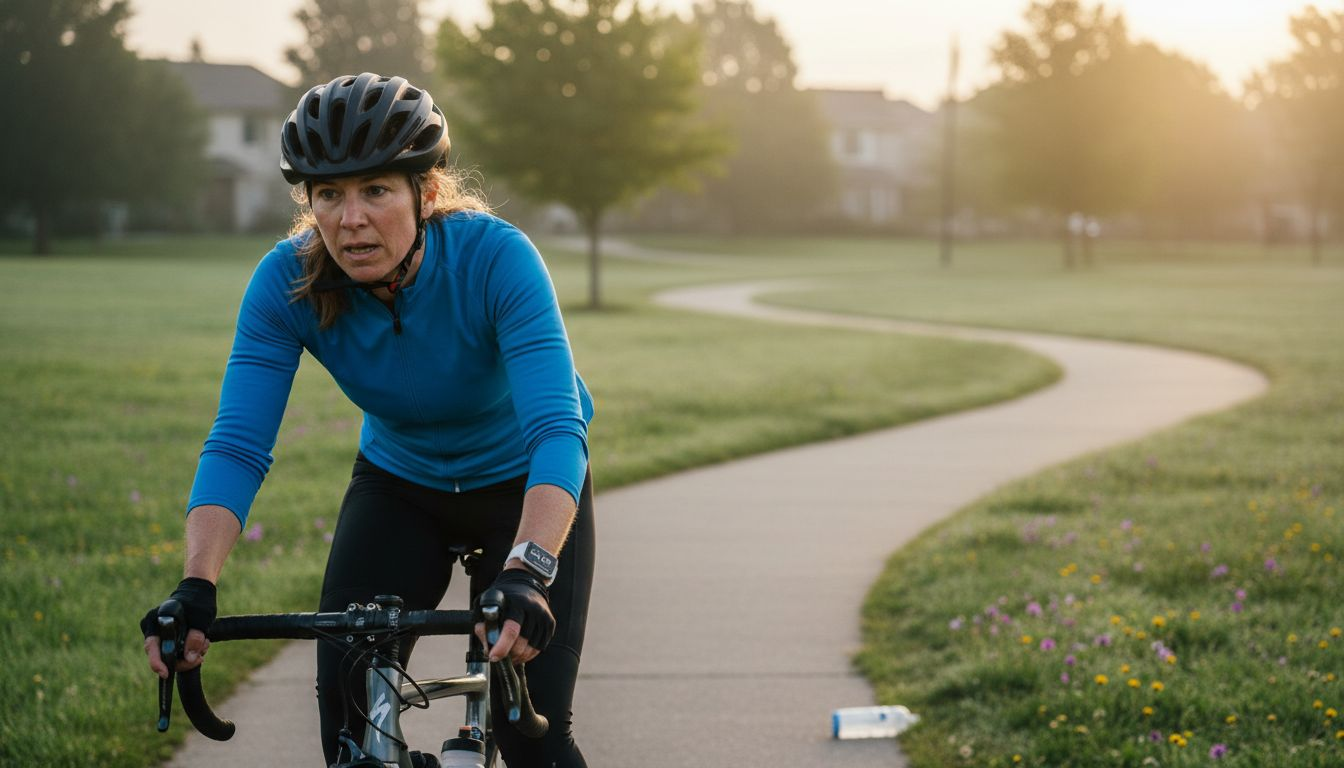
Every 3.5 ml/kg/min increase in VO2 max reduces all cause mortality risk by approximately 13%. This means improving your aerobic capacity directly impacts your lifespan and healthspan. Higher VO2 max correlates with better cardiovascular function, improved insulin sensitivity, and enhanced metabolic resilience.
Key reasons VO2 max matters:
- Endurance performance: Higher VO2 max enables longer, harder efforts before fatigue sets in.
- Cardiovascular health: Strong aerobic capacity reflects efficient heart and lung function.
- Metabolic resilience: Better oxygen utilization improves energy production and metabolic flexibility.
- Longevity predictor: VO2 max ranks among the strongest predictors of mortality, often stronger than traditional risk factors.
For athletes, VO2 max sets the ceiling for aerobic performance. For everyone else, it signals how well your body handles physical stress and recovers. Low VO2 max increases risk for metabolic syndrome, heart disease, and premature death. High VO2 max offers protection and resilience.
“VO2 max is one of the most powerful predictors of health and longevity, often surpassing traditional biomarkers like cholesterol or blood pressure in predictive value.”
Improving VO2 max through training and lifestyle changes delivers measurable health dividends. It’s not vanity. It’s survival. Tracking VO2 max alongside other metrics helps you build a metabolic health improvement workflow that targets real outcomes.
Explore more about the health benefits of VO2 max to understand why this metric deserves attention in any serious health strategy.
Common Misconceptions About VO2 Max
Several myths about VO2 max persist despite clear evidence. Correcting these misunderstandings helps you set realistic expectations and avoid wasted effort.
VO2 max is entirely genetic and unchangeable. False. While genetics influence your starting point and upper limit, training can improve VO2 max by 10-30%. Research confirms VO2 max is modifiable by training and is not solely genetically fixed. Consistent aerobic training, interval work, and lifestyle optimization produce measurable gains.
VO2 max alone determines endurance performance. Not quite. VO2 max explains 30-60% of performance variation, but other factors matter equally. Lactate threshold, running economy, neuromuscular efficiency, and mental resilience all contribute. Two athletes with identical VO2 max can perform very differently based on these variables.
VO2 max doesn’t decline with age if you stay active. Wishful thinking. VO2 max declines roughly 1% per year after age 30, even in active individuals, though training slows this decline significantly. Men and women experience different rates and baseline values due to physiological differences.
Wearable VO2 max estimates are as accurate as lab tests. Not true. Wearables offer convenience and trend tracking but carry error margins up to 15%. They’re useful for monitoring changes over time, not for precise baseline measurement or clinical decisions.
Common misconceptions to avoid:
- Believing VO2 max can’t improve with effort.
- Ignoring other performance factors beyond VO2 max.
- Expecting wearable devices to match lab test precision.
- Assuming age related decline is fully preventable.
Pro Tip: Use wearables to spot trends and motivate consistency, but validate significant changes with a lab test. This approach keeps you honest and ensures you’re responding to real physiological shifts, not device noise.
For precise VO2 max analysis and actionable insights, professional testing removes guesswork. Dive deeper into VO2 max myths and facts to separate evidence from assumptions.
VO2 Max Benchmarks by Age, Sex, and Fitness Level
Comparing your VO2 max to normative benchmarks helps contextualize results and set realistic improvement goals. Values vary by age, sex, and fitness level due to physiological differences and training history.
Men typically display higher VO2 max values than women because of greater hemoglobin concentration, larger heart size, and higher muscle mass. VO2 max peaks in the mid 20s and declines approximately 1% per year after age 30, though active individuals slow this decline.
VO2 Max Benchmarks by Age and Sex (ml/kg/min)
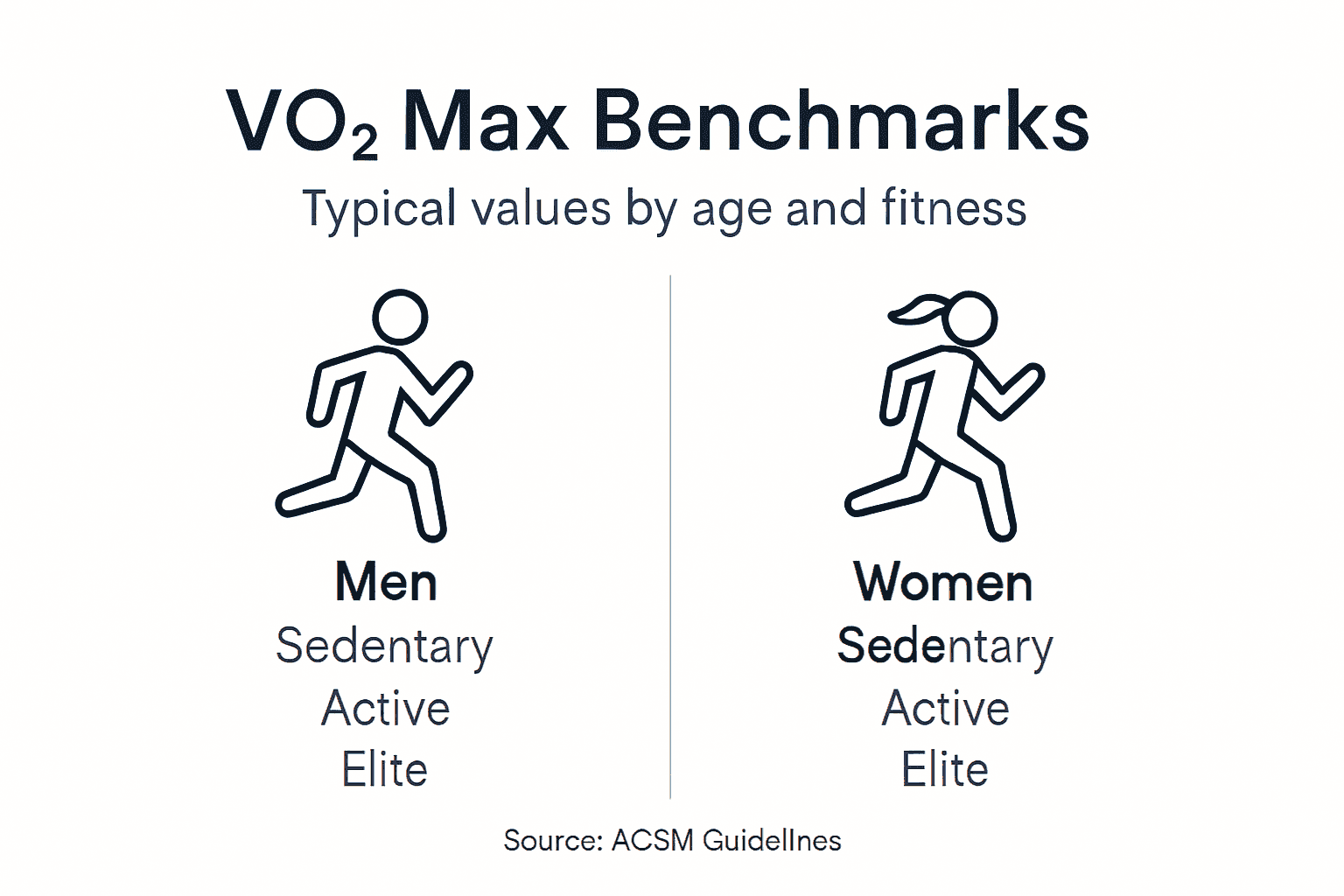
| Age Group | Sedentary Male | Active Male | Elite Male | Sedentary Female | Active Female | Elite Female |
|---|---|---|---|---|---|---|
| 20-29 | 35-40 | 45-52 | 60-75 | 28-33 | 38-45 | 55-68 |
| 30-39 | 33-38 | 42-49 | 55-70 | 26-31 | 36-42 | 50-63 |
| 40-49 | 31-35 | 39-46 | 50-65 | 24-29 | 33-39 | 45-58 |
| 50-59 | 28-32 | 36-42 | 45-60 | 22-26 | 30-36 | 40-53 |
| 60+ | 25-29 | 32-38 | 40-55 | 20-24 | 27-32 | 35-48 |
These ranges reflect general population norms. Elite endurance athletes often exceed upper ranges, while sedentary individuals with health conditions may fall below lower bounds. Your personal benchmark depends on training history, genetics, and health status.
Use these benchmarks to:
- Assess where you currently stand relative to peers.
- Set achievable improvement targets based on age and fitness level.
- Track progress over time and adjust training intensity.
- Identify if your VO2 max signals health risks requiring intervention.
Remember, improving VO2 max by even 10-15% delivers meaningful health and performance benefits regardless of starting point. Focus on your trajectory, not just absolute values.
How to Improve Your VO2 Max: Training and Lifestyle Strategies
Improving VO2 max requires targeted training and supportive lifestyle habits. Evidence shows training at 60-85% VO2 max intensities optimizes aerobic improvements over weeks to months. Gains typically appear within 4-8 weeks of consistent effort, with total improvements reaching 10-30% depending on starting fitness and adherence.
Effective training strategies to boost VO2 max:
- High intensity interval training (HIIT): Perform 4-6 intervals of 3-5 minutes at 85-95% VO2 max with equal recovery periods twice weekly. This stimulates maximal cardiovascular adaptation.
- Sustained threshold work: Include 20-40 minute sessions at 75-85% VO2 max once or twice weekly to build aerobic capacity and lactate clearance.
- Long aerobic sessions: Add 60-90 minute efforts at 60-70% VO2 max to enhance mitochondrial density and fat oxidation efficiency.
- Progressive overload: Gradually increase training volume and intensity every 2-4 weeks to prevent plateaus and drive continued adaptation.
- Cross training variety: Mix running, cycling, rowing, and swimming to reduce injury risk and provide novel stimuli for aerobic systems.
Beyond training, lifestyle factors influence VO2 max gains:
- Altitude exposure: Training at altitude or using altitude simulation increases red blood cell production and oxygen carrying capacity.
- Nutrition optimization: Adequate protein, carbohydrates, and micronutrients (especially iron) support oxygen transport and muscle adaptation.
- Recovery protocols: Prioritize 7-9 hours of quality sleep and active recovery to allow physiological adaptations to consolidate.
- Body composition management: Reducing excess body fat improves the power to weight ratio reflected in VO2 max per kilogram measures.
Pro Tip: Periodize your training by cycling between HIIT focused blocks and endurance focused blocks every 4-6 weeks. This prevents overtraining, maintains motivation, and maximizes long term VO2 max gains.
Consistent effort matters more than perfection. Even modest improvements in VO2 max translate to better health outcomes and performance. Pair training with the athlete wellness checklist to ensure you’re supporting adaptation holistically.
Learn more about VO2 max training zones to fine tune intensity prescriptions and accelerate progress.
Applying VO2 Max Data for Personalized Performance and Health Optimization
Knowing your VO2 max unlocks personalized training zones and health strategies tailored to your physiology. Research demonstrates personalizing training intensity and recovery using VO2 max zones improves adaptations and reduces risks. Instead of guessing effort levels, you can prescribe precise intensities that maximize aerobic gains without overtraining.
Define individualized training zones using VO2 max percentages:
- 60-70% VO2 max: Easy aerobic base building, fat oxidation, recovery sessions.
- 70-80% VO2 max: Tempo and threshold work, lactate clearance, sustained efforts.
- 80-90% VO2 max: High intensity intervals, VO2 max stimulation, performance peaks.
- 90-100% VO2 max: Maximal efforts, neuromuscular power, short sprints.
Wearable devices provide ongoing monitoring, tracking heart rate, activity, and estimated VO2 max trends. Advanced wearables integrate VO2 max with other data for dynamic, personalized health insights. Use this feedback to adjust training load, recognize overreaching early, and optimize recovery timing.
Integrating VO2 max with metabolic health data creates a comprehensive optimization strategy:
- Combine VO2 max testing with resting metabolic rate and body composition analysis for complete energy expenditure profiles.
- Track VO2 max changes alongside glucose control, lipid panels, and inflammatory markers to assess systemic health improvements.
- Use VO2 max trends to validate training effectiveness and adjust protocols based on measurable progress.
- Avoid overtraining by aligning intensity prescriptions to physiological feedback from multiple biomarkers.
Personalized approaches outperform generic plans because they account for your unique physiology, goals, and constraints. For ongoing guidance, explore latest health insights and AI driven health optimization strategies that turn data into action.
Access comprehensive metabolic testing options to build a complete picture beyond VO2 max alone. Learn more about using VO2 max for training zones and wearable VO2 max monitoring technology to refine your approach continuously.
Unlock Your Peak Performance with Aihealthician’s Advanced VO2 Max Testing
Understanding VO2 max is one thing. Measuring it accurately and turning data into personalized action is another. Aihealthician offers lab grade Active Metabolic Analysis VO2 Max Test that delivers precise insights into your aerobic capacity, training zones, and metabolic efficiency.
Combine VO2 max testing with essential health diagnostics to build a complete physiological profile. Our expert workflows translate raw data into actionable strategies tailored to your performance and longevity goals. Whether you’re an athlete chasing podiums or someone optimizing healthspan, we turn numbers into results.
Explore our metabolic health improvement workflow to see how VO2 max fits into a broader optimization strategy. Stop guessing. Start measuring. Unlock your potential with data driven precision.
What Is VO2 Max? Frequently Asked Questions
What does VO2 max measure and why does it matter?
VO2 max measures the maximum amount of oxygen your body can use during intense exercise, reflecting cardiovascular, respiratory, and muscular system efficiency. It predicts endurance performance, longevity, and metabolic health, with higher values correlating to reduced mortality risk.
How accurate are wearable VO2 max estimates compared to lab tests?
Wearable devices estimate VO2 max with error margins up to 15%, while lab graded exercise tests achieve accuracy within 3-5%. Wearables excel at tracking trends over time but shouldn’t replace lab tests for precise baseline measurements or critical training decisions.
How do I interpret my VO2 max results?
Compare your VO2 max to age, sex, and fitness level benchmarks to understand where you stand. Values vary widely, but focus on your personal trend. Improvements of 10-30% are achievable with consistent training, and even modest gains deliver meaningful health and performance benefits.
How often should I test my VO2 max to track progress?
Test VO2 max every 8-12 weeks if you’re actively training to measure adaptations and adjust protocols. Use wearables for continuous monitoring between lab tests to spot trends early. Annual testing suffices for maintenance or general health tracking outside structured training phases.
Can VO2 max improve at any age?
Yes, VO2 max can improve at any age with proper training, though gains may be smaller and take longer in older adults. Consistent aerobic and interval training delivers measurable improvements regardless of starting point, slowing age related decline and enhancing healthspan.


